
Under the 2025 One Big Beautiful Bill (section 10302), producers will have a voluntary opportunity to add new base to their operation, with up to 30 million new base acres allowed nationwide. The return of unassigned base into producers’ program eligible crop base is included in this total. A general question and answer guide was previously published in Southern Ag Today. Here, I focus specifically on unassigned base acres for cotton producers.
First, it helps to look back on how today’s unassigned base acres were created. In 2018, the Bipartisan Budget Act reinstated ‘seed cotton’ as a covered commodity eligible for participation in Agricultural Risk Coverage (ARC) or Price Loss Coverage (PLC). Cotton producers converted ‘generic base’ from the 2014 Farm Bill back to seed cotton or to other commodities. The calculation for seed cotton base resulted in a residual number of acres classified as ‘unassigned base’. Records for unassigned base were retained by the Farm Service Agency (FSA), but those acres were ineligible for ARC or PLC participation.
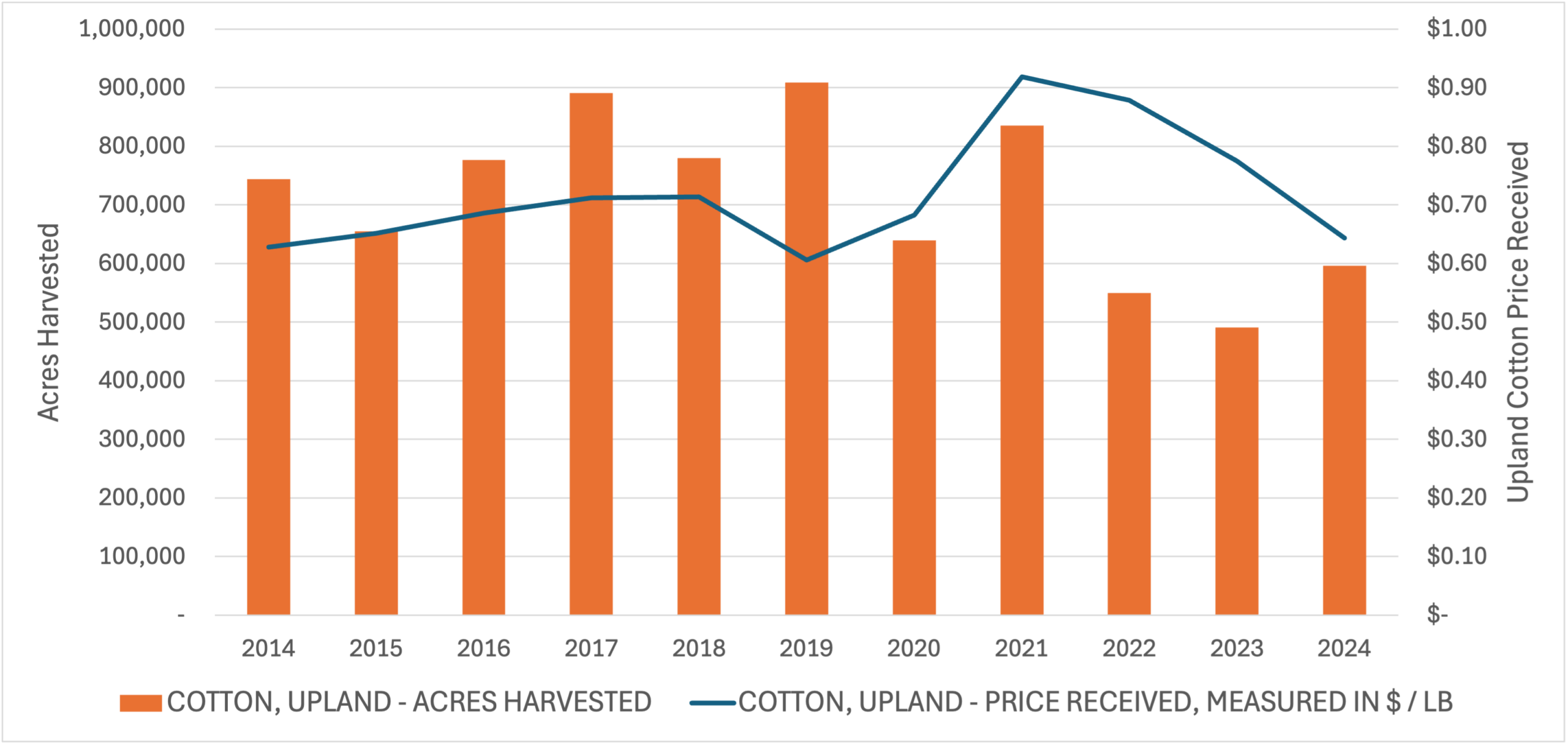
Each year since 2019, seed cotton producers have enrolled in either ARC or PLC, with the percentage of acres enrolled in each program varying over time. ARC payments for seed cotton peaked in 2022 [1] in the Southern states (total payments $52 million, with 26% of acres enrolled in ARC-CO) followed closely by 2023, driven heavily by weather related crop losses. Acres harvested and prices are shown in the figure. PLC payments peaked in 2019 ($981 million, with 99% of acres enrolled in PLC) during a period of low prices.
Fast forward to today. For cotton producers across the Southern region, the chance to voluntarily restore unassigned base into safety net programs is a meaningful opportunity. In 2025, there were 2.51 million unassigned generic base acres and 12.31 million seed cotton base acres in the U.S. The likelihood of unassigned base acres returning as seed cotton base acres varies geographically.
The National Cotton Council 2026 Economic Outlook [2] provided some encouraging signs that global demand may expand, but price pressure is expected to remain. With the increase in the seed cotton reference price from $0.367/lb to $0.42/lb in the One Big Beautiful Bill, expanded safety net eligible acres for cotton producers with a 5-year history of production may help cover a portion of breakeven costs that remain above historical average levels.
Figure 1. Upland Cotton
[1] USDA Farm Service Agency. 2019-2026 ARC and PLC Program Data. Available online: https://www.fsa.usda.gov/resources/programs/arc-plc/program-data
[2] Campiche, J., S. Boyd, and M. Huffman. 2026. “The Economic Outlook for U.S. Cotton 2026.” The National Cotton Council. Available online: https://www.cotton.org/econ/reports/annual-outlook.cfm
Hagerman, Amy. “Bringing Unassigned Base Back into Program Eligibility for Cotton Producers.” Southern Ag Today 6(8.4). February 19, 2026. Permalink
