
Generally, the cattle market follows a clear pattern. Tighter supplies lead to higher prices. Currently, the U.S. cattle herd is at its lowest level in decades. This scarcity supports strong market prices.
However, the recent emergence of the New World Screwworm (NWS) has created significant uncertainty. Since late 2025, concerns about the pest spreading from the south have introduced a risk premium into the market. As a result, the market faces two opposing forces. The first is the reality of tight physical supplies. The second is the anxiety regarding live cattle trade restrictions and dealing with an occurrence.
Headline Risk in Action
That tension reached a breaking point on Friday, January 16, 2026, which offered a clear case study of how headline risk can temporarily disrupt market fundamentals.
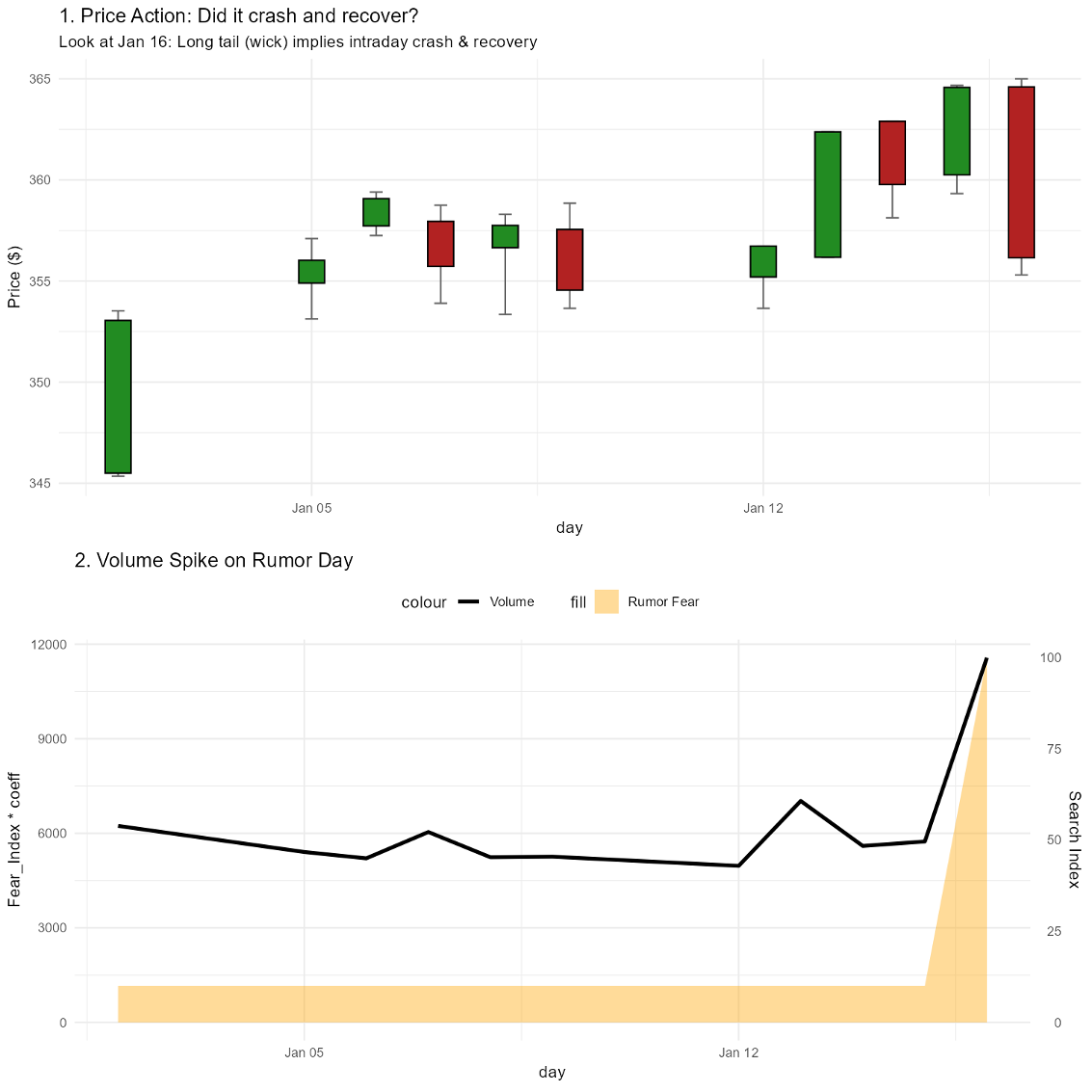
Unverified rumors circulated that NWS had been detected in Texas or New Mexico. The reaction in the futures market was immediate. Feeder cattle futures opened near $364.60. As the rumors spread, algorithmic trading and panic selling accelerated. This drove prices down to a low of $355.30. In just a few hours, the market lost nearly $10 per hundredweight. This move approached “limit down” territory.
Trading volume surged alongside the price drop, confirming that there was a broad “rush for the exits.” However, the market collected itself later in the day and closed at $356.15, recovering part of the intraday loss.
To support the cause of this crash, Figure 1 presents an analysis of intraday market data alongside online search trends. This comparison maps the timing of the price drop against Google Search intensity for terms related to the outbreak. The data reveals a direct link. As search volume for “NWS rumors” spiked (shown in the orange area of Figure 1), trading volume exploded, and prices collapsed. This data supports the hypothesis that the sell-off was driven by information flow and psychology, not by a sudden change in the physical cattle trade.
Navigating the Noise
For producers, January 16 highlights a critical difference between futures and cash markets. Futures respond instantly to headlines. An occurrence would likely cause short-term futures market volatility and lower prices. Cash markets respond to physical reality. Rising production costs due to a sustained outbreak would lead to tighter supplies in the longer term but, little immediate fundamental market changes. When a frightening story hits the news, the futures board turns red immediately. It prices in worst-case scenarios. At the same time, buyers at the sale barn still need cattle to fill orders. Therefore, cash prices often remain steadier.
This disconnect creates a dangerous trap. Selling futures or locking in prices during the peak of a rumor-driven crash is equivalent to accepting a panic discount. The January 16 episode suggests that patience is often the best risk management tool in these moments. Allowing liquidity to stabilize after a headline shock can preserve meaningful value.
In a market shaped by both supply tightness and disease fear, traditional fixed-price hedging can be double-edged. It protects against sharp drops but limits participation in rallies driven by scarcity. More flexible tools such as Livestock Risk Protection (LRP) insurance or put options may offer a better balance in 2026. These strategies provide protection against a true outbreak. They also preserve the ability to benefit when rumors fade and fundamentals reassert themselves.
Conclusion
The New World Screwworm is a serious biological threat that warrants vigilance. For producers, however, the more immediate challenge is market volatility. The fundamentals of the cattle cycle have not changed. Supply remains tight.
The winners in 2026 are unlikely to be those who correctly predict the next headline. They will be those who build marketing plans resilient enough to withstand the sudden swings of a nervous market.
Figure 1. Intraday market shock on Jan 16, 2026. The red bar in the top chart shows the massive price drop (approx. $9.30) from the market open to the daily low. The bottom chart shows Google search interest for rumors (orange area) and trading volume (green line) spiking simultaneously. This confirms the crash was driven by news headlines rather than market fundamentals.
Park, Eunchun. “Rumors, Risks, and the Screwworm: A Lesson from January 16.” Southern Ag Today 6(9.2). February 24, 2026. Permalink
