
Authors: Kuan-Ming Huang, Daniel Petrolia, and Zhifeng Gao
Catfish holds a special place in U.S. food culture, especially in the South, where it’s a beloved staple of regional cuisine. The South is also a major producer of farm-raised catfish, with most (96%) production concentrated in Mississippi (60%), Alabama (27%), Texas (5%), and Arkansas (5%) (USDA NASS, 2021). Outside the South, however, catfish is less popular, and its availability is more limited (House et al., 2003; Muhammad & Jones, 2009). This article presents findings from a recent survey of 5,760 primary household grocery shoppers from across the U.S. experienced in buying and preparing fish. We focus on this specific group of shoppers because 63% of seafood by weight is consumed at home (Love et al., 2020). Home-cooked seafood is likely to be bought and prepared by shoppers who have experience purchasing and preparing it. Thus, understanding these shoppers’ experiences and opinions on catfish is critical for the industry as it seeks to expand the market. We aim to address key questions for catfish farmers and industry stakeholders to refine their marketing strategies: Which consumer segments have never purchased catfish to cook at home? Furthermore, how many of these non-buyers would be willing to buy and try catfish if it were available at their local stores? By understanding where potential resistance exists across regions and sociodemographic groups, the industry can better design strategies to encourage first-time trials in buying and preparing catfish at home. With the right marketing approach, today’s nonbuyers may become tomorrow’s regular catfish home chefs.
Figure 1: Distribution of Respondents by Demographic Characteristics (n=5,760)
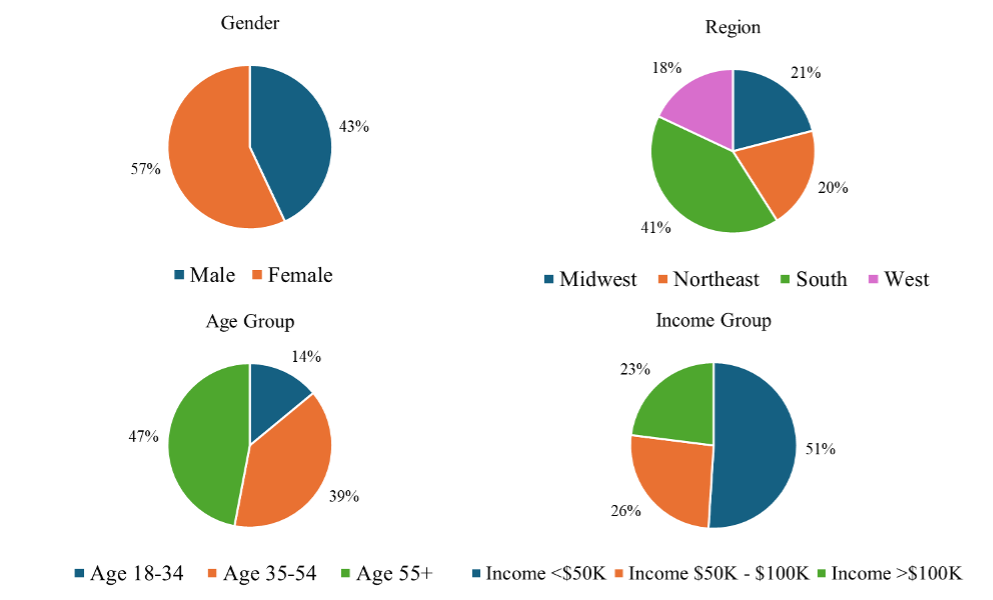
Note: Regional groupings are based on the U.S. Census Bureau definition. Check the following link for more info: https://www2.census.gov/geo/pdfs/maps-data/maps/reference/us_regdiv.pdf
From our survey, 24% respondents indicated they never purchased catfish to prepare at home. Figure 2 highlights several notable patterns in the share of respondents who have never purchased catfish to cook at home. Note that these results specifically reflect grocery shopping and home-cooking habits. Women (30%) are nearly twice as likely as men (16%) to report never buying catfish to prepare at home, and this gender gap is statistically significant. This significant gap may suggest that it’s not just a matter of whether one likes catfish. Instead, it is possible that current retail packaging or specific product attributes simply aren’t hitting the mark for many female shoppers. Differences across age groups are also significant and even more pronounced: more than one-third (37%) of respondents aged 55 and older have never purchased catfish to cook at home, compared with only about 10-14% among younger groups. This is consistent with and partially supported by a Global Seafood Alliance report indicating that younger generations are more likely to cook seafood at home, and to do so more frequently, compared to older generations (Craze & Crocker, 2024). As younger consumers cook more seafood at home, they should have more opportunities to try cooking different types of fish, including catfish. Significant disparities emerged across income levels as well. Only 13% of households earning $100k+ have never bought catfish, whereas more than a quarter of those in lower income brackets report no experience purchasing it for home preparation. Catfish (about $6 – $10 for a pound of fillets) is an affordable alternative to premium protein options like steak or salmon, but it is still more expensive than budget-friendly proteins like tilapia and chicken. As expected, geographic location significantly influences purchasing history. The South has the highest market penetration, with a never-purchased rate of only 21%, which is statistically lower than the Midwest (26%) and the Northeast (28%). This disparity likely reflects the industry’s distribution, where catfish is mainly produced, has higher local availability, and holds deep-rooted cultural significance in the South.
Figure 2: Percentage of Respondents Who Never Purchased Catfish to Cook at Home in Each Sociodemographic Group (n=5,760)

Recognizing that limited availability may be why some respondents have never purchased catfish to cook at home, we asked a follow-up question to respondents who said they have never purchased catfish: Would you be willing to buy and try catfish if it were available in your local stores? Of these 1,375 respondents, 36% said yes they would be willing to buy and try catfish if it were available at their local stores. This suggests that a proportion of non-buyers are not inherently opposed to the product but may rather be constrained by product accessibility. This conclusion is supported by House et al. (2003), who found that the lack of availability is one of the main reasons why non-consumers do not consume catfish.
Taken together, these findings highlight a strong foundation for the industry and point toward exciting avenues for expansion. First, the data underscores a more solid and larger consumer base in the South, compared to other regions. This home-field advantage serves as a powerful model for success that can be leveraged in other markets. The greater number of non-buyers in the Northeast and Midwest should be viewed as an opportunity. As supply chains continue to evolve, these regions represent emerging market opportunities where increased visibility can turn unfamiliarity into new demand. Furthermore, as younger generations prioritize convenience when buying seafood (Craze & Crocker, 2024) and catfish consumers are more likely to eat it in a restaurant than cook at home (House et al., 2003), introducing quick-prep packaging and simplifying the home-preparation experience can allow the industry to empower more households to make catfish a staple in their home-cooked meal rotations. By focusing on these high-potential segments and bridging the geographic gap, the industry is well-positioned to convert curious non-buyers into lifelong customers, ultimately driving long-term growth across the national market.
Reference:
Craze, M., & Crocker, G. (2024). Report: Seafood industry must adapt to younger consumers’ demand for convenience as at-home prepared foods sector booms. Global Seafood Alliance Report. https://www.globalseafood.org/advocate/report-seafood-industry-must-adapt-to-younger-consumers-demand-for-convenience-as-at-home-prepared-foods-sector-booms/
House, L., Hanson, T., Sureshwaran, S., & Selassie, H. (2003). Opinions of US consumers about farm-raised catfish: Results of a 2000-2001 survey. Mississippi Agricultural & Forestry Experiment Station Bulletin, 1134.https://www.mafes.msstate.edu/publications/bulletins/b1134.pdf
Love, D. C., Asche, F., Conrad, Z., Young, R., Harding, J., Nussbaumer, E. M., Thorne-Lyman, A. L., & Neff, R. (2020). Food sources and expenditures for seafood in the United States. Nutrients, 12(6), 1810.
Muhammad, A., & Jones, K. G. (2009). An assessment of dynamic behavior in the US catfish market: An application of the generalized dynamic Rotterdam model. Journal of Agricultural and Applied Economics, 41(3), 745-759.
USDA National Agricultural Statistics Service (NASS). (2021). Catfish Production. Agricultural Statistics Board, 1948-271X. https://www.nass.usda.gov/Publications/Todays_Reports/reports/cfpd0221.pdf
Huang, Kuan-Ming, Daniel Petrolia, and Zhifeng Gao. “In Search of Tomorrow’s Catfish Buyers.” Southern Ag Today 6(12.5). March 20, 2026. Permalink
