Authors: Julio Bellodi Cortarelli and Grant Gardner
Brazil’s rapid expansion in corn-based ethanol production has important implications for U.S. corn markets. While Brazil has long been the world’s second-largest ethanol producer (RFA, 2025), it has historically relied on sugarcane. By 2024, roughly 20% of Brazil’s ethanol output came from corn (EPE, 2025), driven largely by expansion of the safrinha crop in the Center-West.
As more Brazilian corn is pulled into ethanol production and feed use, export availability may fluctuate. In some years, this could ease competition with U.S. corn, but it also introduces more volatility into global supply dynamics. For U.S. producers, that makes these trends worth watching. Importantly, corn is not simply replacing sugarcane one-for-one in Brazil’s ethanol sector. Rather, it is helping expand total ethanol production, especially in the Center-West, while sugarcane remains the dominant feedstock nationally.
One key distinction is how we measure this growth. The 20% figure reflects actual ethanol production. Figure 1 shows processing capacity, the maximum volume mills are designed to handle, not what they necessarily use each year.
Safrinha corn is planted after soybeans, which gives ethanol mills more flexibility throughout the year. Unlike sugarcane, which must be processed shortly after harvest, corn can be stored. That allows mills to better manage input costs and production timing and has supported the rapid growth in corn ethanol production.
That growth shows up in projected capacity. Corn processing capacity begins at roughly 23 million metric tons in 2026 and is projected to rise between 33 and 55 million metric tons by 2035, depending on investment conditions and market scenarios. Brazil’s 2025/26 corn harvest totaled 141.16 million metric tons, so projected 2026 capacity represents about 16% of total production. Domestic corn consumption grew 7.8% compared to the previous harvest, driven primarily by ethanol expansion (Conab, 2026).
Sugarcane capacity, by contrast, is expected to remain relatively stable, even though it is still much larger than corn processing capacity. As shown in Figure 1, most of the growth in ethanol capacity through 2034 comes from corn. New investment is concentrated in the Center-West, particularly in Mato Grosso, where safrinha production is concentrated.
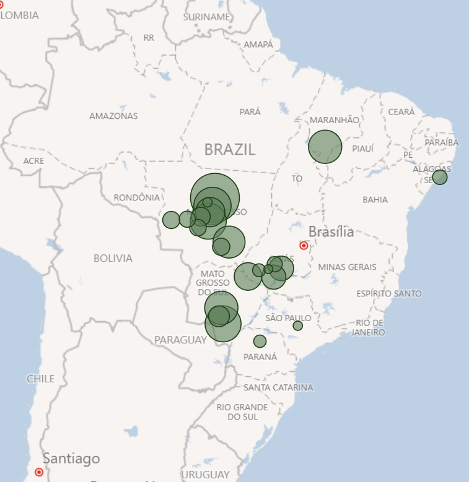
Of the 24 operating corn ethanol plants in Brazil, 20 are located in the Center-West region, with Mato Grosso leading in both existing and planned capacity (UNEM, 2025). Figure 2 highlights this clustering. Despite record safrinha production in 2024/25, domestic corn prices have remained relatively stable. That suggests ethanol demand, particularly in northern Mato Grosso, is helping support local prices (Notícias Agrícolas, 2025). As more corn is used domestically, export availability is likely to fluctuate more than in the past, which could reshape Brazil’s role in global corn trade and reduce competition with U.S. corn in some years (Colussi, Schnitkey, and Paulson, 2025).
Corn has moved from a secondary crop to a more important ethanol feedstock in Brazil’s Center-West. Farmers are now forward contracting corn ahead of harvest, much like soybeans, reflecting confidence in sustained demand and prices. As more production is used domestically, export availability becomes less predictable, increasing the potential for volatility in global markets and U.S. corn futures.
What to watch is straightforward: ethanol investment, plant utilization, and domestic feed demand. These factors will increasingly drive Brazil’s corn balance sheet as the sector matures.
Sugarcane trends reinforce this shift but are not the main story. While more sugarcane is being directed toward sugar production in 2025/26, U.S. imports likely will depend on ongoing legal challenges to tariffs imposed by the Trump Administration. Regardless, additional supply will move into global markets.
The bottom line is that Brazil’s ethanol story is increasingly a corn story. That shift introduces new uncertainty into global trade flows and creates both risks and opportunities for U.S. market participants.
Figure 1. Ethanol Production Capacity (Sugarcane and Corn) in millions of tons. Made by the authors based on Brazilian Energy Research Company (EPE, 2025).
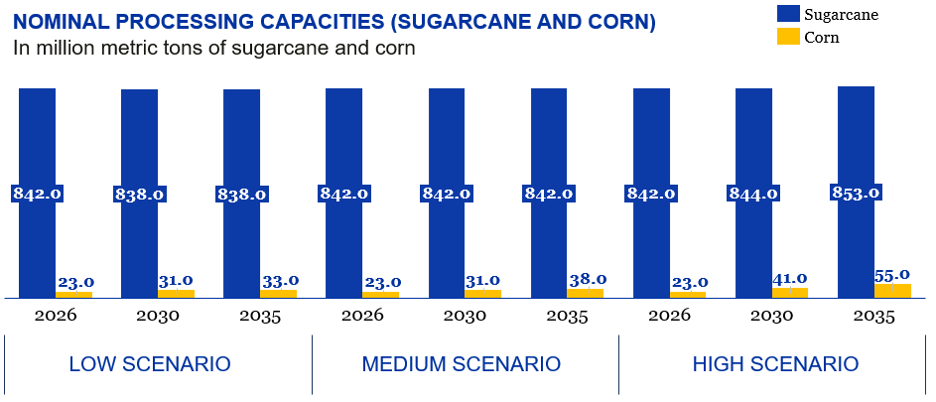
Figure 2. Location of Corn Ethanol Plants in Brazil. União Nacional do Etanol de Milho (2025).
Sources:
Colussi, Joana, Gary Schnitkey, and Nick Paulson. 2025.
“Ethanol Boom Drives Sharp Rise in Brazil’s Corn Consumption.” Farmdoc Daily 15 (69).
https://farmdocdaily.illinois.edu/2025/04/ethanol-boom-drives-sharp-rise-in-brazils-corn-consumption.html
Companhia Nacional de Abastecimento (CONAB). 2026.
Acompanhamento da safra brasileira: Grãos – Safra 2025/26, 7º levantamento.
https://www.gov.br/conab/pt-br/atuacao/informacoes-agropecuarias/safras/safra-de-graos/boletim-da-safra-de-graos/7o-levantamento-safra-2025-26/e-book_boletim-de-safras-7o-levantamento_2026.pdf
Empresa de Pesquisa Energética (EPE). 2025.
Relatório Síntese 2025.
https://www.gov.br/mme/pt-br/assuntos/secretarias/sntep/publicacoes/balanco-energetico-nacional/ben-2025/relatorio-sintese/Sintese_BEN2025/view
Notícias Agrícolas. 2025.
“Demanda do etanol é o que está sustentando os preços do milho no Brasil.” September 30, 2025.
https://www.noticiasagricolas.com.br/noticias/milho/408456-demanda-do-etanol-e-o-que-esta-sustentando-os-precos-do-milho-no-brasil.html
Renewable Fuels Association (RFA). 2025.
“Annual Ethanol Production.”
https://ethanolrfa.org/markets-and-statistics/annual-ethanol-production
União Nacional do Etanol de Milho (UNEM). 2025.
“Biorrefinarias no Brasil.”
https://etanoldemilho.com.br/biorrefinarias-no-brasil/
Bellodi Cortarelli, Julio, and Grant Gardner. “Brazil’s Expanding Corn Ethanol Sector: Implications for U.S. Corn Markets.” Southern Ag Today 6(17.3). April 22, 2026. Permalink