Authors: Karen L. DeLong, Professor & Carlos Trejo-Pech, Associate Professor – University of Tennessee Institute of Agriculture
Southern Ag Today has reported extensively on the difficulties experienced by row crop farmers around the country given low commodity prices and persistent high input prices. America’s sugar farmers are facing those same challenges, plus a sudden increase in high-tier (Tier 2) sugar imports that is leading them to financial distress. Deliberto, Hilbun and DeLong (2025) have documented the decline in U.S. sugar farms. From 1997 through 2022, the number of U.S. sugarbeet and sugarcane farms decreased by 54% and 31%, respectively, and since 2016, sugar production in Hawaii, Texas and California has ceased to exist. Since 2000, roughly 40% of U.S. sugar mills, refineries, and sugarbeet factories have also closed (Deliberto and DeLong, 2025).
Contrary to most U.S. row crop commodities, the U.S. is a net importer of sugar (Deliberto, DeLong and Fischer, 2024). In fact, under World Trade Organization (WTO) and trade agreements, 40 sugar-exporting countries are granted access to the U.S. market through a Tariff Rate Quota (TRQ) system at a near-zero duty (Deliberto, DeLong, and Fischer, 2024). If the market needs more sugar, the TRQ can be increased to meet consumer needs. If countries want to export sugar beyond those amounts, they can do this through the “out-of-quota”, high-tier (Tier 2), sugar duty. For simplicity, we will refer to this as the Tier 2 tariff throughout the remainder of the paper.
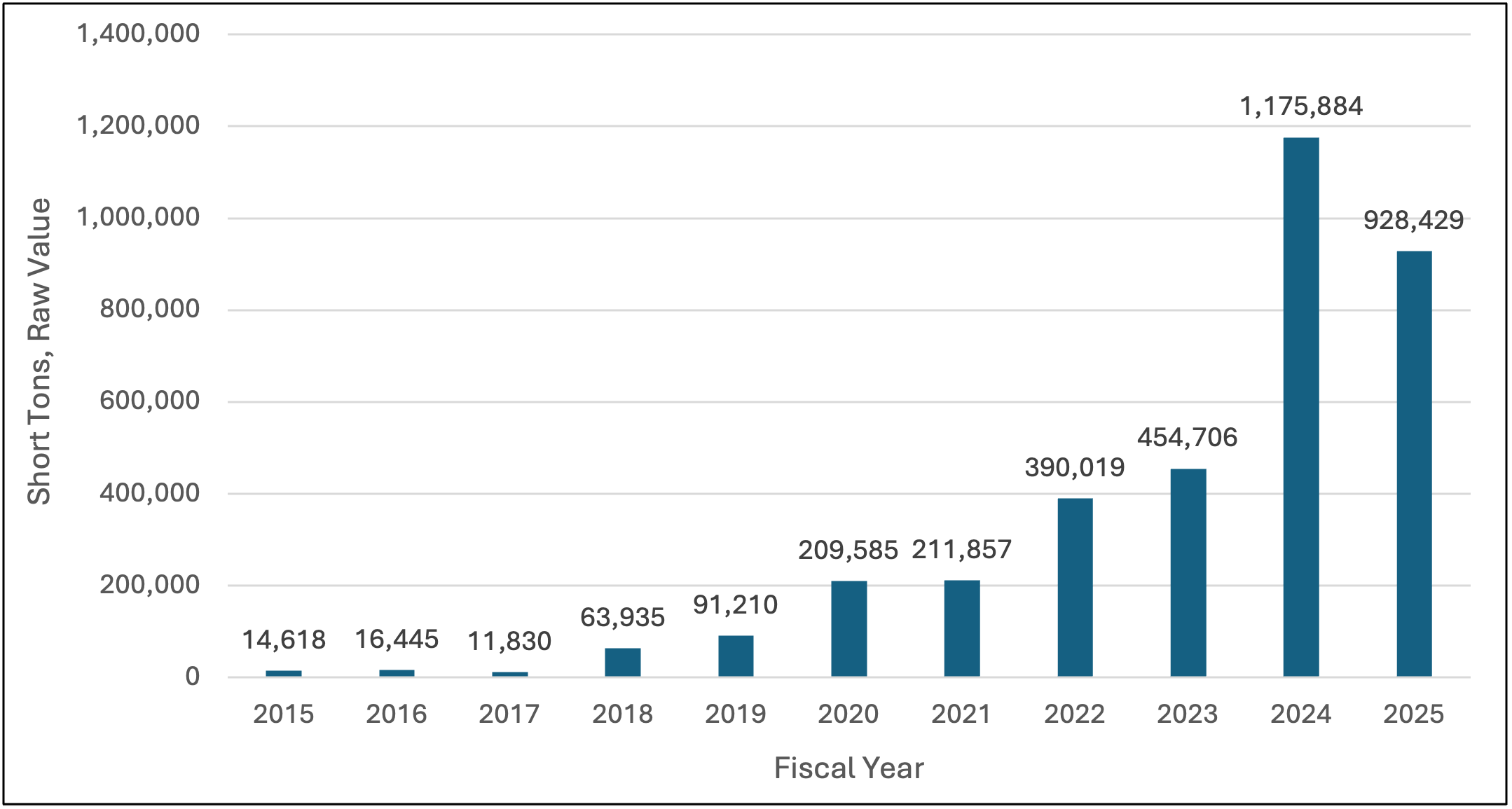
The Tier 2 tariff is 15.36 cents per pound for raw sugar and 16.21 cents per pound for refined sugar (USDA Economic Research Service 2026a). Historically, the Tier 2 tariff was effectively prohibitive, and relatively low amounts of sugar were exported to the United States using this tariff (Figure 1). However, the world sugar market contains such large quantities of subsidized surplus sugar that foreign sugar producers are now exporting sugar to the United States through the Tier 2 tariff (USDA Economic Research Service, 2026b; USDA Foreign Agricultural Service, 2026). Figure 1 shows how Tier 2 imports have increased by over 1,400% since fiscal year (FY) 2018, going from only 64,000 short tons raw value (STRV) to 928,429 STRV by FY 2025[1]. While the reciprocal tariffs imposed by the Trump Administration have started to moderate Tier 2 imports (as shown by the decrease from FY2024 to FY 2025), the Tier 2 import volumes are still at a high level, which threatens the economic viability of domestic sugar producers. In addition, the reciprocal tariffs are now in question given the recent Supreme Court ruling against President Trump’s use of the International Emergency Economic Powers Act (IEEPA) to impose the additional tariffs. Thus, sugar farmers continue to face an influx of foreign sugar, and that is resulting in enormous financial losses to domestic sugar farmers. In fact, on April 15, 2026, the American Sugar Alliance (ASA) filed comments with the U.S. Trade Representative asking the U.S. government to use Section 301 authorities to address, “the unreasonable and discriminatory acts, policies, and practices of sugar-producing countries that have harmed U.S. sugar producers, refiners, and workers (American Sugar Alliance, 2026).”
Figure 1. U.S. Tier 2 Over Quota Sugar Imports by Fiscal Year.
The U.S. Tier 2 tariff rates were last updated over 25 years ago, in 2000, which likely contributes to why they are significantly less effective in preventing over-quota imports, especially since price levels have approximately doubled during that time due to inflation (U.S. Bureau of Labor Statistics, 2026). Due to the increase in Tier 2 imports, coupled with high input costs, domestic sugar prices are now significantly below sugar farmers’ cost of production (Deliberto and DeLong, 2023). As stated by the ASA (2026), “Without containing this flood [of subsidized foreign sugar imports], the U.S. industry is facing catastrophe, with [loan] forfeitures likely starting within a matter of months and closures following.”
The global sugar market is one of the most distorted global markets, driven by a variety of foreign subsidies that result in overproduction around the world (LMC International, 2021; Hudson, 2019). Congress has long regarded sugar as an essential and strategic ingredient in the U.S. food supply and has expressed commitment to maintaining a strong domestic sugar industry to ensure our nation’s food security (Cammack, 2023). While U.S. sugar policy has helped to maintain at least some domestic sugar production, DeLong, Deliberto, and Fischer (2023) explain how reports have criticized U.S. sugar policy for keeping the U.S. price of sugar above the global price of sugar.
While it is well known that consumers prefer domestically produced foods, including sugar (Lewis et al., 2016), sugar-using firms argue that they are negatively impacted by not being able to access the heavily subsidized global sugar market. Therefore, we have conducted extensive research analyzing how U.S. sugar prices affect sugar-using companies and whether changes in U.S. sugar prices affect sugar containing product (SCP) prices. In one recent study (DeLong and Trejo-Pech, 2022), we found that changes to sugar prices were not statistically significant in determining the prices of SCPs. In that study, we analyzed 379 SCPs and found that, on average, the cost of sugar represented less than five percent of the total SCP price, even though sugar consisted of 48% of the SCP’s weight. In a more recent study (Trejo-Pech, DeLong and Johansson, 2023), we found that sugar-using firms’ financial performance was superior to that of their publicly traded agribusiness peers and that U.S. sugar policy does not hinder the financial success of sugar-using firms.
Why does this matter today? As U.S. farmers call on Congress and the Trump Administration to modernize the Tier 2 tariff schedule by raising the Tier 2 tariff rates from the levels last updated in 2000, there is already speculation about whether this policy adjustment will affect the affordability of food, particularly SCPs. As we’ve shown time and again, the price of sugar has very little bearing on the prices (or affordability) of SCPs. The real question we should be asking is, “what are the implications if we allow the flood of Tier 2 imports into the country to continue? Are we willing to cause more domestic sugar farmers to go out of business?”
As previously stated, consumers overwhelmingly prefer domestically sourced sugar over foreign sugar (DeLong, Deliberto, and Fischer, 2023; Lewis et al., 2016). It’s also likely that sugar-using companies benefit from a domestically available supply of sugar (Trejo-Pech, DeLong and Johansson, 2023)[1]. If the United States fails to act promptly to address the surge of foreign sugar entering the market, both consumers and sugar-using companies will have no choice over where their sugar originates. They will soon be forced to rely on foreign countries because the domestic sugar industry is at risk of disappearing altogether.
[1] For example, one can look at the volatility of the cocoa market to see what happens when a country depends on an international market for an essential ingredient (Villacis and Dimas, 2026).
[1] This level of Tier 2 imports is substantial considering, for example, in FY24 total U.S. sugar imports were 3,840,000 STRV with 1,175,884 being Tier 2 imports. This indicates that Tier 2 imports represented approximately 31% of U.S. sugar imports in FY24 (USDA, 2026).
References:
American Sugar Alliance. 2026. Docket No. USTR-2026-0067: Request for Comments on the Section 301 Investigations of Acts, Policies, and Practices of Certain Economies Relating to Structural Excess Capacity and Production in Manufacturing Sectors. Retrieved from: https://sugaralliance.org/wp-content/uploads/2026/04/2026-04-15-ASA-Sec-301-Excess-Capacity-Submission.pdf
Cammack, Kat. 2023. Press Release: Representatives Kat Cammack and Dan Kildee Introduce Resolution to Zero Out Harmful Foreign Sugar Subsidies. Retrieved from: https://cammack.house.gov/media/press-releases/representatives-kat-cammack-and-dan-kildee-introduce-resolution-zero-out
Deliberto, M. and K.L. DeLong. 2023. “Examining Sugarcane and Sugarbeet Production Costs.” Southern Ag Today. December 11, 2023. https://southernagtoday.org/2023/12/11/examining-sugarcane-and-sugarbeet-production-costs/
Deliberto, M., B. Hilbun, and K.L. DeLong. 2025. “Sugarbeet and Sugarcane Production and Farm Trends.” Southern Ag Today. June 25, 2025. https://southernagtoday.org/2025/06/25/sugarbeet-and-sugarcane-production-and-farm-trends/
Deliberto, M., and K.L. DeLong. 2025. “The 2025 Sugar Market Domestic Supply and Outlook.” Southern Ag Today. May 28, 2025. https://southernagtoday.org/2025/05/21/the-2025-sugar-market-domestic-supply-and-outlook/
Deliberto, M., K.L. DeLong, and B.L. Fischer. 2024. “Navigating U.S. Sugar Imports From 70 Countries.” Southern Ag Today. April 18, 2024. https://southernagtoday.org/2024/04/18/navigating-us-sugar-imports-from-70-countries/
DeLong, K.L. and C. Trejo-Pech. 2022. “Factors Affecting Sugar-Containing-Product Prices.” Journal of Agricultural and Applied Economics, 54(2): 334-356. https://doi.org/10.1017/aae.2022.12
DeLong, K.L., M. Deliberto, and B.L. Fischer. 2023. “Evaluation of the Recent Government Accountability Office Sugar Program Report.” Southern Ag Today. November 30, 2023. https://southernagtoday.org/2023/11/30/evaluation-of-the-recent-government-accountability-office-sugar-program-report/
Hudson, D. (2019), An Examination of Foreign Subsidies and Trade Policies for Sugar, Texas Tech University, Lubbock, Texas, pp. 1-32, BP-19-01.
Lewis, K.E., C. Grebitus, and R. Nayga, Jr. 2016. “U.S. Consumer Preferences for Imported and Genetically Modified Sugar: Examining Policy Consequentiality in a Choice Experiment.” Journal of Behavioral and Experimental Economics, 65:1-8. https://doi.org/10.1016/j.socec.2016.10.001
LMC International. World Sugar Prices vs Costs of Production. Oxford: LMC International, 2021.
Trejo-Pech, C.J.O., K.L. DeLong, and R. Johansson. 2023. “How Does the Financial Performance of Sugar-Using Firms Compare to other Agribusinesses? An Accounting and Economic Profit Rates Analysis.” Agricultural Finance Review, 83(3): 453:477. https://doi.org/10.1108/AFR-08-2022-0103
U.S. Bureau of Labor Statistics. 2026. CPI Inflation Calculator. Retrieved from: https://www.bls.gov/data/inflation_calculator.htm
USDA Economic Research Service. 2026a. Sugar and Sweeteners-Policy. Retrieved from: https://www.ers.usda.gov/topics/crops/sugar-and-sweeteners/policy#sugar
USDA Economic Research Service. 2026b. Sugar and Sweetener Yearbook Tables, Table 1. Retrieved from: https://www.ers.usda.gov/data-products/sugar-and-sweeteners-yearbook-tables
USDA Foreign Agricultural Service. 2026. Sugar Monthly Import and Re-Export Data. Retrieved from: https://www.fas.usda.gov/data/search?reports%5B0%5D=report_commodities%3A34&reports%5B1%5D=report_type%3A13285
USDA. World Agricultural Supply and Demand Estimates Report. 2026. Retrieved from: https://www.usda.gov/about-usda/general-information/staff-offices/office-chief-economist/commodity-markets/wasde-report
Villacis, A. and L. Dimas. 2026. “Valentines’ Day and Chocolate in 2026: Love, Price, and the Cocoa Market.” Ohio State University, Q112026. Retrieved from: https://aede.osu.edu/sites/aede/files/AEDEbulletin_chocolate.pdf
DeLong, Karen L., and Carlos Trejo-Pech. “How to Ensure a Domestic Sugar Industry: Increase the Tier 2 Sugar Tariff.” Southern Ag Today 6(17.4). April 23, 2026. Permalink