
Authors: Adam Rabinowitz, Wendiam Sawadgo, Will Maples, and Sthefani Oliveira
Fertilizer is a significant input in the production of row crops for farmers that can quickly disrupt previously calculated break-even levels and marketing decisions. Since the production of fertilizer – especially nitrogen fertilizer – depends on natural gas, it is also very closely tied to oil market activities. There has been much attention in the news about the conflict in the Middle East, the blockage of the Strait of Hormuz, and oil prices. The lack of oil flowing through the Strait is affecting oil markets throughout the world and raising concerns about how farmers will be affected.
Farmer Pre-booking of Fertilizer
To better understand the challenges faced by farmers, the American Farm Bureau Federation (AFBF) conducted a survey of farmers throughout the U.S. from April 3-11. The AFBF survey asked about fertilizer and fuel purchasing and potential impacts from the recent price increases. Respondents in the Southern region reported the lowest percentage of all respondents who pre-booked fertilizer, at 19%, compared to the high of 67% in the Midwest. This means that proportionately more farmers in the South are now facing higher-than-expected input costs as planting approaches. The increase in break-even prices means farmers need to reevaluate what constitutes a “good” marketing opportunity. A price target that looked feasible during the winter may not cover updated input costs. Prior sales also need to be evaluated in this context. Bushels priced earlier in the winter, based on lower cost expectations, may now be insufficient to cover higher input costs.
Farm Input Price Trends
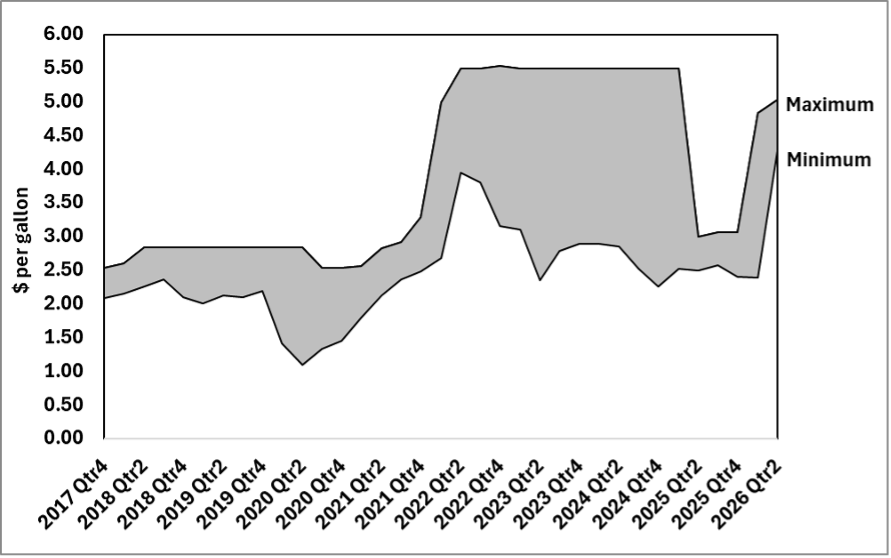
While the recent spike in fertilizer and diesel prices has created additional challenges, it is also important to understand the broader context of these prices over time. The U.S. Department of Agriculture’s Agricultural Marketing Service collects prices for several fertilizer and other input products in Alabama. The minimum and maximum price of each product has been reported weekly since October 2017. The area between the minimum and maximum price depicts the range in prices that farmers pay in Alabama. Figures 1 and 2 show the price ranges for urea and farm diesel.
There are two important observations to be made from these price charts. First, changes in the lowest price are not always the same as changes in the highest price. Thus, it is important for farmers to look for where they can find the best price or to consider strategies to obtain lower prices. Carefully planning the purchase (or pre-purchase) of inputs can help farmers obtain lower prices.
Second, while prices toward the end of 2025 had decreased from the peak in early 2022, they still had not returned to pre-2021 levels. This is true for both the inputs shown in Figures 1 and 2, as well as for inputs that have not seen major price increases since the start of the war, such as ammonium nitrate, DAP, and potash. Before the current price increases, we started to see the range between the lowest and highest prices shrink, a potential sign that markets were stabilizing at that time. The current increase may not maintain that trend, and seeing the bigger picture helps inform future expectations.
Takeaway Message
It is important to maintain focus on the broader issues in the farm economy. While the prices of urea and diesel have risen significantly since the end of February, simply correcting that increase will not address the longer-term issues at hand. Farmers have faced higher prices for inputs since the increases in 2021, compared to prices from late 2017 to early 2021. Given the volatility in fertilizer prices, discipline will be required in marketing decisions going forward.
Will Maples noted in a recent Southern Ag Today article that knowing cost of production to estimate breakeven costs should be the starting point for determining pricing goals as part of a pre-harvest marketing plan. When the pricing of inputs changes, it is advisable to watch those breakeven costs and maintain flexibility in marketing activities.
Farmers might also consider splitting intended sales into smaller portions and committing those bushels as price opportunities and cost estimates evolve. Thinking about sales in smaller units, such as 5,000 bushels, allows producers to remain more flexible in their marketing decisions. This approach provides the ability to adjust as conditions change.
Farmers should also have a plan for any unpriced grain that could be placed into storage. With increases in break-even costs, farmers may choose to store grain at harvest or may be forced to sell to meet cash flow or loan obligations. For Southern producers, this situation may be more challenging. The region generally has less on-farm storage capacity and, as noted earlier, fewer producers pre-booked fertilizer. Together, the factors discussed increase the need for farmers to pay careful attention to their marketing plan and maintain flexibility in their risk management strategies.
Figure 1. Urea: Quarterly Price Range in Alabama, 2017-2026
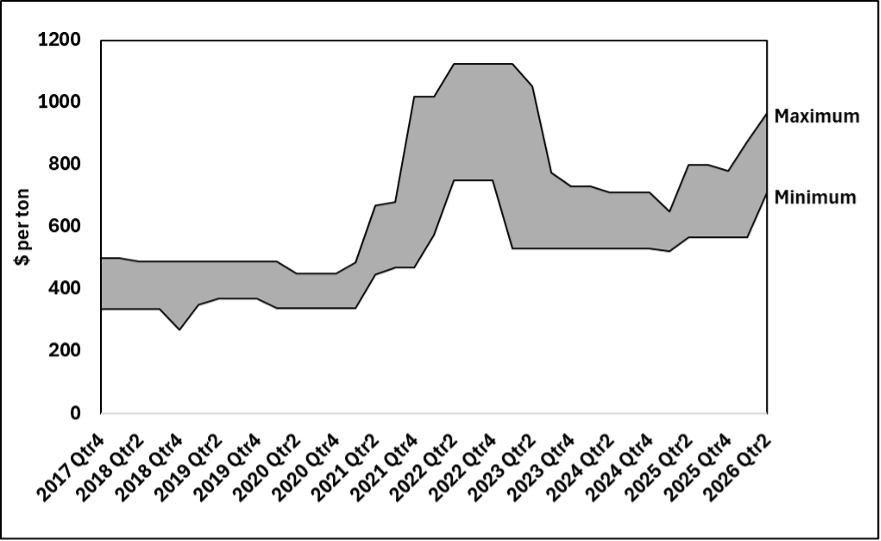
Figure 2. Farm Diesel: Quarterly Price Range in Alabama, 2017-2026
References:
Maples, William. “What Determines a “Good” Price?” Southern Ag Today 6(10.3). March 4, 2026.
USDA-AMS. Alabama Production Cost Report (Weekly). Available at: https://mymarketnews.ams.usda.gov/viewReport/3051
Rabinowitz, Adam, Wendiam Sawadgo, Will Maples, and Stefan Oliveira. “Fertilizer Prices: A Recent Price Spike but a Longer-Term Issue that Impacts Marketing Decisions.” Southern Ag Today 6(18.3). April 29, 2026. Permalink