
In their April 8, 2026, Southern Ag Today article, Will Maples and Wendiam Sawadgo explained why futures markets matter for producers. Futures markets help farmers manage price risk, but speculators also play a useful role. Speculators add liquidity and take the “other side” of hedges, assuming price risk. But there is a second question worth asking. What happens when large amounts of financial capital enters agricultural futures markets?
Today’s agricultural commodity prices reflect more than local crop fundamentals. They also reflect money moving across asset classes. Economists call this “financialization”—the flow of capital into and out of agricultural futures by pension funds, index investors, exchange-traded funds, and managed money. Financial investors trade commodities for different reasons, including diversification and inflation protection. While stocks and bonds respond to interest rates, earnings, and Federal Reserve policy, agricultural commodities respond more directly to drought, exports, livestock cycles, biofuel demand, and global food demand. That difference makes commodities an attractive investment in a portfolio. As commodity index products have grown, agricultural futures markets have gained a larger and more persistent source of outside capital, contributing to price movements that may not always align with underlying crop fundamentals.
The extent to which financialization affects commodity prices remains debated. Fundamentals still dominate long-run agricultural prices, but financial participation can matter at the margin and add liquidity. It can also increase price volatility, moving with oil and other financial markets, as well as news from outside agriculture. Tang and Xiong (2012) found that after the growth of index investment, agricultural commodity futures became more correlated with broader financial markets, especially for commodities included in major indexes.
Using cotton markets as an example, Figure 1 plots the rolling 12-month correlation between monthly ICE cotton futures returns and monthly S&P 500 returns from December 2012 through May 2026. The correlation is positive in most months, averaging about +0.25. It reached +0.91 in the summer of 2020, when cotton and equities rallied together during the pandemic-era policy response. It can also turn negative, such as what occurred in late 2021 and early 2026. Some of this co-movement is fundamental. Cotton is an industrial input for textiles, and apparel demand rises and falls with consumer spending. However, the swings suggest that broader financial conditions may have affected the cotton price signal alongside fundamentals.
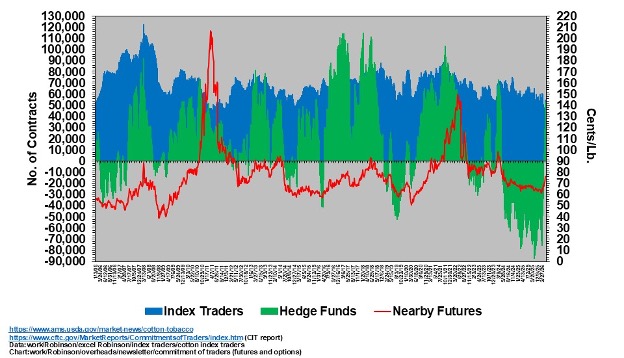
Figure 2 helps explain the financial channel. Index trader positions are large and slow to change. Hedge fund positions swing more sharply. Nearby cotton futures prices often move with those swings, but that does not mean hedge funds determine cotton prices. Robinson (2021) estimated that hedge fund positioning contributed to the 2021 rally, while flagging that tightening fundamentals and index fund buying were also at work. The lesson is that speculative flows can amplify short-run price moves.
Financialization does not displace fundamentals. Drought, exports, livestock cycles, and global food demand still drive agricultural prices in the long run. But financial flows now also shape how prices move in the short run, and the strength of that influence varies with the macroeconomic environment. Commodity futures prices carry two signals: one from the field and one from Wall Street. The weight of each changes over time. Producers do not need to become Wall Street traders, but understanding how that signal is built is now part of marketing agricultural commodities.
Figure 1. Rolling 12-Month Correlation Between ICE Cotton No. 2 Futures and the S&P 500, December 2012 Through May 2026.
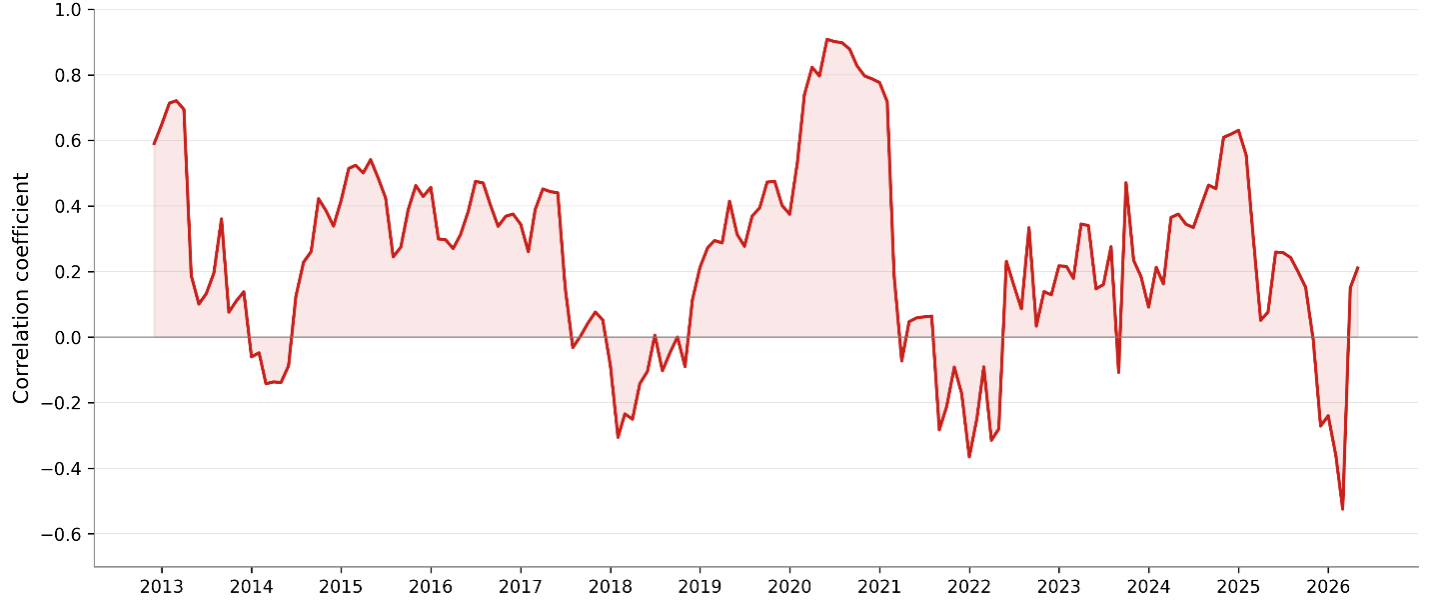
Figure 2. Cotton Net Positions of Index Funds, Hedge Funds, vs Nearby Futures Prices. January 3, 2006, through April 28, 2026
References.
Maples, W., & Sawadgo, W. (2026, April 8). What producers need to know about futures markets. Southern Ag Today. https://southernagtoday.org/2026/04/08/what-producers-need-to-know-about-futures-markets/
Robinson, J. (2021, November 1). Speculative influence on ICE cotton futures. Southern Ag Today.
https://southernagtoday.org/2021/11/01/speculative-influence-on-ice-cotton-futures/
Robinson, J. (2026). Commitment of Traders: Net position of speculators. The Cotton Marketing Planner, Texas A&M AgriLife Extension.
https://cottonmarketing.tamu.edu/recent-price-patterns-and-short-term-influences/net-position-of-speculators/commitment-of-traders/
Tang, K., & Xiong, W. (2012). Index investment and the financialization of commodities. Financial Analysts Journal, 68(6), 54–74. https://doi.org/10.2469/faj.v68.n6.5
Calil, Yuri. “How Financial Markets Shape Farm Prices.” Southern Ag Today 6(19.3). May 6, 2026. Permalink