
In the last three years, the global rice market has been dominated by the supply side, with global production outpacing global demand and leading to increasing ending stocks and decreasing international prices. A lot has been said already about the role of India’s production and exportable surplus in previous issues (e.g., https://southernagtoday.org/2025/05/15/global-market-prospects-for-u-s-long-grain-rice-for-the-upcoming-marketing-year-3/), which is still at play in marketing year 2025/26.
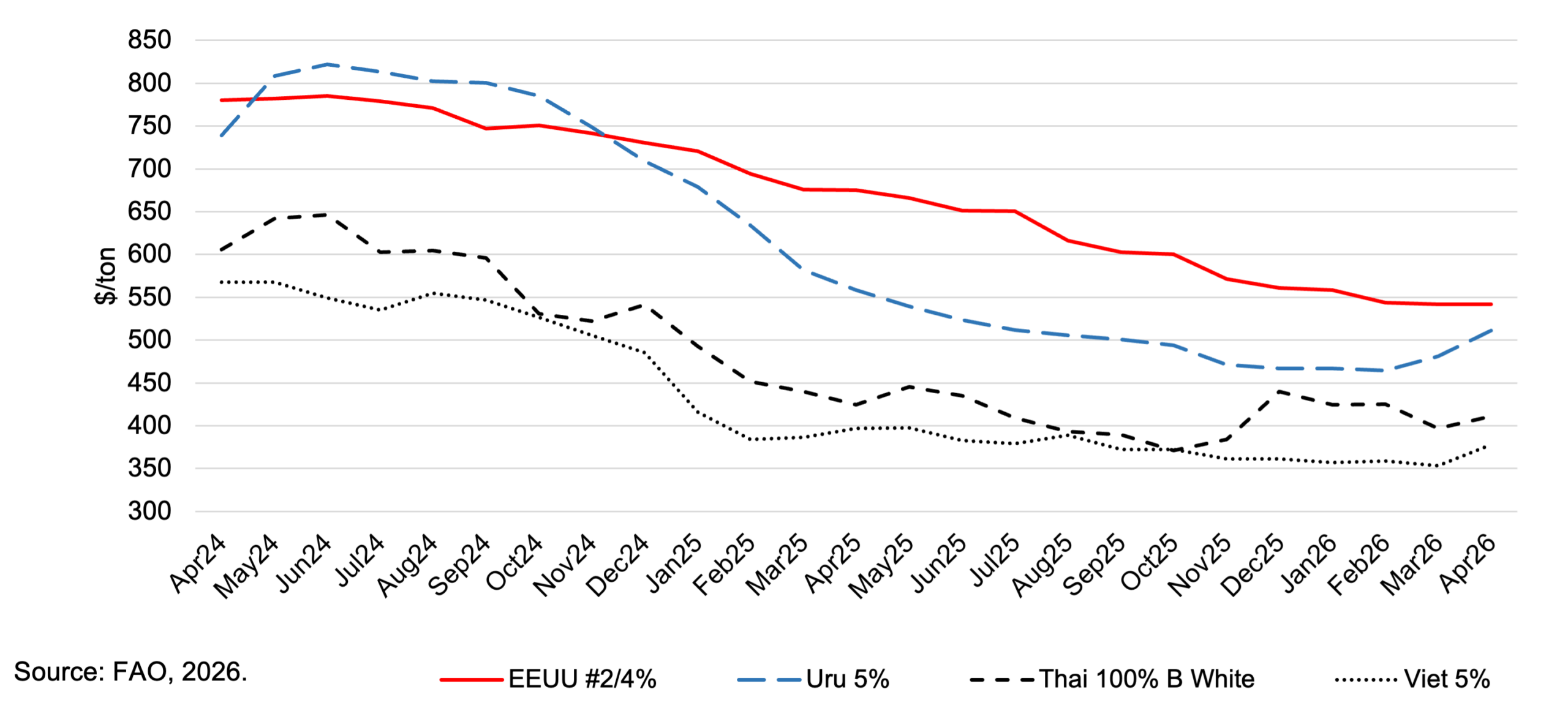
The war in Iran, and particularly the situation in the Strait of Hormuz, has added more uncertainty/risk to the market through higher energy and input costs and trade disruptions. The impact of the war on input costs affects rice producers differently in different countries, depending on the level of input use and support policies. Producers in countries such as the U.S. that use energy-derived inputs (e.g., fertilizers) without domestic subsidies are more exposed than producers in countries that either use inputs less intensively and/or subsidize inputs (e.g., India). The trade disruptions also affect countries differently depending on how much they trade with countries in the Middle East. For example, the U.S.’s long-grain milled rice exports to Iraq and long-grain parboiled milled rice to Saudi Arabia, Thailand’s long-grain milled rice exports to Iraq, and India’s long-grain milled parboiled rice and basmati rice to Saudi Arabia and the United Arab Emirates have been disrupted. On the other hand, Vietnam’s and Mercosur’s rice exports are for the most part unaffected, given the low exposure to trade with the Middle East. Overall, the resulting higher production costs and marketing risks have resulted in a shift in the international price trend in the last month (Figure 1).
Figure 1. Monthly average export price of long-grain rice from selected exporters.
Arguably, the biggest factor looming on the global rice market is the growing concerns tied to potential El Niño drought conditions in Southern Asia later in 2026. Experts worry about potentially large reductions in production in Thailand, India, and the Philippines, which could shock the global rice market given their relevance as rice producers and traders. India and Thailand are the two largest exporters, and the Philippines is the largest importer of rice globally. If El Niño drought conditions materialize, we will most certainly see rice prices strengthening in the second half of 2026.
The U.S. long-grain rice industry is facing a major downturn. Planted acreage in 2026 is projected at about 1.65 million acres, the lowest in over 40 years and nearly 1.17 million acres below the 2010 peak. Acreage is expected to decline across all major producing states, led by Arkansas (-24% to 900,000 acres). The USDA (2026) projects that long-grain rice production will decrease by 20% relative to 2025, with total supply decreasing by 12% year-to-year (the smaller decrease in supply than production is due to expected increases in initial stocks and imports of 6% and 5%, respectively). Producer prices are expected to strengthen in 2026 to $12/cwt relative to the projected $10.4/cwt for 2025 (USDA, 2026). The projected price level will still be insufficient for rice farmers to break even in the current cost environment.
Given the global and regional situation, what can we expect for the upcoming 2026 marketing year? The answer hinges primarily on the war in Iran and the prospects of drought conditions throughout Southern Asia (El Niño can also undermine production in Mercosur due to wetter than expected conditions). Both factors can either offset or reinforce each other. If the war in Iran resolves (and trade through the Strait of Hormuz resumes and energy costs decrease) and the drought conditions in Southern Asia do not materialize, we could see downward pressure on rice prices to prevail in marketing year 2026/27. If both events evolve in the opposite direction, we could see significant price increases in the upcoming year. Many other plausible scenarios in between the two extremes above are possible, and therefore, watching the evolution of those two factors in the coming months would be crucial for rice actors in the U.S. and worldwide. Given the production disruption it could generate, it could be argued that an El Niño year would disrupt the global rice market (and strengthen rice prices) more than the war in Iran.
References
FAO, 2026. Rice Price Update. May 2025. Available at https://www.fao.org/markets-and-trade/commodities/rice/fao-rice-price-update/en/.
USDA, 2026. USDA WASDE Report. May 2026. Available at https://www.usda.gov/oce/commodity/wasde.
U.S. Rice Producers Association. Rice Advocate. Volume 23, Issue 16.