Part 1: https://southernagtoday.org/2025/07/21/whos-driving-the-broiler-revenue-bus-part-1of-3/
Part 2: https://southernagtoday.org/2025/12/22/broiler-revenue-drivers-part-2/
In early 2025, USDA’s Agricultural Marketing Service (AMS) proposed the Poultry Grower Payment Systems and Capital Investment Systems rule. If finalized, this rule would amend the Packers and Stockyards Act and require poultry companies to change how contract broiler growers are paid. The proposed changes closely reflect payment terms required by the U.S. Department of Justice for the Wayne‑Sanderson Farms merger completed in 2022.
Under the proposal, integrators would no longer be allowed to use negative performance-based payment adjustments that reduce grower pay. All growers would instead receive a guaranteed minimum base pay rate, regardless of individual farm performance. According to USDA, the intent of the rule is to create a more “fair comparison” across contract payment systems. Companies could still offer positive performance incentives, but they would not be required to do so. Although the rule was originally scheduled to take effect on July 1, 2026, implementation has been delayed until at least December 31, 2027.
Given the potential implications of this rule, two prior SAT articles examined whether contract pay rate or total pounds produced has a greater impact on grower revenue, and whether those differences are large enough to influence management decisions. Part 3 of this series builds on that work by evaluating how the proposed changes could affect revenues for farms with different production performance levels.
Most broiler growers today are paid based on a rate per pound (hundredweight in our example) multiplied by the total live weight of birds delivered to the processor. Under the current tournament payment system, the final pay rate varies depending on each farm’s cost of production relative to other farms delivering birds in the same tournament period. Factors such as mortality, feed conversion, and average daily gain influence these costs. Farms that perform below the weekly average for these measures typically receive a lower effective pay rate, while higher-performing farms receive a higher rate.
If the proposed rule were implemented, many companies may choose to move to a flat, guaranteed base pay system. This base rate would probably be set close to what most companies already refer to as “average pay” or “contract base pay,” which currently serves as the starting point for pay adjustments under tournament systems.
To better understand how this shift could affect grower revenue, we compare farms with different performance profiles across 17 flocks during the same period. One of the farms, “Farm B”, was analyzed in Parts 1 and 2 of this series. It is an older, but updated, farm that performed slightly below average over the three-year period. “Farm C” is a newer farm growing similar-sized birds but achieving above-average performance over the same period. Both farms operated under a contract base pay rate of $7.45 per hundredweight (CWT) before tournament performance adjustments.
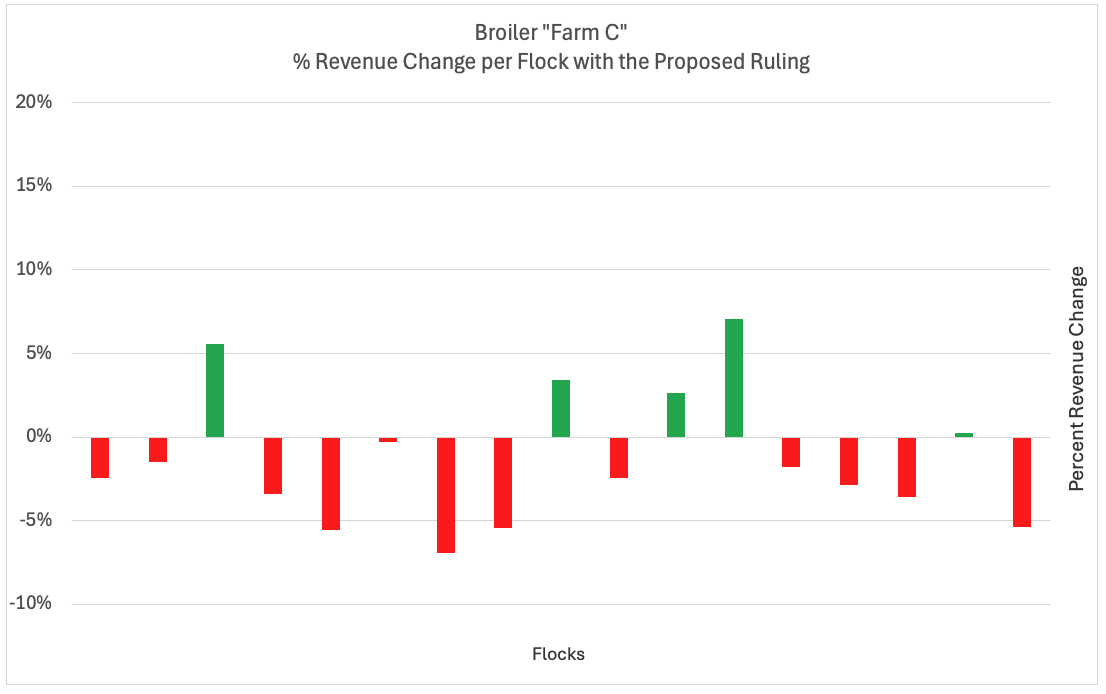
The key question: What would have happened to flock-level and overall revenues if the proposed rule had been in place during this period? To answer this, each farm’s actual tournament-based revenue was compared to a hypothetical scenario in which all birds were paid at the flat base rate of $7.45 per CWT. Revenues were analyzed on a per–square foot basis by flock, with percentage changes by flock shown in Figure 1 and 2 below.
As expected, a guaranteed base pay system benefits lower-performing farms while reducing revenue for higher-performing farms. Farm B would have seen a net revenue increase of 2.9 percent. This would have raised its effective pay rate from $7.23 to $7.45 per CWT, or about $0.015 per square foot. In contrast, Farm C would have experienced a revenue decline of approximately 1.4 percent, reducing its effective rate by $0.10 per CWT, from $7.55 to $7.45, or about $0.008 per square foot. Support for the proposed rule obviously varies among growers.
Integrators are concerned about their bottom-line production costs and the signals they send to growers. As the ruling is currently written, the option would remain for integrators to implement a guaranteed minimum pay rate by the pound that is “fair and not arbitrarily low”, allowing for positive performance incentives. However, as the industry moves forward, there could still be winners and losers, and continued questions of fairness, transparency, and the incentives in payment systems.
Figure 1. Farm B
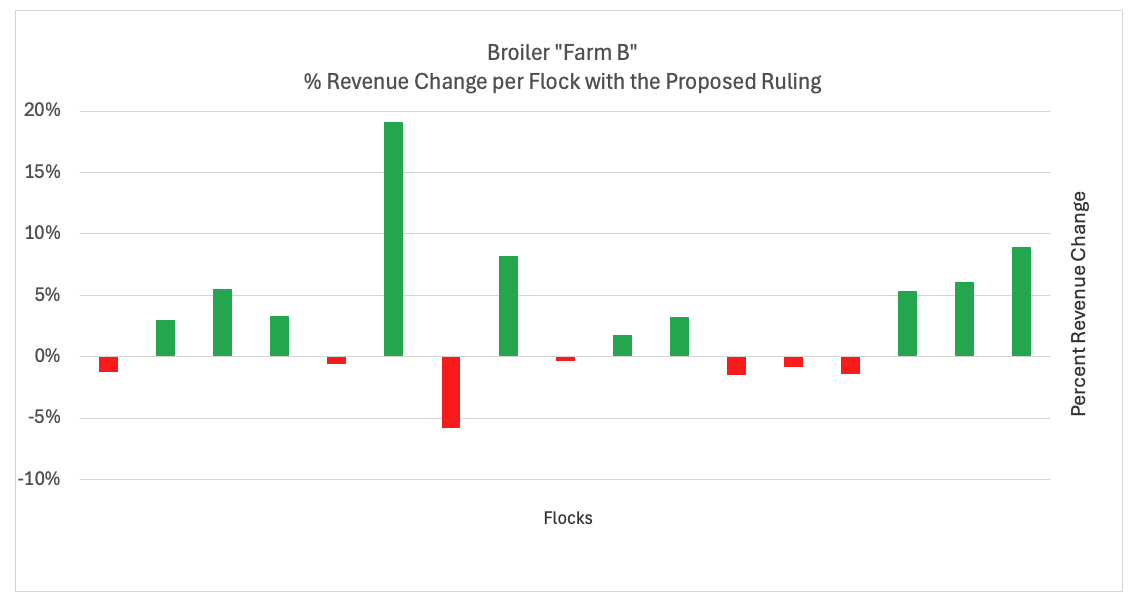
Figure 2. Farm C
Brothers, Dennis. “Broiler Revenue Questions – Part 3.” Southern Ag Today 6(22.1). May 25, 2026. Permalink