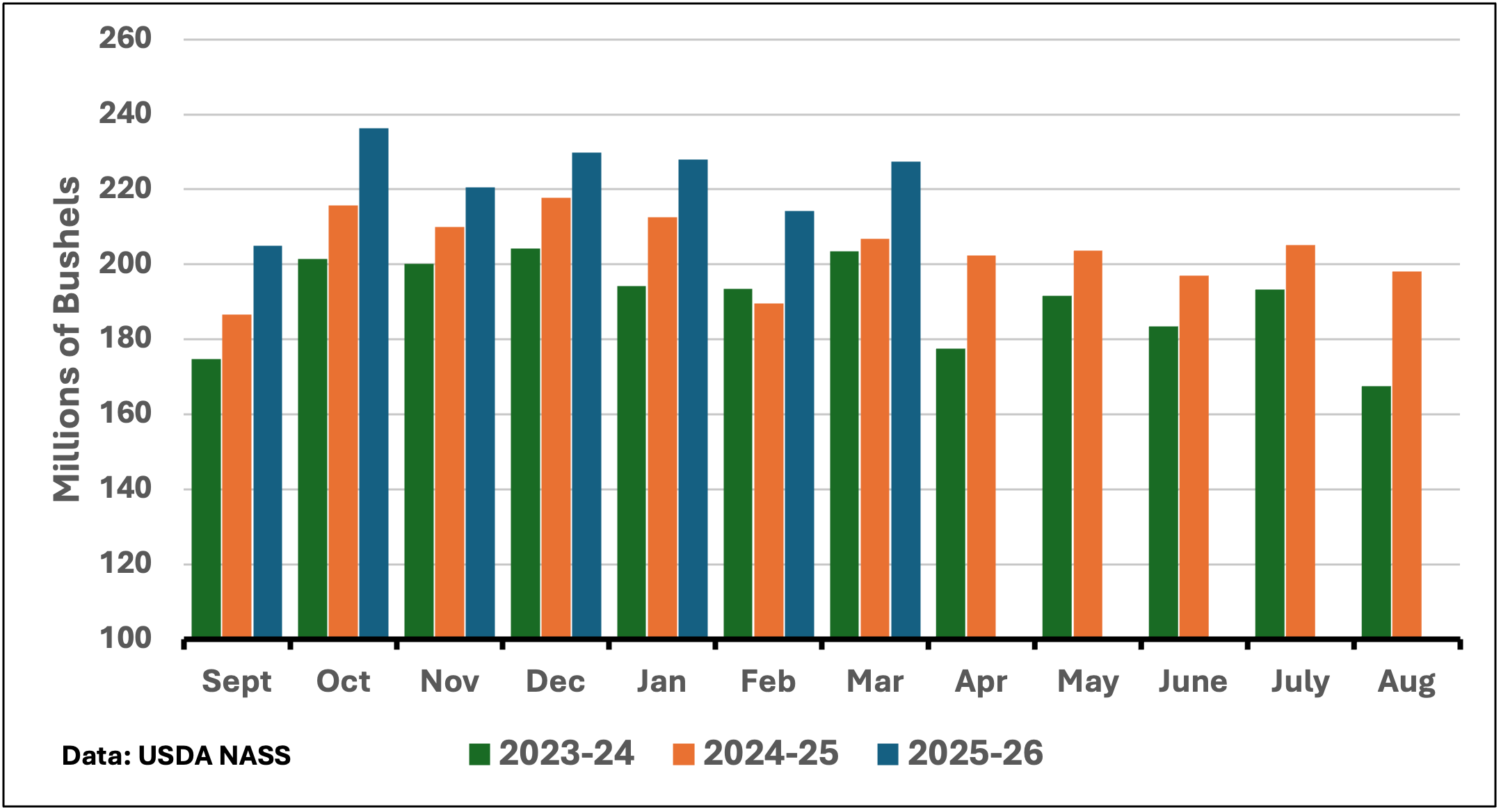
Biofuels policy underpins recent expansion in soybean crush capacity. At present, soybean crush levels, as seen in Figure 1, are setting monthly records due to this growth. Strong biofuel policies and soybean meal demand place the crush expansion on firm footing. This article focuses on the recent renewable volume obligations (RVOs) put forth for the Renewable Fuel Standard (RFS) and the implications for the soybean oil market.
Figure 1: Monthly U.S. Soybean Crush
EPA’s final “Set 2” rule, released March 27, 2026, established RVOs under the RFS for 2026 and 2027. Renewable volume obligations are the mandated levels of biofuels required for blending in the U.S. transportation fuel supply each year. A renewable identification number (RIN) is the unique number generated for each gallon of biofuel produced or imported into the U.S. The recent RVO’s list requirements in RIN gallons. Biomass-based diesel under the RFS, in general, generates D4 RIN’s while ethanol generates D6.
Biomass-based diesel RVO increases are unprecedented, jumping 67 and 70 percent above 2025 levels to reach 9.07 billion RIN gallons in 2026 and 9.20 billion in 2027. By using EPA data applied to both the D4 and D6 RIN markets, estimated projections indicate D4 net RIN generation must climb from 7.10 billion gallons in 2025 to 10.4 billion in 2026 and 11.7 billion in 2027—increases of 55 and 67 percent, respectively.[i] The 3.89-billion-gallon jump between 2025 and 2026 alone exceeds the entire 2025 D4 RIN ending bank generated under the previous RVO’s.
Two sources of D4 demand drive this optimistic scenario for D4 RINs. The first is the biomass-based diesel RVO itself. The second is the D6 shortfall, a structural deficit in ethanol RIN supply that forces obligated parties to substitute D4 RINs to satisfy conventional fuel obligations. Because U.S. ethanol usage holds limited prospects for domestic growth, approximately 1.42 and 1.41 billion gallons of D4 RINs must fill the D6 RIN gap in 2026 and 2027.
Figure 2: D4 RIN Generation
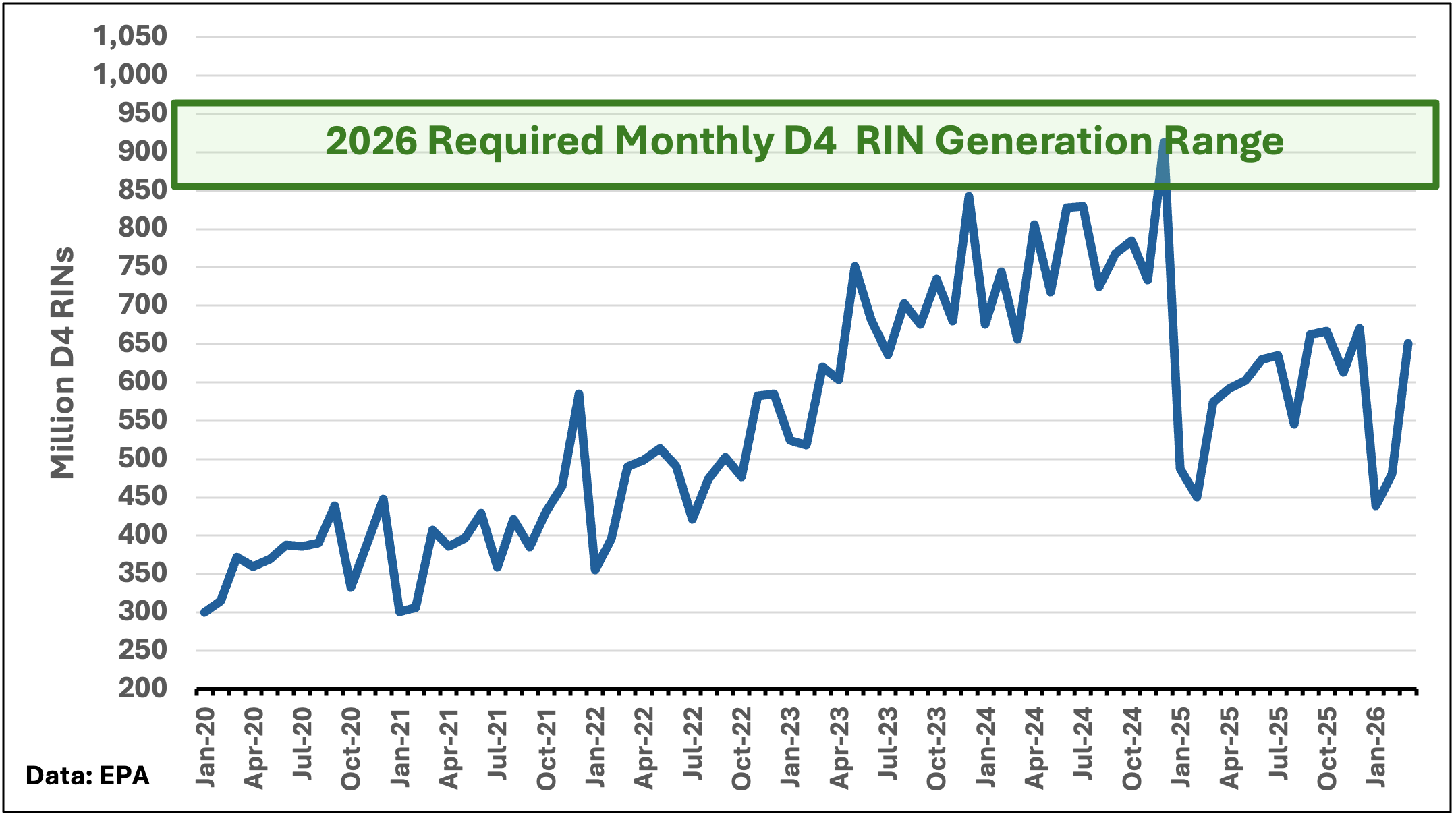
Growth in D4 RIN generation during the renewable diesel boom under the previous RVOs is obvious in Figure 2. In fact, a historically large 2.43-billion-gallon buffer in D4 RINs accumulated at year-end 2024 and is projected to collapse to just 200 million gallons by year-end 2026. The low volumes produced and imported during the first quarter of 2026 while awaiting policy finalization ate into any buffer provided by the RIN bank coming into the year. The estimated RIN generation necessary equates to 6.5 and 7.3 billion physical gallons in 2026 and 2027, respectively. At present, a range of possible D4 RIN supply needs is calculated to be between 850 – 950 million a month for the remainder of the year. This total is well above historical generation levels with only one point, December 2024 due to expiration of the biodiesel tax credit pulling imports forward, hitting the estimated needs for the RVOs.
The RIN market will operate without a meaningful bank cushion moving forward, with physical production and imports needing to closely match required generation. EIA states current operating capacity for biodiesel at 1.96 billion gallons and renewable diesel at 4.89 billion. The potential for running above operable capacity exists and should be expected for moderate durations. Even so, the production necessary is very tight for 2026, given the first three months of the year saw slower production utilization as the EPA finalized the rules. A disruption to feedstock supply chains, BBD plant capacity shortfalls, or demand surprises for additional fuel will have limited banked supply to absorb it. Implications for feedstock markets, including soybean oil, are already being felt.
Figure 3: Soybean Oil Use for Biodiesel
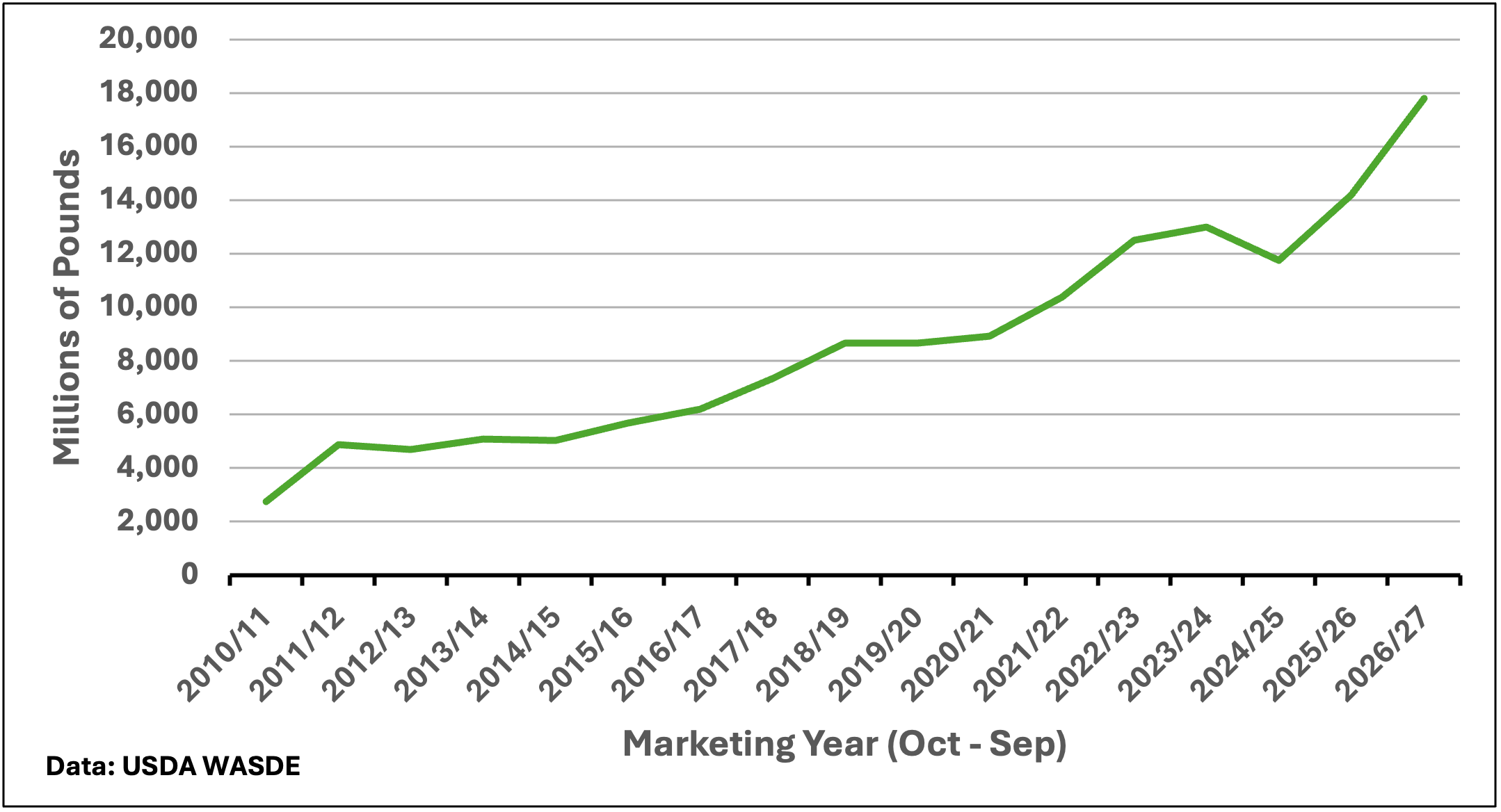
Soybean oil prices increased to over 75 cents per pound in the first quarter of 2026, as confirmation of the RVOs set in. Demand for soybean oil should not wane. As shown in Figure 3, USDA forecasts large growth in soybean oil use for biodiesel in 2026-27. Soybean oil traditionally constituted between 35 and 40 percent of feedstock for biodiesel and renewable diesel production. In USDA’s latest WASDE, soybean oil use for biodiesel production in the 2025-26 marketing year remained at 14.2 billion pounds due to the slow start of the marketing year. The 2026/27 marketing year came in at 17.8 billion pounds. A continuation of strong crush levels and soybean oil demand appears highly probable, barring major disruption.
[i] Detailed calculations can be found at: Hubbs, T. and S. Irwin. “Rewriting the RFS Playbook: The Impact of Final RVOs on Projected D4 Biomass-Based Diesel RIN Generation for 2026-2027.” farmdoc daily (16):73, Department of Agricultural and Consumer Economics, University of Illinois at Urbana-Champaign, April 27, 2026.