
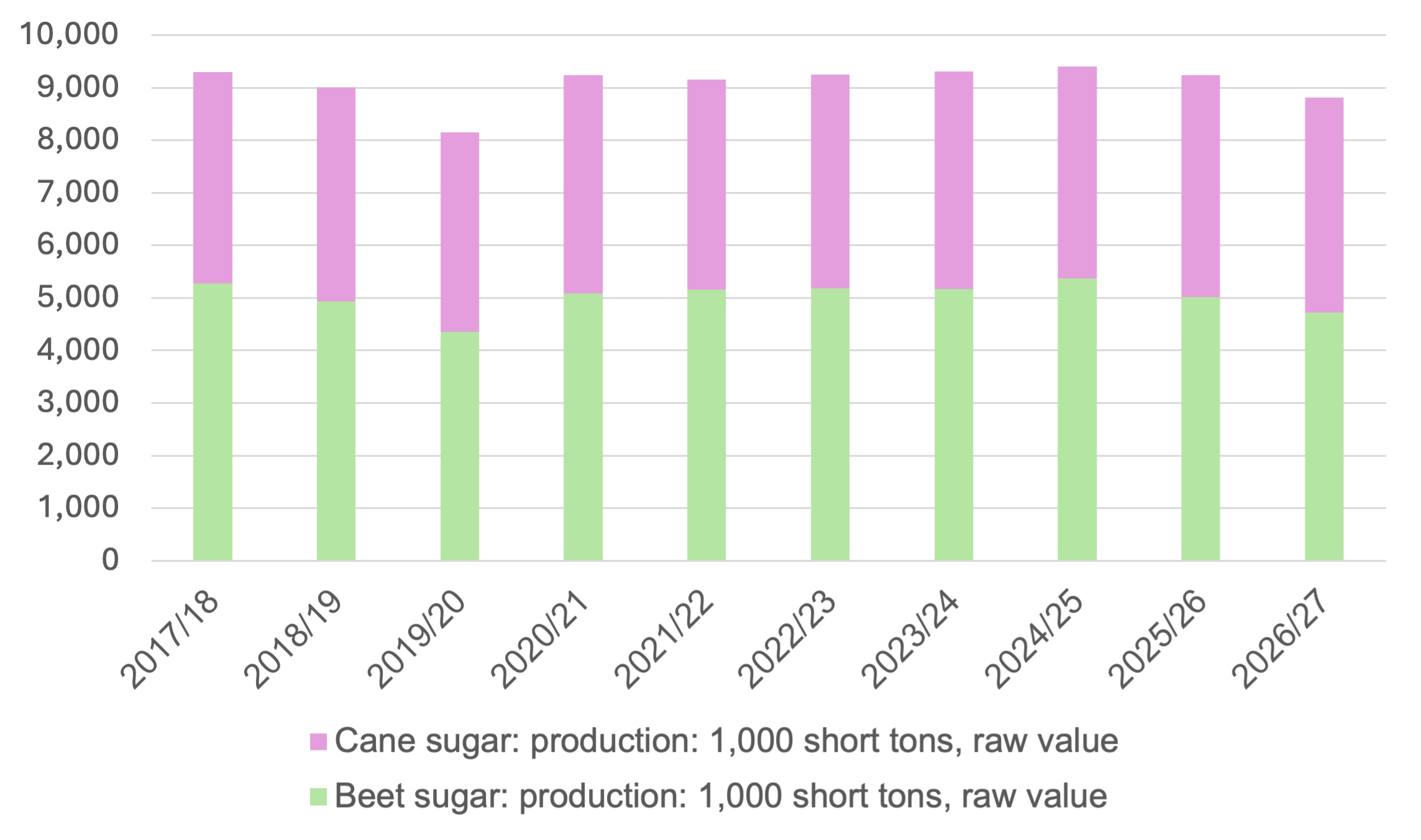
The USDA released its first supply and use estimates for 2026/27 on May 12th. For 2026/27, USDA estimates that domestic beet and cane sugar production will total 8.810 million short tons, raw value (STRV). If realized, this nearly 5% reduction would be the lowest domestic production level in more than a half decade (Figure 1). The June WASDE report will reflect the first yield/production survey forecasts for 2026/27, with some in the industry expecting the estimate to be up from the May report.
Beet sugar production (~55% of U.S. sugar production) is estimated to reach 4.722 million STRV, its lowest level since the freeze-damaged crop of 2019/20. This represents a year-over-year decrease of 300,000 STRV due to a reduction in planted beet area and lower yields based on delays in springtime planting across the entire beet-production region.
Cane sugar production is expected to total 4.088 million STRV, which, like beet sugar, would amount to its lowest output since 2022/23. This represents a year-over-year decrease of 130,000 STRV. While Louisiana’s cane sugar crop is forecasted at 2.146 million STRV, down 86,000 year-over-year, production in the state is still expected to continue the trend of expanding acres. Yields are expected to track the five-year average following last year’s record yields and sugar recovery rate. Florida’s cane sugar production is forecast at 1.942 million STRV, a yearly decrease of 44,000 STRV as the February freeze inhibited early growth on sugarcane planted the preceding fall.
Figure 1. Historical U.S. sugar production (1,000 STRV). USDA-ERS.
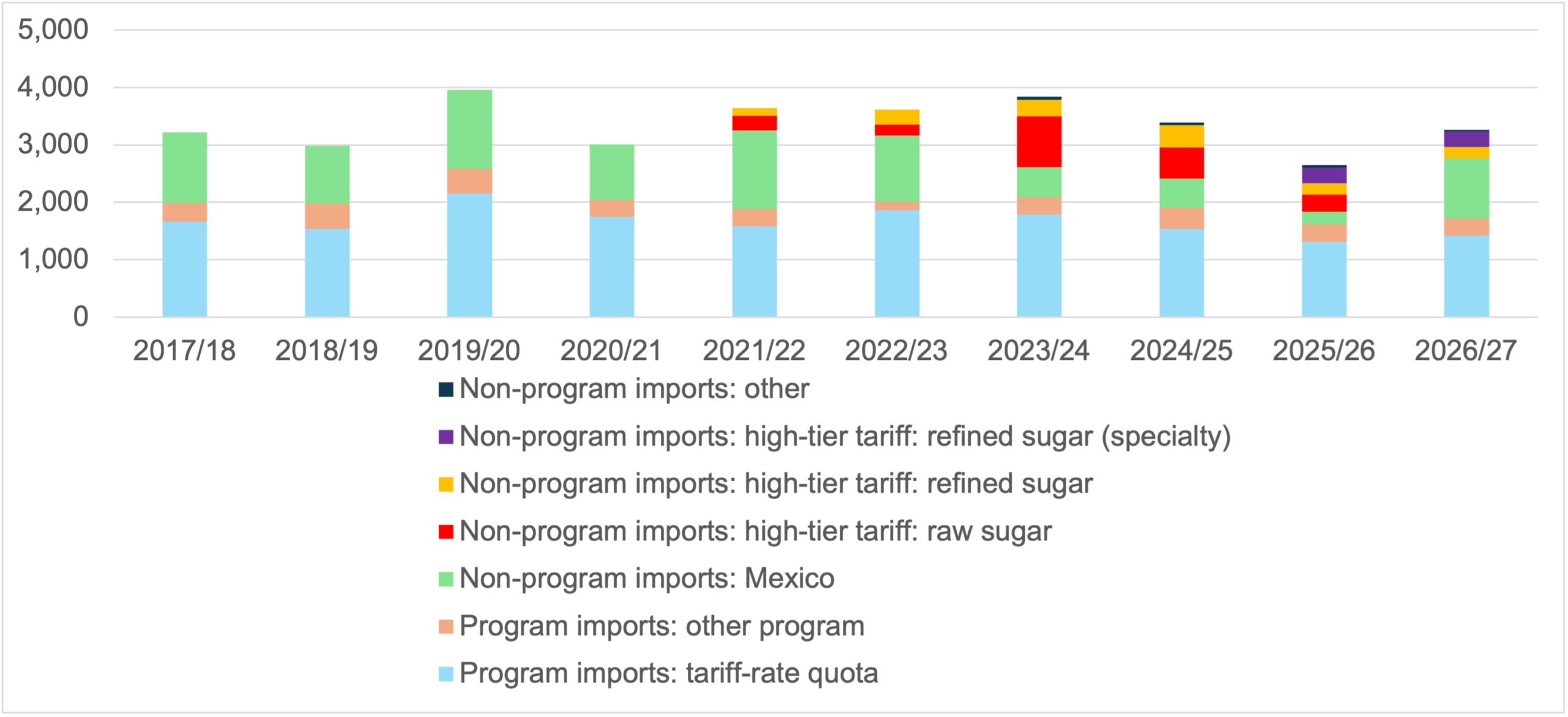
Imports for 2026/27 are initially estimated at 3.260 million STRV, which equates to a 23% increase from the year prior. This threshold is the result of minimum commitment levels of World Trade Organization (WTO) raw sugar tariff-rate quotas (TRQs) of 1.137 million STRV, WTO refined sugar quotas of 24,251 STRV, free trade agreement (FTA) TRQs of 260,777 STRV, and imports from Mexico. Based on calculations as stipulated in the 2014 U.S.-Mexico Suspension Agreements, U.S. imports from Mexico currently are estimated at 1.046 million STRV. This would be an increase from the 220,000 STRV supplied by Mexico last year and double the 504,000 STRV imported in 2024/25. Based on the stocks-to-use ratio, the Suspension Agreements with Mexico will determine the quota for Mexico in July, September, December, and March. High-tier duty sugar (refined and specialty refined) imports are initially set at 466,000 STRV. USDA sets 2026/27 high-tier raw sugar imports initially at zero. As high-tier raw sugar imports are observed entering U.S. ports, they will then be reflected in the balance sheet. For 2025/26, a total of 299,000 STRV of high-tier raw sugar imports have entered the country as of the May WASDE with another 100,000 STRV expected in the second half of the fiscal year (Figures 2 and 3). The amount of high-tier imports landed will have a proportional impact on the import quota from Mexico. As the amount of high-tier imports is increased, the import quota level from Mexico is reduced.
Figure 2. Estimated U.S. sugar imports (1,000 STRV) for 2026/27. USDA ERS.
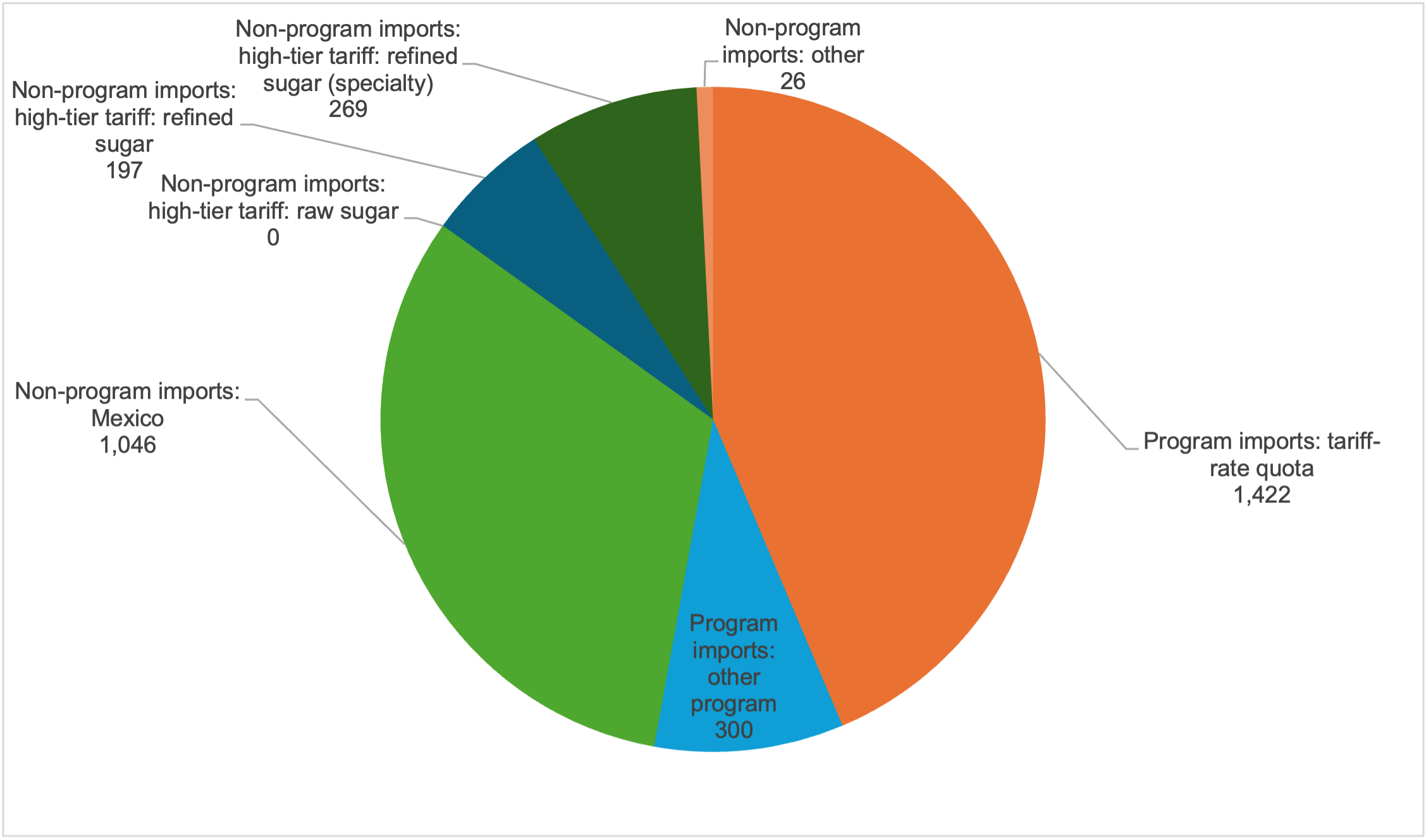
Figure 3. Historical U.S. sugar imports, by source. USDA ERS.
There is uncertainty with U.S. sugar demand as inflationary pressures, an overall reduction in food and beverage consumption (due to the adoption of glucagon-like peptide-1 drugs (GLP-1)), and changes in food consumption recommendations weigh on the market. The demand estimate of 12.259 million STRV is unchanged from the prior year’s estimate. However, there is a declining multi-year trend in sugar for food consumption from the high reached in 2022/23 (12.473 M STRV).
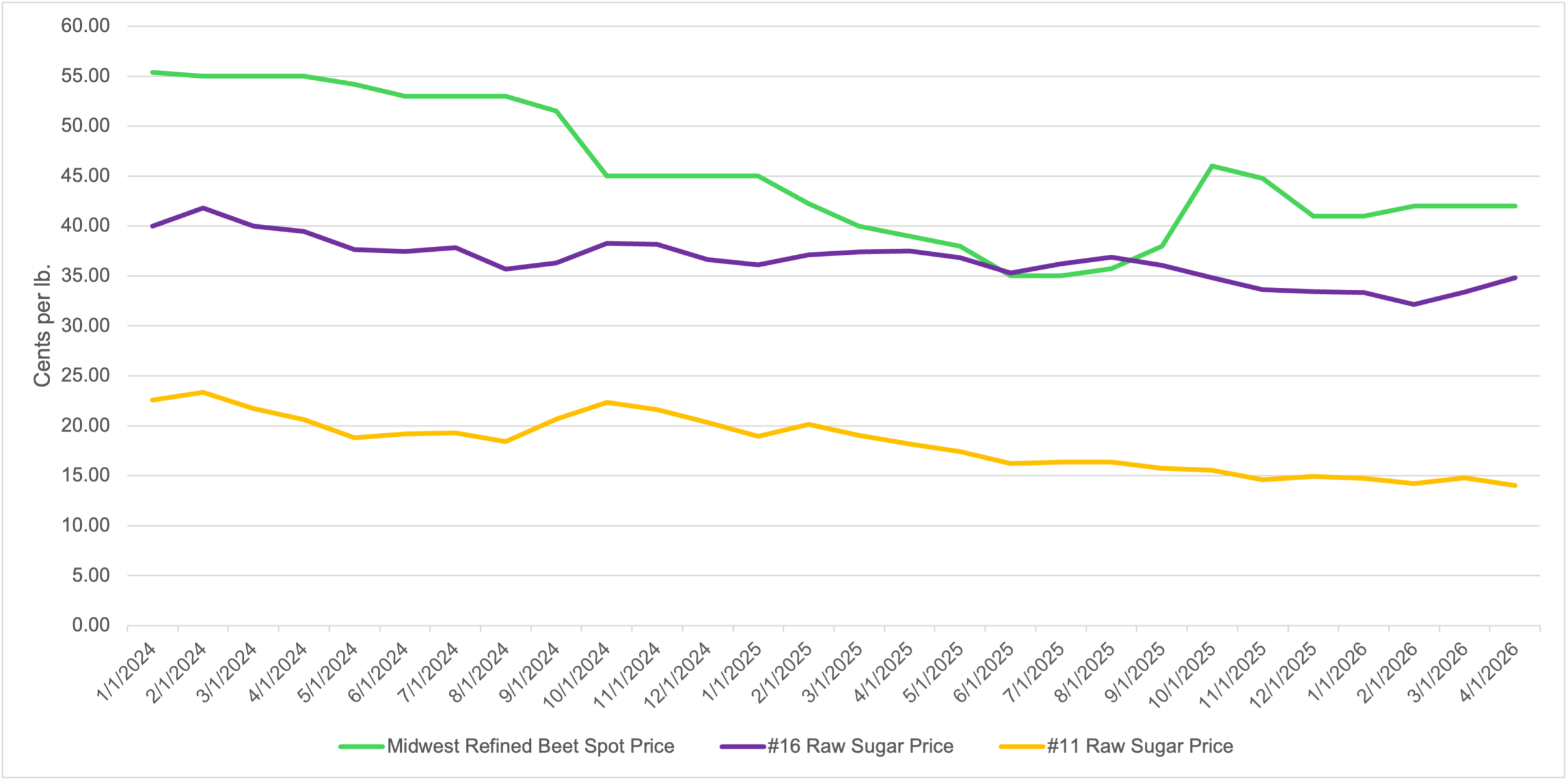
Looking to the global sugar market, for the 2025/26 crop year, the International Sugar Organization (ISO) raised its forecast for the 2025/26 global sugar surplus volume thus indicating an adequately supplied market. As such, the #11 world raw sugar futures price has declined from a high of 27.31 cents per pound in November 2025 to 14.05 cents per pound in April 2026.
Domestically, the U.S. #16 raw sugar futures contract has averaged 32.97 cents per pound from January to April. The Midwest refined beet spot price has averaged 41.67 cents per pound over the same period. Although the #16 raw sugar price has declined since last September to end the fiscal year prior, a record cane harvest in Louisiana acted to moderate prices. Coupled with flat U.S. sugar demand, #16 raw futures decreased from 36.06 cents per pound in September 2025 to a low of 32.14 in February 2026. However, raw sugar prices have begun to increase to 34.81 cents per pound in April. Midwest refined beet spot prices have also moderated since September (38 cents) to 42.00 cents per pound in April. The anticipation of reduced domestic sugar production is seen as supportive for U.S. prices (Figure 4).
Figure 4. Midwest refined beet sport price, #16 U.S. raw sugar futures price, and #11 world raw sugar futures price, January 2024 to April 2026. USDA ERS.
Prior to the Middle East conflict that began in March, world raw sugar prices were already starting a downward trend, settling under 15 cents per pound. While other commodities like corn, soybeans, and cotton have showed gains resulting from the conflict amid the rally in crude oil prices and shipping disruptions through the Strait of Hormuz, world raw sugar prices continued to be suppressed from the available surplus. However, the #11 futures market was not entirely absent of gains as resulting support from the energy complex provided spillover support to prices. Sustaining that support has been challenging. U.S. sugar producers are not immune from the challenges faced by other agriculture producers such as rising input costs and falling commodity prices. While pressure continues to mount for the industry, USDA announced $150 million in assistance to sugar beet and sugarcane producers in response to temporary market disruptions and increased production and processing costs. This assistance was designed to ensure producers have the financial stability needed to continue operations and plan for the upcoming crop year.
Looking forward to 2026/27, the ISO forecasts a deficit of global sugar due to potential impacts on sugar cane crops from a developing El Niño weather system and the expectation that more sugar cane crush will be diverted into ethanol production away from sugar production (which should raise the #11 world raw price). As the #11 world raw price increases, the U.S. #16 futures will tend to follow suit.
Deliberto, Michael. “Sugar Market Outlook.“ Southern Ag Today 6(24.3). June 10, 2026. Permalink