
Authors: Yuan Zhang, Andrew Anderson, and Ryan Loy
When drought pushed the Mississippi River level to historic lows in late 2022, barge freight rates jumped far above their usual levels. However, those costs do not stop at the river. They are disseminated throughout the grain marketing system and show up at the farmgate as weaker basis.
For corn and soybeans moving from interior elevators to Gulf export terminals, barge transportation helps determine the grain’s local value. When barge rates rise, the cost of moving grain to export markets also rises. Elevators then face a wider gap between what they can pay farmers and the grain’s value at the Gulf. Part of that transportation shock is passed back to producers in the form of lower cash bids.
The size of that pass-through depends heavily on where farmers sell their grain. River transportation conditions, local grain demand, and competition among buyers all influence how much of a change in barge freight costs reaches the farmgate. Low river levels can restrict navigation and raise transportation costs, while differences in local marketing opportunities can either amplify or reduce the resulting impact on basis. As a result, the impact of higher barge rates varies considerably across regions and crops.
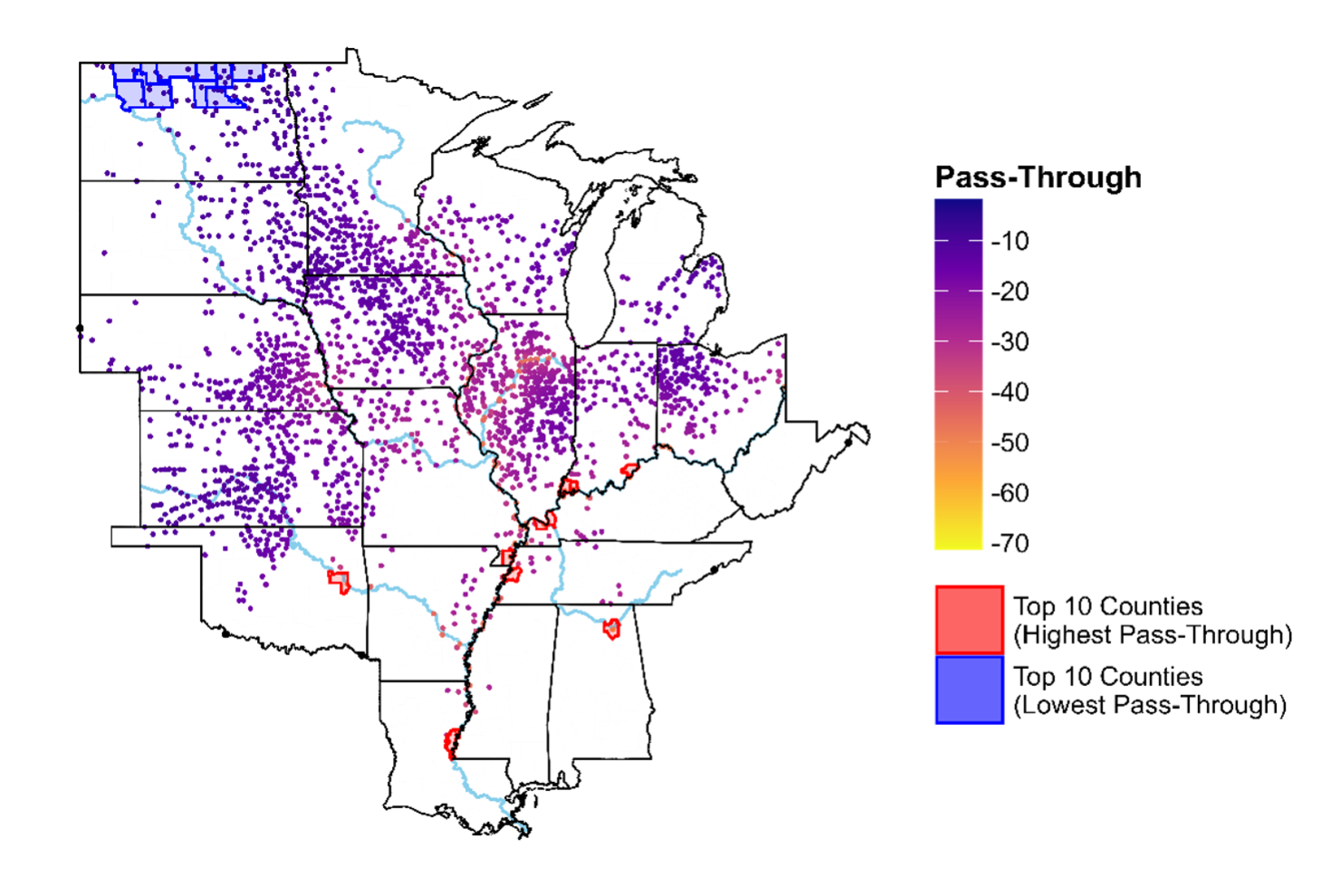
Recent research by Zhang et al. (2026) finds evidence that barge freight shocks are passed back to farmers through weaker local corn and soybean basis. Higher barge rates weaken basis for both crops, but the effect is not uniform. Figures 1 and 2 identify areas where barge rate increases had the most severe impact on local basis. Lighter yellow areas indicate larger basis declines from the same increase in barge rates. The strongest impacts are concentrated in southern river states, especially along the lower Mississippi and Ohio River corridors. In the most exposed corn counties, including parts of Louisiana, Arkansas, Kentucky, and Tennessee, more than half of a barge rate increase reaches the farmgate as weaker basis. In the most exposed counties, a $1.00 per bushel increase in barge rates reduced corn basis by roughly 60 to 71 cents and soybean basis by roughly 49 to 53 cents. The crop differences reflect different marketing channels. For corn, the smallest basis impacts tend to occur in areas with more local buying competition and nearby processing alternatives. For soybeans, the smallest impacts tend to occur farther from river ports, reflecting soybeans’ stronger connection to export-oriented barge movement. For southern river states, however, the main result is the same for both crops: higher barge rates lead to substantially weaker local basis.
Figure 1. Estimated Effects of Barge Freight Rate Increases on Local Corn Basis.
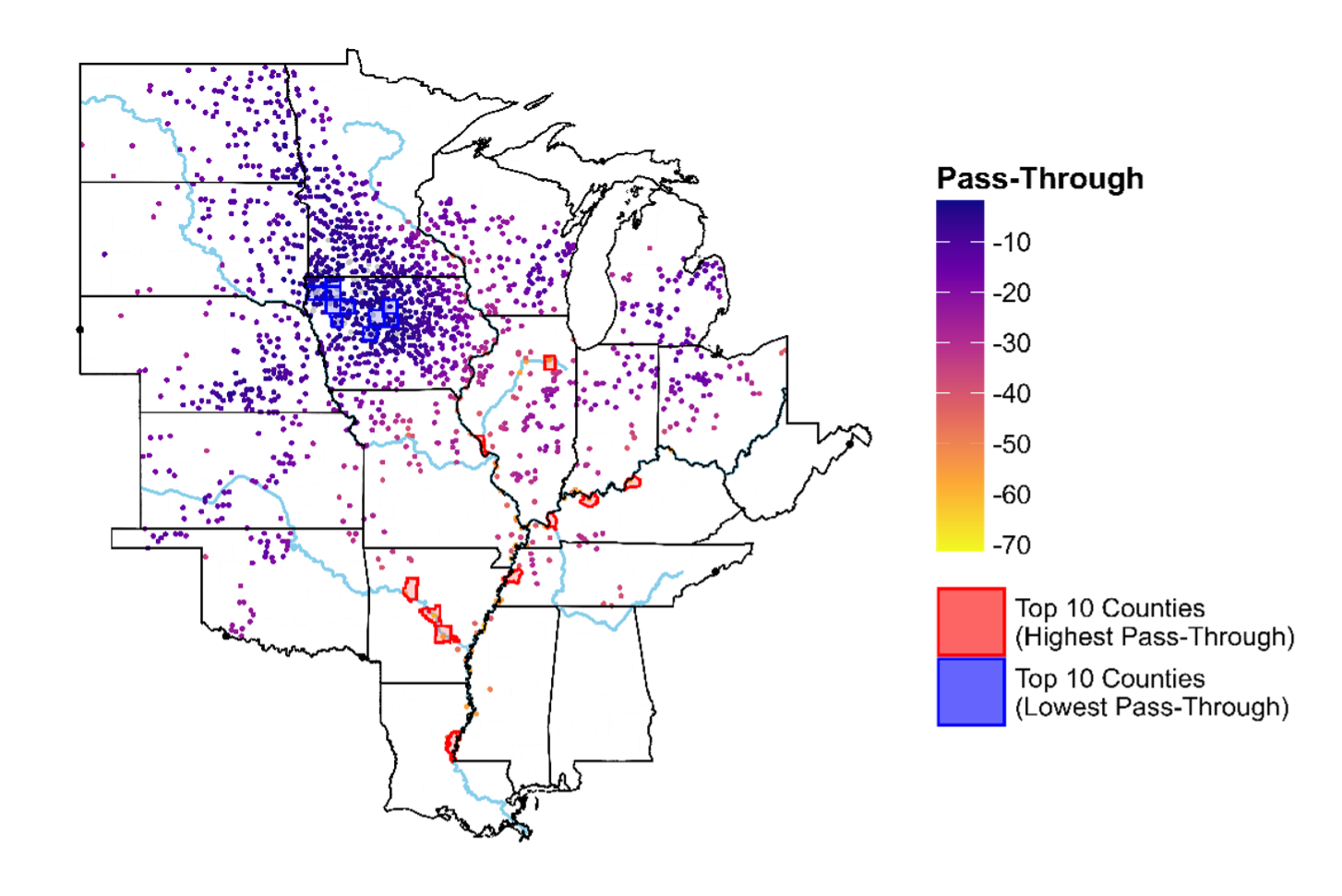
Figure 2. Estimated Effects of Barge Freight Rate Increases on Local Soybean Basis.
Futures and options can protect farmers against changes in broad commodity prices, but they do not hedge local basis risk. Farmers in highly exposed areas have fewer tools when river disruptions weaken local cash bids, making reliable river navigation especially important for farm profitability. Investments that reduce navigation disruptions can help protect farm revenues, particularly in counties along the lower Mississippi River, where transportation shocks are strongly passed through. Local competition also matters. When farms have fewer elevator options, more of the transportation shock is reflected in their cash bids. Practical responses include diversifying buyers, selling to nearby processors when possible, and using owned or leased storage to wait out short-term navigation problems. Together, these findings highlight how transportation infrastructure and local marketing opportunities influence the extent to which farmers absorb river-related transportation shocks.
References
Zhang, Y., A. E. Anderson, N. J. Pates, and E. Park. 2026. “When the River Runs Low: Heterogeneous Impacts of Transportation Disruptions on Local Grain Basis.” Agribusiness. doi: 10.1002/agr.70108.
Recommended citation format: Zhang, Yuan, Andrew Anderson, and Ryan Loy. “When the River Runs Low, Southern Grain Farmers Pay the Most.” Southern Ag Today 6(26.3). June 24, 2026. Permalink