Established following the May 2026 summit between President Donald Trump and Chinese President Xi Jinping, the U.S.-China Board of Trade is a new bilateral initiative aimed at rebuilding commercial ties between the U.S. and China by reducing trade barriers, addressing tariff disputes, and encouraging trade between countries (USTR, 2026). Implementation details, including which products will be covered, how procurement commitments will be measured, and how compliance will be enforced, are still being finalized.
In a recent bipartisan letter to U.S. Trade Representative Jamieson Greer, members of Congress urged the Administration to explicitly include “American hardwood lumber” in the newly established framework, to ensure that China’s procurement commitments prioritize U.S. hardwood lumber. The lawmakers argue that restoring access to the Chinese market is critical for the U.S. hardwood industry. As noted in the letter, the industry has suffered nearly $10 billion in lost sales and a 48% decline in domestic hardwood lumber production since the onset of the U.S. trade war with China in 2018. See the following link for a full copy of the letter: https://www.shaheen.senate.gov/imo/media/doc/ustr_hardwood_letter.pdf.
The importance of this letter becomes clearer when viewed in the context of the hardwood industry and declining export sales, especially to China.
The U.S. is one of the world’s leading producers and exporters of hardwood logs and lumber, with exports providing an important source of income for forest landowners, sawmills, and rural communities. Hardwood exports are particularly significant in the U.S. South, a region characterized by abundant timber resources and a strong dependence on international markets for sales. For instance, the largest hardwood export category, oak lumber (red and white), was valued at $873 million in 2025, led by exports from the South ($327 million) where North Carolina, Virginia, Tennessee, and Kentucky are top suppliers. It is important to note that prior to the 2018 trade war, U.S. oak lumber exports were $1.3 billion. In 2017, China accounted for more than 60% of U.S. oak lumber exports. This decreased to 34% in 2025 (USDA, 2026).
Trade data show just how important the Chinese market has been for southern hardwood producers (See Figure 1). Exports of hardwood products from the South experienced strong growth after 2010, driven largely by rising demand from China. Southern hardwood lumber exports to all destinations increased from roughly $500 million in 2010 to more than $1.2 billion in 2017, while exports to China alone grew from less than $200 million to nearly $700 million over the same period. This pattern highlights the central role that China played in expanding markets for southern hardwood producers. Hardwood log exports also benefited from Chinese demand, although growth was more modest than for lumber.
The 2018 trade war marked a clear turning point. Following retaliatory tariffs imposed by China, hardwood lumber exports to China fell sharply, dropping by nearly half between 2018 and 2019. Exports have never returned to their pre-trade-war levels and continued to decline through 2025. Lumber exports from the South to all countries also trended downward after 2018, suggesting that losses in the Chinese market were only partially offset by sales to other destinations. Southern hardwood log exports have also weakened, although they have generally been more stable than lumber exports. Overall, the figure shows how deeply the southern hardwood industry depended on China before 2018 and how the trade war fundamentally altered exports.
Rebuilding trade with China could help strengthen the southern hardwood industry. Among overseas markets, China emerged as one of the most important destinations for U.S. hardwood products. Expanding furniture manufacturing and increasing demand for high-quality wood materials contributed to a substantial rise in U.S. hardwood exports to China. As a result, many U.S. hardwood producers became increasingly reliant on Chinese demand. These exports supported employment, investment, and forest management activities throughout southern states.
Figure 1. U.S. Hardwood Exports from Southern States to All Countries and China: 2010-2025
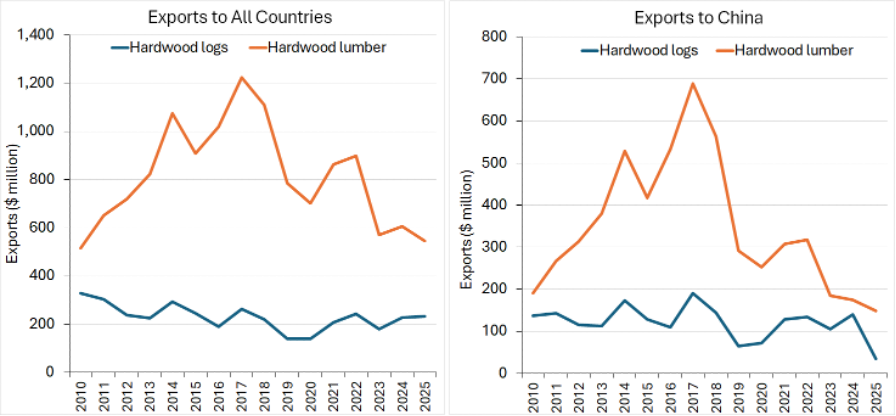
Source: U.S. Department of Agriculture, Foreign Agricultural Service (2026)
For more information:
Office of the United States Trade Representative (USTR) (2026). USTR Seeks Public Comment on the Scope and Operation of a Mechanism to Promote Balanced and Reciprocal Trade with China. Press Release (June 02, 2026). https://ustr.gov/about/policy-offices/press-office/press-releases/2026/june/ustr-seeks-public-comment-scope-and-operation-mechanism-promote-balanced-and-reciprocal-trade-china
U.S. Department of Agriculture (USDA) (2026). Global Agricultural Trade System. Foreign Agricultural Service. https://apps.fas.usda.gov/gats/default.aspx
Recommended citation format: Muhammad, Andrew. “Can the U.S. South Regain Its Hardwood Market in China?” Southern Ag Today 6(29.4). July 16, 2026. Permalink