2026 Mid-Year Farm Financial Condition Update
Entering the second half of 2026, a new farm financial snapshot points to the continued financial challenges facing Southern agriculture, particularly among crop producers. The findings are based on a semi-annual survey conducted by the Mississippi State University Extension. Survey respondents included producers, professional farm managers, land appraisers, commercial bankers, Farm Credit System lenders, and USDA Farm Service Agency personnel operating in Mississippi, Arkansas, Louisiana, Tennessee, and neighboring states.
Figure 1: Agricultural Financial Indicators
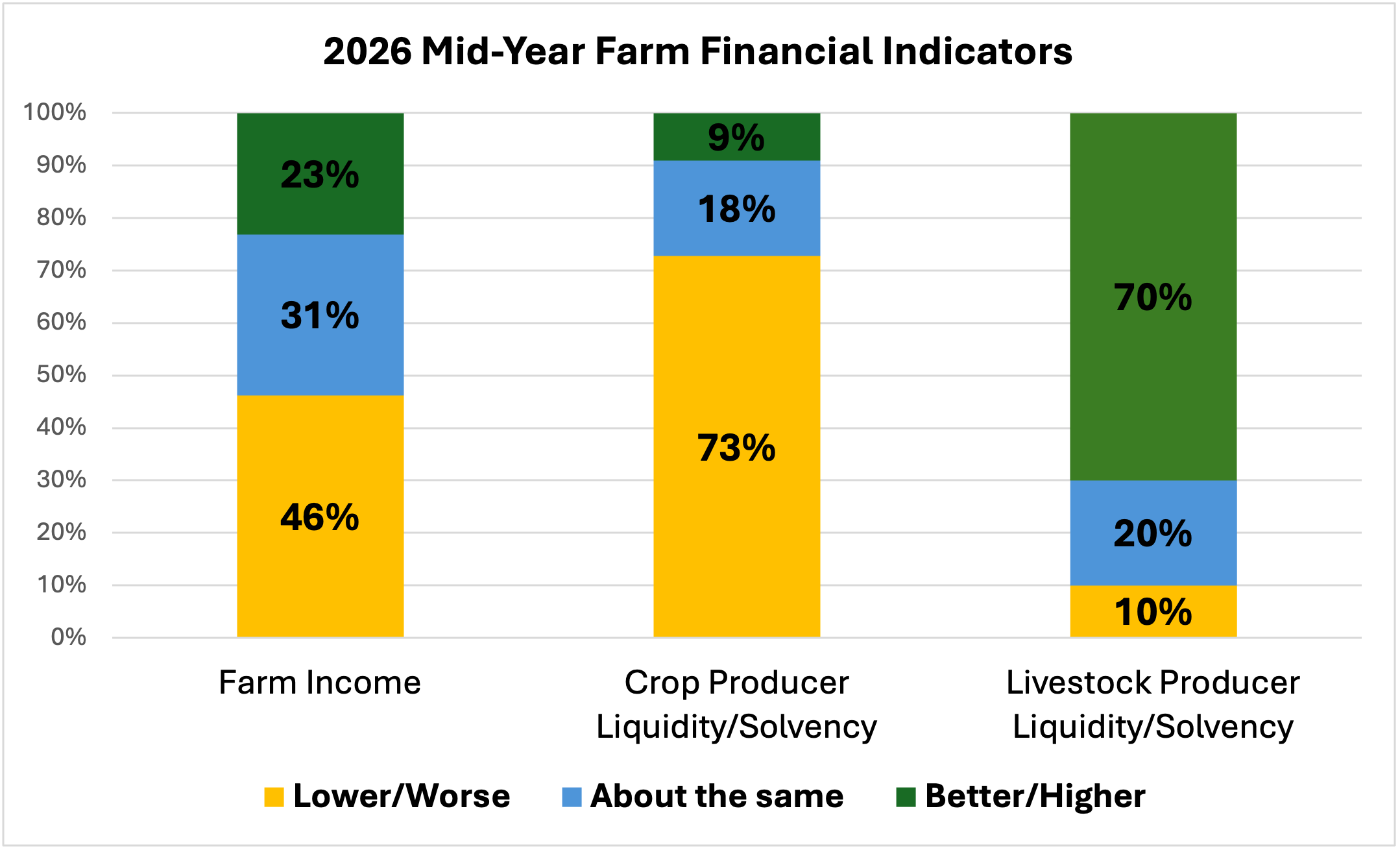
As shown in Figure 1, overall farm income remained weaker than during the same period last year. Approximately 46% of respondents reported lower farm income in their region, while 31% indicated that farm income was about the same as in the same period of 2025. Survey comments suggested that significantly higher fuel prices have further increased production costs. Consistent with these responses, the USDA Economic Research Service’s May 2026 Farm Income Forecast projects that lower cash receipts, combined with higher production costs, will place additional downward pressure on farm profitability. Only about 23% of respondents reported higher farm income in their region.
Crop producers’ liquidity and solvency worsened again in 2026. 73% of respondents reported worsening liquidity and solvency for crop producers, while less than 10% of respondents reported improvements in these financial health measures. Several respondents noted that consecutive years of weak crop returns have substantially eroded producers’ financial positions. In contrast, livestock producers continued to experience improving liquidity and solvency for a second consecutive survey period, largely supported by stronger cattle prices.
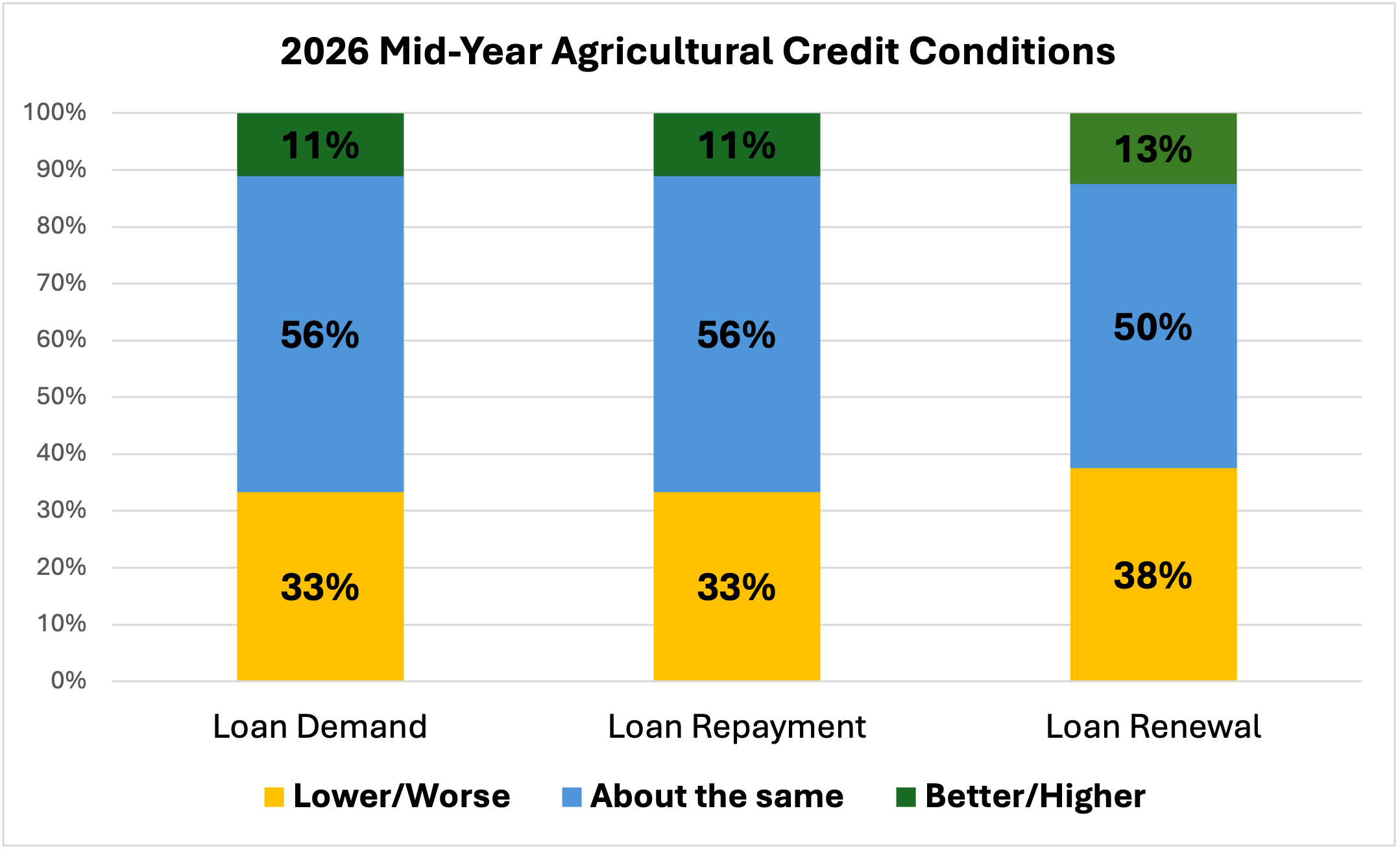
Figure 2: Agricultural Credit Conditions
The survey also collected agricultural loan interest rates from a range of lenders, including commercial banks, the Farm Credit System, and insurance companies. Average interest rates for operating, intermediate-term, and farmland loans all remained around 7.5%, generally consistent with rates reported in the Federal Reserve Bank of Dallas’s quarterly agricultural credit survey. Interest rates were modestly higher than those reported in the survey conducted six months earlier.
Agricultural credit conditions also weakened slightly during the first half of 2026. As shown in Figure 2, more than half of lenders reported that loan demand remained at about the same level as last year, while 33% of respondents reported lower loan demand. Respondents attributed the slight increase in loan demand observed in some regions to producers experiencing lower farm income. At the same time, most respondents indicated that loan repayment rates and loan renewals remained about the same as last year. However, among those reporting a change, more respondents reported worsening rather than improving conditions, suggesting growing cash flow stress among borrowers and increasing financial pressure across the region.
Figure 3: Agricultural Land Value Expectation
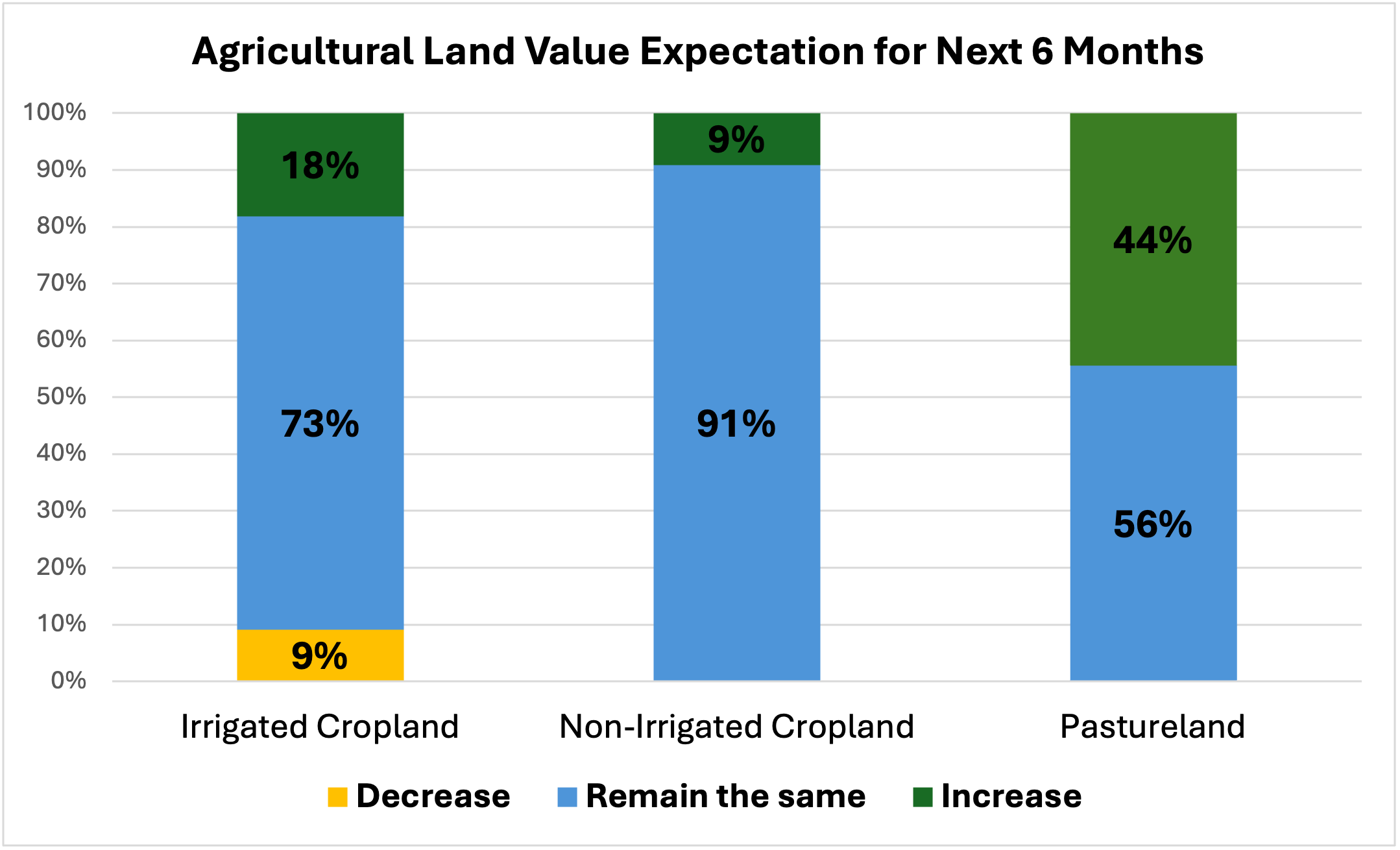
Despite increasing financial pressure on crop producers, farmland values remained resilient. Both cropland and pastureland values increased in 2026 compared to 2025. When asked about farmland value expectations for the next six months, respondents generally expected cropland and pastureland values to either remain stable or increase, as shown in Figure 3. While 18% and 9% of respondents expected increases in irrigated and non-irrigated cropland values, respectively, 44% anticipated another increase in pastureland values over the next six months. Survey comments suggest that continued demand from non-agricultural investors and alternative land uses has helped support farmland prices despite weaker farm profitability.
Overall, although farmland values have remained strong, declining crop returns and rising production costs continue to place significant financial pressure on producers. Many respondents expressed frustration and concern about the deteriorating liquidity of crop operations, with several describing the first half of 2026 as one of the most challenging financial periods in recent years. Many emphasized the need for greater attention from policymakers to address the financial challenges facing the agricultural sector.
Recommended citation format: Kim, Kevin. “2026 Mid-Year Farm Financial Condition Update.” Southern Ag Today 6(37.1). September 7, 2026. Permalink
