Authors: Shawn Wade and Darren Hudson, International Center for Agricultural Competitiveness, Texas Tech University
Sugar is sweet… especially for foreign sugar producers who find themselves at the receiving end of generous subsidies and other policies meant to protect their domestic production.
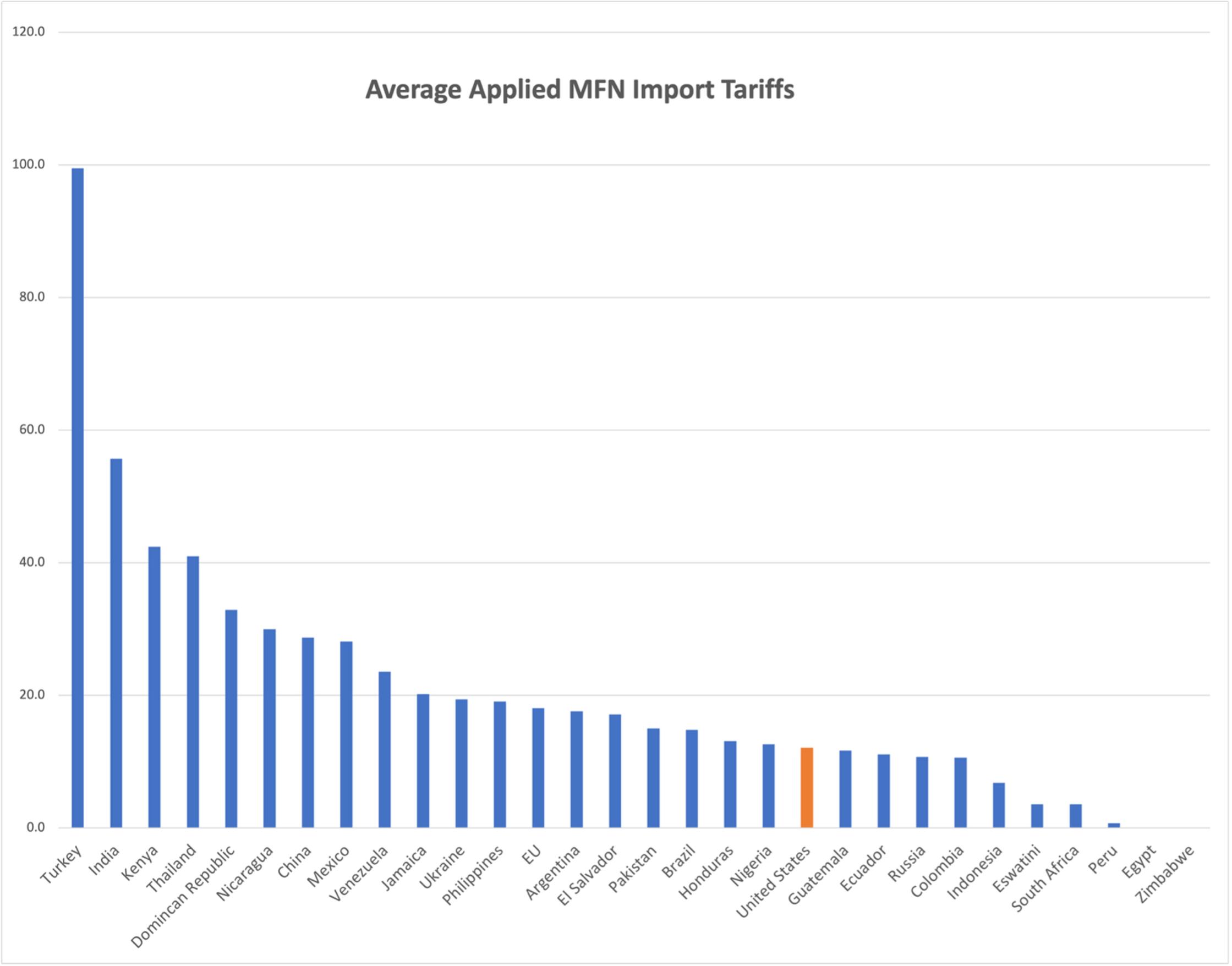
Sugar remains one of the most highly protected commodities in the world, with import tariffs (or tariff rate quotas, TRQs) being the most common policy tool. Applied tariffs range from 0 to 100% globally, with the United States on the low end according to the World Trade Organization (WTO). Many of the largest producers, including China, India, and Turkey, have applied tariffs of far more than 20% (Figure 1), whereas the U.S. is at 12.1%.
Added to the import controls, many of the largest producers utilize production/input subsidies, tax credits, and state monopoly trading mechanisms which give their producers significant advantages over U.S. producers. In fact, monetary transfers to Chinese and Indian producers have been around $2-3 billion per year since 2005, nearly 3x the OECD (Organization for Economic Co-operation and Development) average. A 2024 U.S. government report submitted to the WTO documented $17.6 billion in subsidies to Indian sugar producers in 2022 alone, even after a WTO dispute panel ruled that India had violated its WTO commitments on sugar.[1]
And, the proliferation of ethanol mandates has provided significant indirect support to sugar prices, especially where sugar is the primary feedstock. By contrast, the U.S. sugar program is designed to operate at “no net cost” to the U.S. taxpayer, and U.S. biofuel policies are not related to sugarbeet or sugarcane production.
With U.S. production being below self-sufficiency (<= 90% of domestic production), the door is open to sugar imports from more highly subsidized markets. Our analysis (linked below) outlines the policies in place around the world that impact sugar markets.
This is an especially timely analysis as the U.S. sugar industry is asking the U.S. Trade Representative to use Section 301 authorities in response to what the industry is calling “unreasonable and discriminatory trade practices.” [2]
Sugar is a popular target in the subsidy debate, but it is helpful to understand just how much support is being provided around the world to inform that debate.
Figure 1. Average Applied Most-Favored Nation (MFN) Import Tariffs for HS17 (Sugars and Sugar Confectionary), Last Reported Year for Each Country.
To view the entire report go to the Texas Tech International Center for Agricultural Competitiveness website: https://www.depts.ttu.edu/aaec/icac/
[1] Study available at: https://docs.wto.org/dol2fe/Pages/SS/directdoc.aspx?filename=q:/G/AG/W245.pdf&Open=True
[2] See https://sugaralliance.org/sugar-expert-testifies-on-unfair-trade-practices-harming-american-farmers-workers/41277
Recommended citation format: Wade, Shawn. “Sugar is sweet, just sweeter in some places…” Southern Ag Today 6(39.4). September 24, 2026. Permalink