Authors: Falin Sun, Ph. D Student, Auburn University and Sunjae Won, Assistant professor, University of Arkansas.
Irrigation plays very different roles across the Southern region. According to the 2022 Census of Agriculture, Arkansas, Texas, and Mississippi account for the largest shares of irrigated farmland, while Virginia, Kentucky, and Alabama irrigate comparatively little. These differences reflect the region’s diverse production systems and water resources, making irrigation an important farm-management issue across the South.
Figure 1 compares irrigated farms and irrigated acreage across Southern states. States with the largest irrigated acreage do not necessarily have the greatest number of irrigated farms. For example, Mississippi’s irrigated land is concentrated on relatively few, larger farms, whereas Georgia has irrigation distributed across many more operations. This contrast illustrates how farm size, crop mix, and production systems influence irrigation adoption beyond acreage alone.
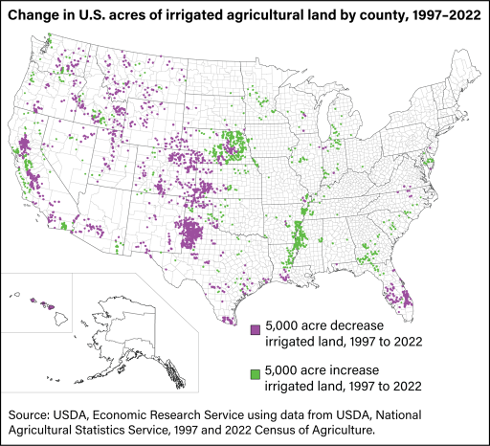
Figure 2 highlights where irrigated acreage changed between 1997 and 2022. Declines in West Texas and parts of Oklahoma are consistent with long-term pressure on the Ogallala Aquifer and declining groundwater availability (Hornbeck and Keskin, 2014). In the Rio Grande Valley, unreliable surface-water supplies, increasing municipal water demand, and urban expansion have reduced irrigation opportunities, while improvements in irrigation efficiency do not necessarily reduce total agricultural water use (Ward and Pulido-Velazquez, 2008). Florida experienced substantial declines following the widespread impacts of citrus greening, which has significantly reduced citrus production since the mid-2000s (Bové, 2006). In contrast, counties across the Mississippi Delta and South Georgia recorded notable increases in irrigated acreage, reflecting the availability of relatively shallow groundwater and growing use of irrigation to reduce production risks associated with variable rainfall and periodic drought (USDA ERS, 2022).
These regional areas of transition highlight the difficult farm-management and risk-management decisions of shifting to, or away from, irrigated production. The contrasting trends shown in Figure 2 suggest that producers adapt irrigation decisions to local water availability, production systems, and economic conditions. In water-constrained areas, improving irrigation efficiency and adjusting crop choices may provide greater benefits than expanding irrigated acreage. In regions where irrigation continues to grow, producers should carefully evaluate whether additional investments will remain profitable under changing rainfall patterns, rising pumping costs, and future water availability. Extension programs can further support these decisions by providing region-specific recommendations on irrigation scheduling, technology adoption, and long-term water management.
Figure 1. Irrigated farms and irrigated acreage in Southern states, 2022.
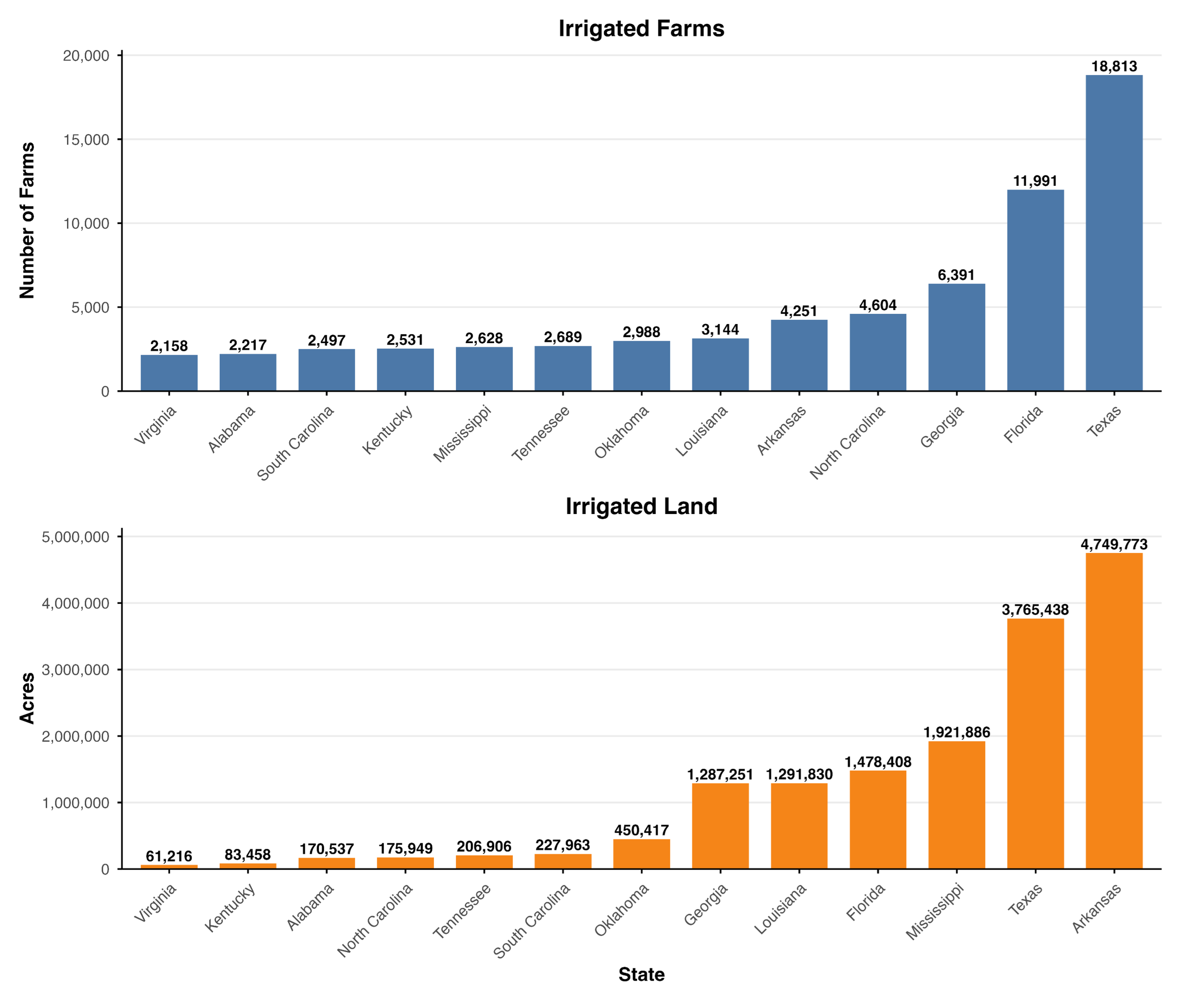
Figure 2. Change in irrigated agricultural land by county, 1997-2022.
References
U.S. Department of Agriculture, National Agricultural Statistics Service. 2022. 2022 Census of Agriculture. https://www.nass.usda.gov/AgCensus/
U.S. Department of Agriculture, Economic Research Service. 2022. Trends in Irrigated Agriculture Reveal Sector’s Ability To Adapt to Evolving Climatic, Resource, and Market Conditions. Amber Waves. https://www.ers.usda.gov/amber-waves/2022/january/trends-in-irrigated-agriculture-reveal-sector-s-ability-to-adapt-to-evolving-climatic-resource-and-market-conditions
U.S. Department of Agriculture, Economic Research Service. 2026. Irrigation & Water Use. https://www.ers.usda.gov/topics/farm-practices-management/irrigation-water-use/
Bové, J. M. 2006. Huanglongbing: A destructive, newly-emerging, century-old disease of citrus. Journal of Plant Pathology 88(1): 7-37.
Hornbeck, Richard, and Pinar Keskin. 2014. The Historically Evolving Impact of the Ogallala Aquifer: Agricultural Adaptation to Groundwater and Drought. American Economic Journal: Applied Economics 6(1): 190-219.
Ward, Frank A., and Manuel Pulido-Velazquez. 2008. Water Conservation in Irrigation Can Increase Water Use. Proceedings of the National Academy of Sciences 105(47): 18215-18220.
Recommended citation format: Sun, Falin, and Sunjae Won. “Irrigation Footprints Across the Southern Region.” Southern Ag Today 6(41.1). October 5, 2026. Permalink