Last month, President Trump announced a plan to allow 300,000 metric tons of beef to enter the United States over a 90-day period without being subject to out-of-quota tariffs. The plan was part of a broader effort to lower beef prices for consumers. We are now more than a month into the 90-day window and have enough data to examine how much beef has actually been imported under the plan.
The import plan is divided into three monthly tranches, with a new 100,000 metric ton tariff-rate quota (TRQ) available each month. Importantly, this new quota does not apply to beef coming from countries that already have their own treatment under the existing U.S. beef import system. Canada and Mexico are not subject to the beef TRQ, while Argentina, Australia, New Zealand, and Uruguay have country-specific quotas.
U.S. Customs and Border Protection reports weekly imports entered under the “Affordable Beef” quota. As of September 8, 15,370 metric tons had entered under the first 100,000 metric ton tranche. That total increased to 22,156 metric tons by September 14, 31,129 metric tons by September 21, and 37,486 metric tons by September 28. Thus, 37.5% of the first tranche had been filled by the end of September, leaving approximately 62,514 metric tons of the initial 100,000 metric ton allocation unused.
Beyond the obvious observation that the first tranche was well below its allocated quantity, the more important question is how much of the beef imported under the new quota represents beef that would not have otherwise entered the United States. In other words, how much of it is actually “new beef”? As we discussed when the plan was first announced, some beef entering under the Affordable Beef quota may have already been expected to enter the U.S. market but can now do so under the expanded quota rather than being subject to the out-of-quota tariff. Separating those imports from truly additional imports is important for understanding how much the policy has actually increased U.S. beef supplies.
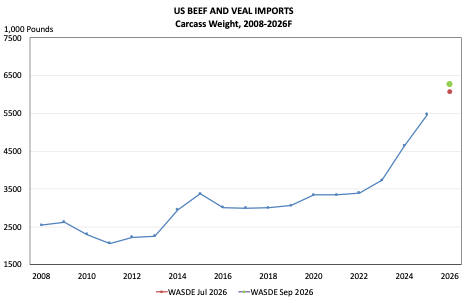
The first graph in this article shows annual U.S. beef and veal imports, along with USDA’s 2026 forecasts from the July WASDE, before the plan was announced, and the September WASDE, after the plan was announced. Between July and September, USDA increased its 2026 beef import forecast by 64,455 metric tons on a product-weight basis. That increase is equivalent to about 21% of the 300,000 metric tons included in the Affordable Beef plan. If we apply that same 21% to the 37,486 metric tons imported under the Affordable Beef quota through September 28, approximately 8,054 metric tons would represent beef that was not already expected to enter the United States this year.
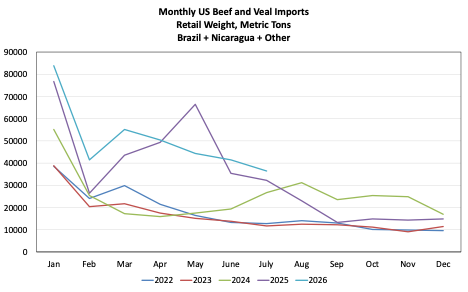
Another way to estimate the amount of new beef is to compare September imports with what the countries eligible to use the Affordable Beef quota have historically shipped to the United States. The second graph shows monthly beef imports from Brazil, Nicaragua, and a group we refer to as “Other Countries.” From 2022 through 2025, September imports from these countries averaged 15,550 metric tons. Through September 28 of this year, 37,486 metric tons had entered under the Affordable Beef quota, or 21,936 metric tons more than the previous four-year September average. This means the amount of “new beef” was considerably larger than the estimate based on the change in USDA’s annual import forecast, but still well below the 100,000 metric tons available under the first tranche of the policy.
There is not a great way to determine exactly how much additional beef this plan from the Trump administration will bring into the United States. The two approaches we used estimate that between 8,054 and 21,936 metric tons were imported in September that would not have otherwise been imported. Of course, both estimates rely on a set of assumptions and use data from the Commodity Status Report, which is subject to change before USDA-ERS publishes its monthly beef trade data.
The main point is that 100,000 metric tons of new beef imports did not materialize in September, and there was no noticeable change in retail beef prices. Even imported beef still has to undergo further processing and move through the marketing system before it is sold to consumers. Increasing the amount of beef that can enter the United States does not mean that the full amount will be imported, nor does it mean that any increase in imports will immediately translate into lower retail beef prices.
Recommended citation format: Mitchell, James. “A Shipload of Beef? Examining the First Tranche of Imports.” Southern Ag Today 6(41.2). October 6, 2026. Permalink