It is not news that Brazil is a powerhouse in agricultural production, especially in soybeans and corn. What may be news for some is that these two crops are strongly linked in Brazil through double cropping. About 80% of Brazil’s corn production happens as a second season corn crop, known as safrinha, immediately after the first crop (usually soybeans) is harvested. However, corn being planted as a second crop is more exposed to weather risk in the most sensitive growth stages of the plant (flowering and grain filling), so it is crucial that it is planted within the low-risk window, and that the first crop is harvested on time. With a record El Niño forming, the question for 2027 is whether the safrinha will be planted on time.
In Mato Grosso (Brazil’s largest corn-producing state), soybeans are planted mostly from mid-September through October and harvested mostly in January and February. However, the low-risk window to plant safrinha, defined by Brazil’s official agricultural climate risk zoning (ZARC), ends between early February and mid-March, depending on the region and the soil.
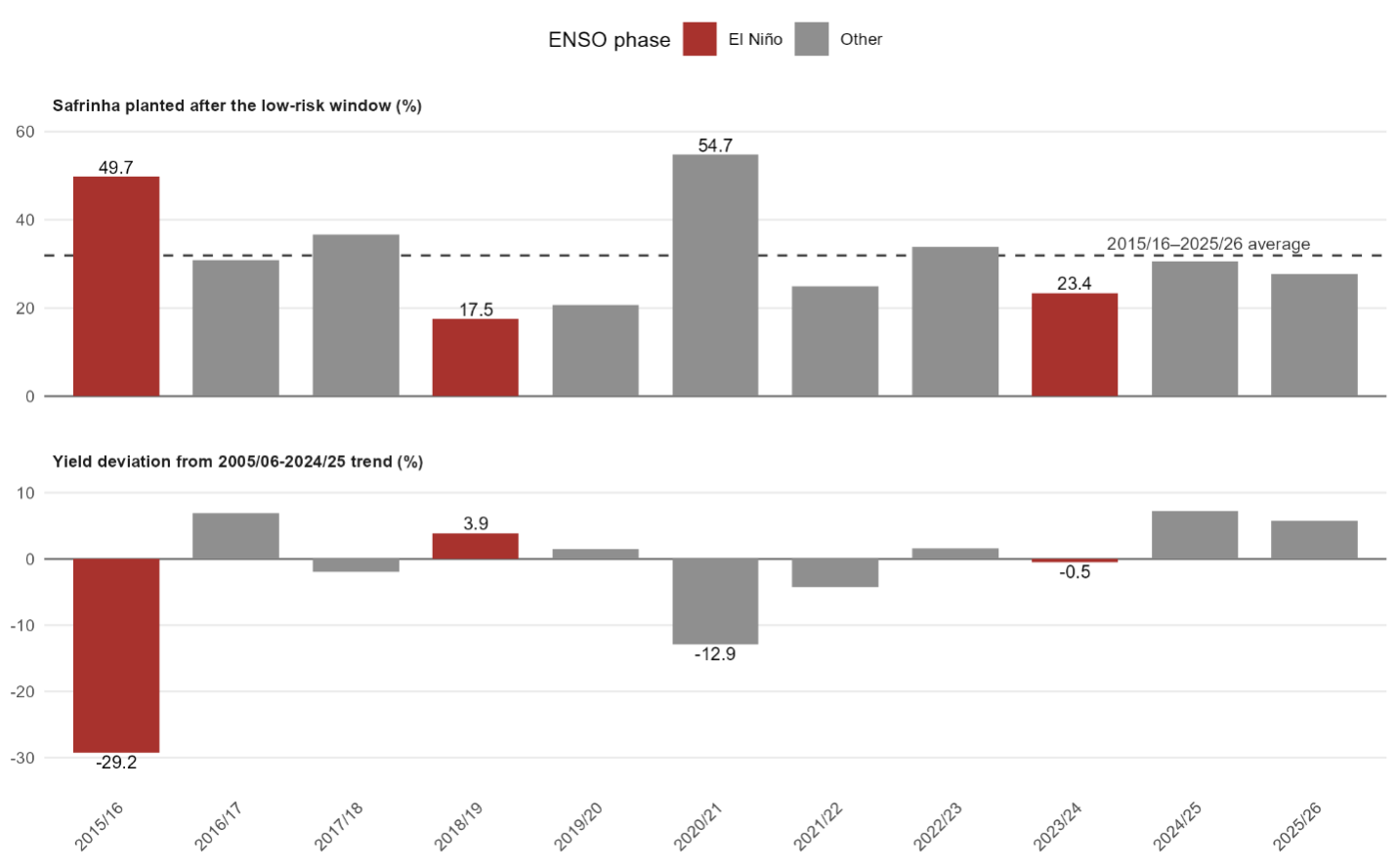
According to the National Oceanic and Atmospheric Administration (NOAA), there is a 75% chance that the current El Niño will be the strongest recorded since 1950 for the October through December period, which coincides with Brazil’s soybean planting. If the consistency of rainfall is affected by this phenomenon, it can delay soybean planting, especially because most of the soybean area in Brazil is rainfed. If soybean planting is delayed, it may push safrinha corn planting to later dates, which could be after the low-risk window closes. Figure 1 shows the share of safrinha area planted after the low-risk window and the yields compared with the trend for each season in Mato Grosso.
In a typical season, about 3 in 10 hectares of safrinha in Mato Grosso are planted after the low-risk window (Figure 1). In the 2015/16 season, the last very strong El Niño, almost half of the safrinha area was planted after the window. Planting was also heavily delayed in 2020/21, a La Niña year: almost 55% of the area was planted after the low-risk window. In both years, we had a significant decrease in yields compared with the trend: a 29% reduction in 2015/16, and almost 13% in 2020/21. In the other nine seasons, yields stayed near the trend. In 2015/16, El Niño also affected the growing season, which may have compounded the effect of delayed planting: rains that usually last until late May stopped in April, when most of the corn in Mato Grosso was flowering and filling grain (Agrolink, 2016a, 2016b).
However, El Niño does not always delay the safrinha. In 2018/19 and 2023/24, weaker El Niño seasons, only 18% and 23% of the area, respectively, were planted after the window, and yields were at or above the trend. What matters is whether the rains start late, which El Niño makes more likely, but does not guarantee.
Figure 1. Share of Safrinha Corn Area Planted after the Low-Risk Window (Upper Panel) and Yield Deviation from the 2005/06–2024/25 Linear Trend (Lower Panel), Mato Grosso, 2015/16–2025/26
If the 2026/27 El Niño affects the soybean planting and harvesting time, pushing safrinha to be planted after the low-risk window, Brazil may have lower yields again. This can impact global prices and quantities as most of Brazil’s corn exports come from the safrinha, which competes directly with U.S. corn in the second half of the year. If the El Niño effects last for more than just the soybean season, reaching the safrinha growing season, the effect may be even larger. It is still too early to say what the effects of this El Niño will be, but three numbers are worth watching: soybean planting in Mato Grosso by October 31 (in 2015/16 and 2020/21, it was below 60%), the soybean harvest by February 20, and rainfall in April, when the safrinha is flowering.
REFERENCES
Agrolink. (2016a, April). MT/milho: Corte de chuvas vai se confirmando [MT/corn: Rain cutoff is being confirmed]. https://www.agrolink.com.br/noticias/mt-milho–corte-de-chuvas-vai-se-confirmando_349436.html
Agrolink. (2016b, May 29). Milho/MT: Plantio tardio, colheita “precoce” [Corn/MT: Late planting, “early” harvest]. Reprinted from Diário de Cuiabá. https://www.agrolink.com.br/noticias/milho-mt–plantio-tardio–colheita–precoce-_355851.html
Companhia Nacional de Abastecimento (Conab). (2026a, August 13). Acompanhamento da safra brasileira de grãos: Safra 2025/26, 11º levantamento [Brazilian grain crop monitoring: 2025/26 season, 11th survey]. https://www.gov.br/conab/pt-br/atuacao/informacoes-agropecuarias/safras/safra-de-graos/boletim-da-safra-de-graos/11o-levantamento-safra-2025-26/e-book_boletim-de-safras-11o-levantamento_2026.pdf
Companhia Nacional de Abastecimento (Conab). (2026b). Séries históricas das safras: Milho 2ª safra [Historical crop series: Second-crop corn] [Data set]. Retrieved September 28, 2026, from https://www.gov.br/conab/pt-br/atuacao/informacoes-agropecuarias/safras/series-historicas/graos/milho/milho2aseriehist.xls/view
Instituto Brasileiro de Geografia e Estatística (IBGE). (2026). Produção Agrícola Municipal, Tabela 839: Área plantada de milho 2ª safra [Municipal Agricultural Production, Table 839: Second-crop corn planted area] [Data set]. SIDRA. Retrieved September 28, 2026, from https://sidra.ibge.gov.br/tabela/839
Instituto Mato-Grossense de Economia Agropecuária (Imea). (2026). Boletins semanais e estimativas de safra de milho, safras 2015/16 a 2025/26 [Weekly corn bulletins and crop estimates, 2015/16 to 2025/26 seasons].
Ministério da Agricultura e Pecuária (MAPA). (2026). Zoneamento Agrícola de Risco Climático (ZARC): Milho 2ª safra, Mato Grosso, safra 2026/27 [Agricultural climate risk zoning: Second-crop corn, Mato Grosso, 2026/27 season]. Retrieved September 28, 2026, from https://www.gov.br/agricultura/pt-br/assuntos/riscos-seguro/programa-nacional-de-zoneamento-agricola-de-risco-climatico/portarias/safra-vigente/mato-grosso
NOAA Climate Prediction Center. (2026a, September 10). ENSO diagnostic discussion.https://www.cpc.ncep.noaa.gov/products/analysis_monitoring/enso_advisory/ensodisc.shtml
NOAA Climate Prediction Center. (2026b). Relative Oceanic Niño Index (RONI) [Data set]. Retrieved September 29, 2026, from https://www.cpc.ncep.noaa.gov/data/indices/RONI.ascii.txt
Recommended citation format: Pinto, Bruno. “El Niño and Brazil’s Second-Season Corn: Should We Be Concerned?” Southern Ag Today 6(42.3). October 14, 2026. Permalink