Stumpage price trends
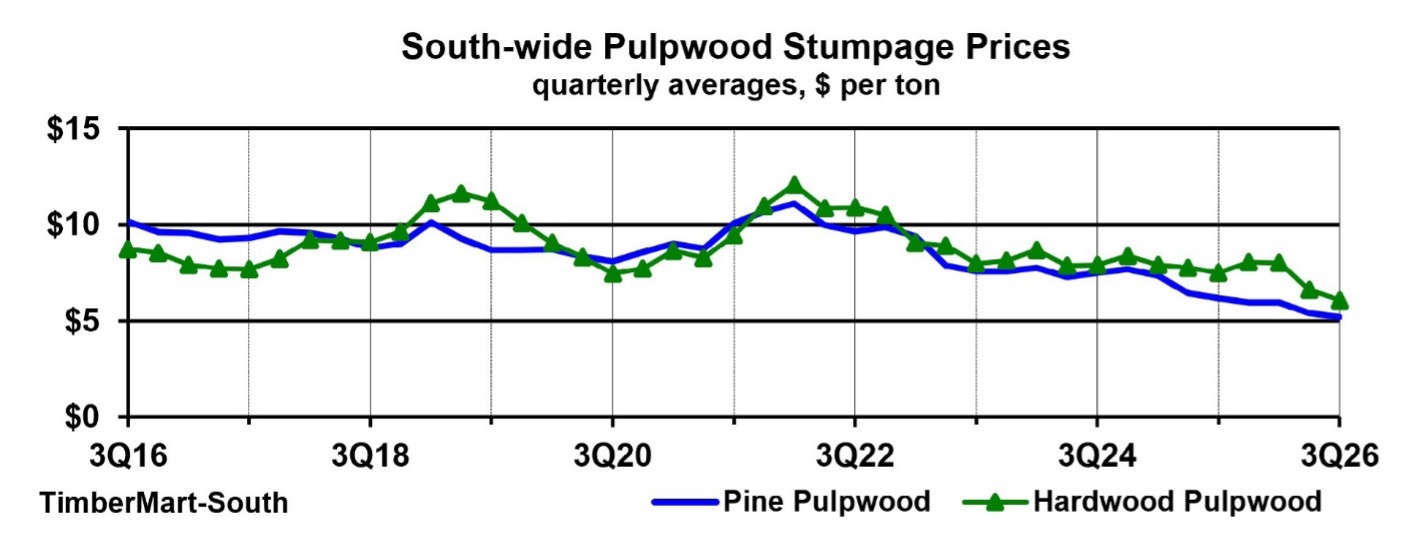
Across the southern region, stumpage prices for pine and hardwood sawtimber edged up in the third quarter (Q3) of 2026, while pulpwood prices continued to decline (Figure 1). Pine sawtimber averaged just under $24/ton, up 2% quarter-over-quarter but down 5% year-over-year and 14% below its early 2022 peak (TimberMart-South, 2026). Hardwood sawtimber averaged slightly above $31/ton, down 5% year-over-year. The average pine chip-n-saw price declined to $16.50/ton, down 8% year-over-year and 21% below its recent peak in 2022.
Pine pulpwood prices continued to decline for the 7th consecutive quarter, dating back to Q1 2025. The average price was just over $5/ton, down 4% quarter-over-quarter and 16% year-over-year. It was less than half of its recent high in 2022. Hardwood pulpwood remained relatively stable until early 2026, then fell more than 24%, averaging slightly above $6/ton in Q3 2026 and narrowing the price gap between hardwood and pine pulpwood.
Figure 1. South-wide pulpwood stumpage prices, Q3 2016 –Q3 2026.
Source: TimberMart-South, 2026.
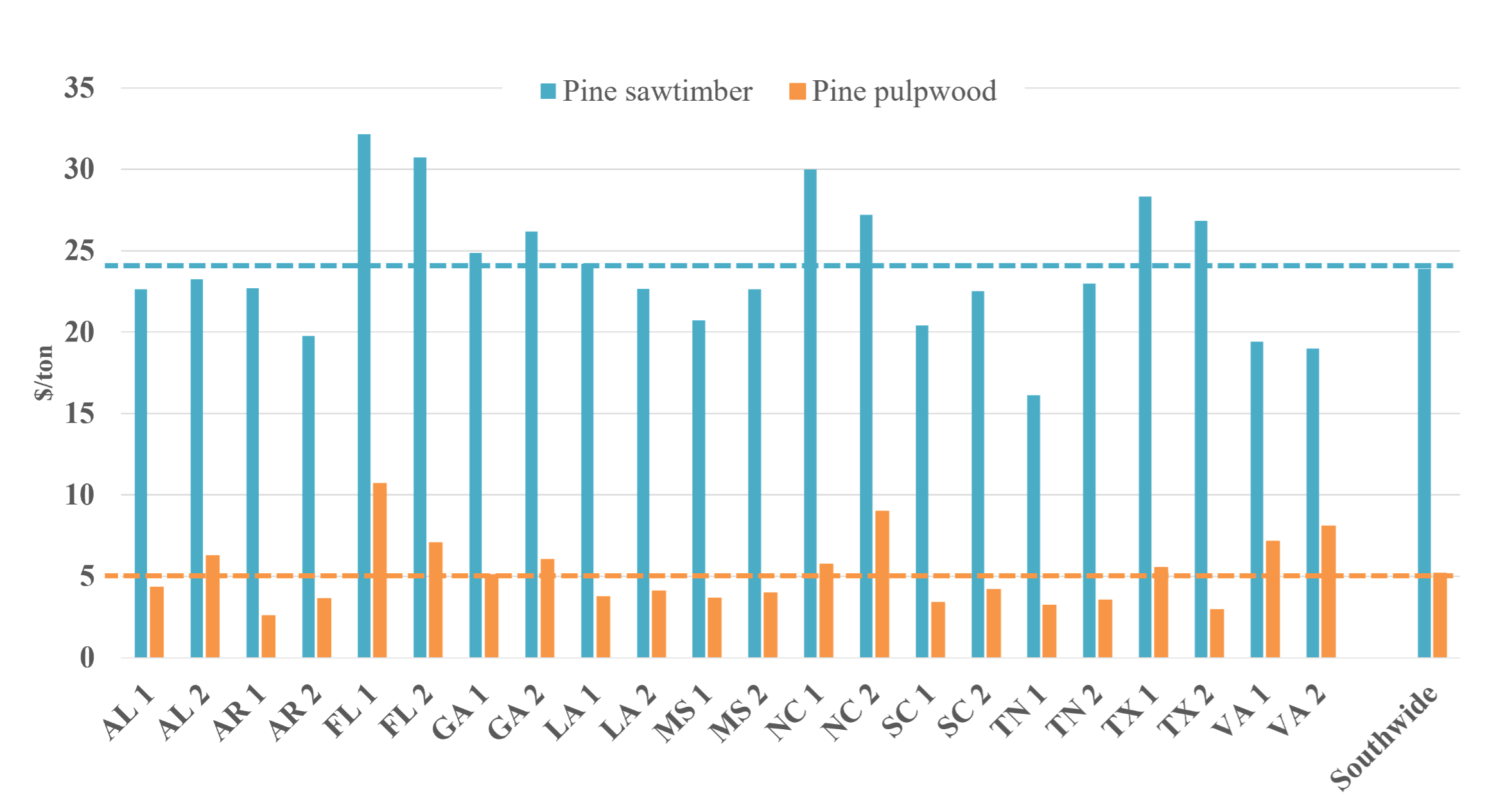
Stumpage prices varied widely across states and subregions. In Q3 2026, pine sawtimber prices ranged from $16-19/ton in eastern Tennessee and Virginia to more than $30/ton in Florida and western North Carolina (Figure 2). Year over year, prices fell most sharply in eastern Tennessee (-23%), northern Arkansas (-18%), northern Mississippi (-15%), North Carolina (-11%), and Virginia (-10%). In contrast, prices increased in northern Georgia (+13%), southeast Texas (+13%), northeastern Florida (+8%), and southern Louisiana (+7%).
Figure 2. Average pine sawtimber and pulpwood stumpage prices by state and subregion, Q3 2026
Data source: TimberMart-South (2026)
In Q3 2026, pine pulpwood prices ranged from $2-3/ton in southern Arkansas and Tennessee to $9-11/ton in north-central Florida and eastern North Carolina (Figure 2). Compared with a year earlier, prices fell sharply in South Carolina (-37%), northern Louisiana (-37%), southern Georgia (-36%), southern Arkansas (-32%), and northern Alabama (-28%). Most other regions experienced declines of approximately 10-25%.
Factors behind price trends
Weak pine sawtimber prices reflect a stagnant housing market and an oversupply of sawtimber in some wood baskets. In September 2026, single-family housing starts, a key demand driver for pine sawtimber and structural panels, were at a seasonally adjusted annual rate of 859,000 units, below the long-term benchmark of 1.1 million units associated with a healthy economy (U.S. Census Bureau, 2026). Housing construction continues to face affordability challenges, high construction and financing costs, labor shortages, and zoning restrictions. The 21st Century ROAD to Housing Act, enacted on July 11, 2026, includes provisions intended to reduce regulatory barriers to housing construction and expand housing supply. However, it remains uncertain how much these policies translate into stronger homebuilding activity, greater lumber demand, and ultimately higher timber demand.
Landowners who have deferred harvesting for several years may need to reassess their expectations and recognize that prices may not return to the levels above $40/ton seen before the 2008-2009 financial crisis. Further delays may allow trees to grow beyond the preferred size specifications of some sawmills, potentially resulting in lower stumpage prices.
The continued decline in pine and hardwood pulpwood prices reflects structural changes in the pulp and paper industry, including shifts in product demand, increased use of recycled fiber, mill modernization, rising wood pulp imports, and relocation to lower-cost regions. These trends have intensified in the past three years, reducing regional pulpwood demand and putting downward pressure on pulpwood stumpage prices. Between 2023 and 2025, more than 10 major pulp facilities in the South closed, eliminating over 25 million tons of annual fiber demand and significantly reshaping regional pulpwood markets (Winn et al., 2026; Forisk, 2026).
Landowners in areas affected by recent mill closures may need to reassess their long-term management strategies in response to reduced pulpwood demand. Potential adjustments may include reducing planting density for reforestation or delaying thinning.
Major takeaways
Southern sawtimber prices remained relatively flat or lower in many wood baskets of the region, while pulpwood prices continued to fall across much of the South. Persistent weakness in housing demand and structural changes in the pulp and paper industry continue to challenge timber markets. Landowners may consider reassessing harvest timing and forest management strategies in light of local stumpage price trends, mill demand, stand conditions, and long-term management objectives.
References
Forisk. 2026. Forisk North American forest industry capacity database. Athens, GA.
TimberMart-South. 2026. Market news quarterly. Athens, GA.
U.S. Census Bureau. 2026. Monthly new residential construction. https://www.census.gov/construction/nrc/index.html
Winn, M., J. Gray, and J. Cooper. 2026. Southern pulpwood production, 2024. Asheville, NC.https://doi.org/10.2737/SRS-RB-250
Li, Yanshu. “Southern Timber Market Update.” Southern Ag Today 6(44.1). October 26, 2026. Permalink