
Authors: Natalie Stewart and Hank Nelson
Beginning in 2027, producers can purchase multiple area-wide crop insurance endorsements that cover a portion of the deductible on their underlying policy: Hurricane Insurance Protection – Wind Index (HIP-WI), the Supplemental Coverage Option (SCO), and the Enhanced Coverage Option (ECO). SCO and ECO follow the underlying Revenue Protection (RP) or Yield Protection (YP) policy, with liability based on the producer’s individual APH, but indemnities are triggered by county-level losses. SCO covers the band from 90% down to the underlying coverage level, and ECO covers 95% to 90%. HIP-WI is triggered by county-level hurricane and tropical storm winds and covers the band from 95% down to the underlying coverage level. Details of HIP-WI were covered in a recent Southern Ag Today article: HIP-WI Basics and Trends.
Before 2027, producers could pair HIP-WI with SCO, but HIP-WI coverage was cut back to the band between 95% and the top of SCO coverage. HIP-WI and ECO could not be combined at all. The complaint was that the policies cover different losses – HIP-WI covers an extreme weather event, while SCO and ECO cover yield and/or price losses (depending on the underlying policy). When HIP-WI triggers, it pays the full HIP-WI coverage band regardless of individual losses, whereas SCO and ECO pay only to the extent county yield or revenue falls below the trigger. However, HIP-WI triggers less often and does not cover other types of losses. The choice was not entirely either/or, though – a storm strong enough to trigger HIP-WI could reduce county yields, so SCO and ECO may still pay in a hurricane year, but not necessarily as much as HIP-WI. In summary, coastal producers were essentially choosing between a potentially larger but less likely payment in HIP-WI, and a more likely one in SCO/ECO.
RMA data from 2020 to 2025 show that for counties in which both HIP-WI and SCO were available, SCO paid out more often than HIP-WI. Across corn, soybeans, cotton, and wheat, SCO triggered on 34% to 46% of policies, compared to 4% to 14% for HIP-WI – roughly three to eight times as often. These results indicate only that an indemnity was received, not the amount paid out for each endorsement (USDA RMA 2026a, 2026b, 2026c). Although SCO has historically paid more often, in practice producers have tended to give up SCO in favor of HIP-WI, prioritizing hurricane protection over coverage for more common county-level losses.
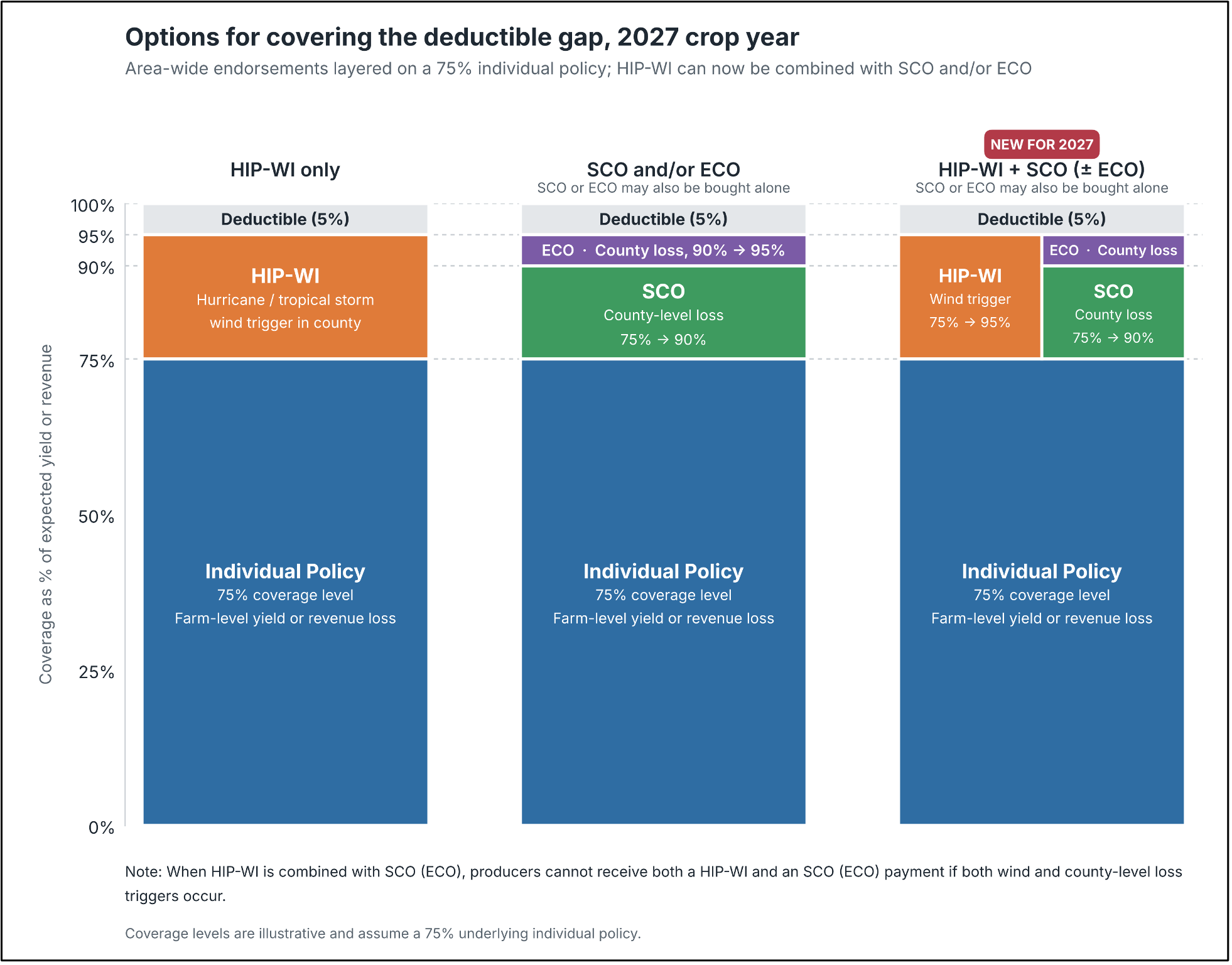
For 2027, producers can purchase HIP-WI with SCO and/or ECO, allowing HIP-WI to cover the same portion of the deductible as SCO and ECO. Producers will pay separate premiums for each policy, but if HIP-WI triggers, they are not eligible for SCO or ECO indemnities – the current industry expectation is that producers cannot receive payments from two policies covering the same portion of the deductible. This is illustrated in Figure 1.
Combining area-wide endorsements gives producers in counties where HIP-WI and SCO are available protection from multiple types of losses. Limiting payment to one policy for each portion of the deductible eliminates the concern that combining policies would allow producers to be paid twice for the same coverage. Producers should weigh the cost of paying both premiums against the value of having both types of protection. Once RMA releases full details, producers should review the rules with their crop insurance agent before making coverage decisions for 2027.
Figure 1. Combining Area-Wide Endorsements for 2027
References
U.S. Department of Agriculture, Risk Management Agency (RMA). 2026a. “Hurricane Insurance Protection–Wind Index Rates and Triggering Events Reports, 2020–2025.” Washington, DC. Accessed October 27, 2026.
———. 2026b. “Supplemental Coverage Option County Yields and Revenues, 2020–2025.” Washington, DC. Accessed October 27, 2026.
———. 2026c. “Cause of Loss Historical Data Files, 2020–2025.” Washington, DC. Accessed October 27, 2026.
Stewart, Natalie, and Henry Hank Nelson. “Combining SCO, ECO, and HIP-WI for 2027.” Southern Ag Today 6(44.4). October 29, 2026. permalink