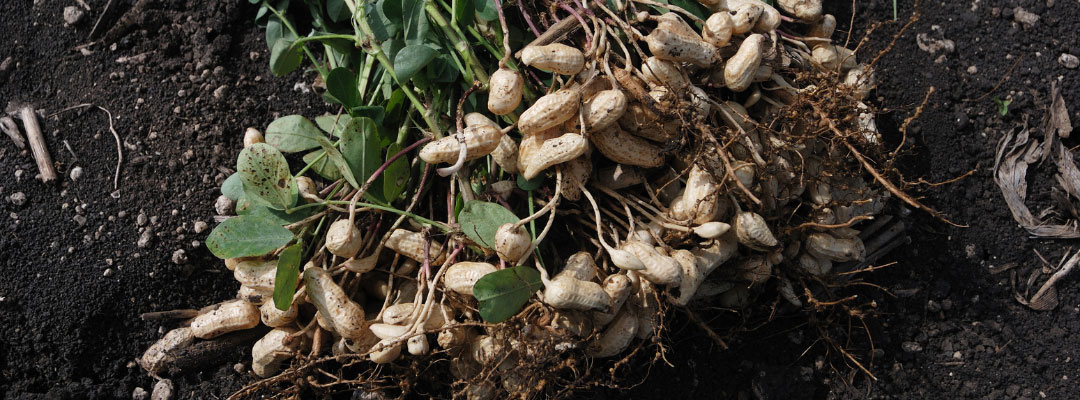
Peanut farmers are in the middle of peanut harvest with over 50 percent of U.S. peanuts harvested. Near-term needs should be covered due to a record carryover from the near-record 2025 crop of 3.55 million tons (8,400 tons shy of the 2017 record). Harvest is a little behind average because of later plantings and a short stoppage in the Southeast due to Hurricane Isaias. The October U.S. Department of Agriculture (USDA) Crop Production report projects total U.S. production to be 2.56 million tons, nearly a million tons (28%) less than 2025 (Figure 1). The projected yield is about the same as last year at 3,766 pounds per acre. Projected yields have fallen throughout the 2026 crop year due to hot and dry weather in parts of the peanut belt.
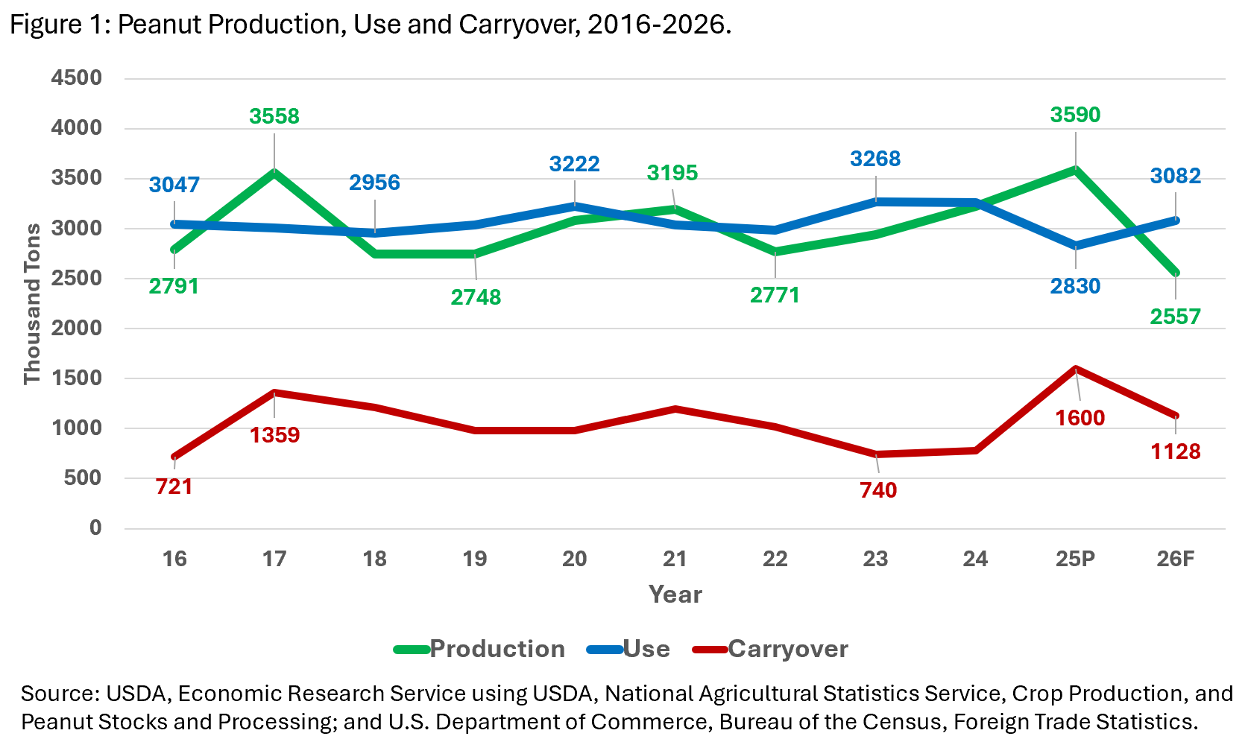
Consumption of peanuts may be described as fairly steady—compared to production from 2016 to 2024—ranging from a low of 2.96 million tons in 2018 to a high of 3.27 million tons in 2023 (Figure 1). However, peanut disappearance dropped to a low of 2.83 million tons during the 2025/26 marketing year while supply jumped to an all-time high, according to the USDA October Oil Crops Outlook report. Shelled edible peanut use was down across the board for peanut butter, candy, and snack categories, according to the August USDA Peanut Stocks and Processing report. Total consumption in 2025/26 is estimated by USDA to be down by 13.3%, largely due to a seed and residual use that decreased by about 658,000 tons from 2024/25. The seed and residual use estimate of 63,000 tons for the 2025/26 marketing year is a bit confusing, as it appears not to be enough to meet seed needs to plant 1.4 million acres in 2026. The drop in consumption and record supply resulted in record carryover stocks for the 2026/27 marketing year, and the buyers of shelled peanuts are now waiting to see the size and quality of the 2026 crop.
Peanut farmers responded to lower spring contract prices by cutting acres by 28%. With peanut production expected to be the lowest since 2013, peanut prices for uncontracted peanuts are expected to rebound some in areas with a short crop. The global supply of peanuts is down, resulting in U.S. exports remaining about the same as last year. Total U.S. consumption is projected to rebound to 3.1 million tons for the 2026/27 marketing year. Domestic consumption, however, has yet to show an improvement. The supply side has responded to low prices. Farmers are hoping the demand side will respond with more consumption.
References:
U.S. Department of Agriculture, Economic Research Service (USDA-ERS). “Oil Crops Outlook: October 2026.” October 14, 2026. https://www.ers.usda.gov/publications/115629.
U.S. Department of Agriculture, National Agricultural Statistics Service (USDA-NASS). “Crop Production.” October 9, 2026. https://esmis.nal.usda.gov/publication/crop-production.
U.S. Department of Agriculture, National Agricultural Statistics Service (USDA-NASS). “Crop Progress.” November 2, 2026. https://esmis.nal.usda.gov/publication/crop-progress.
U.S. Department of Agriculture, National Agricultural Statistics Service (USDA-NASS). “Peanut Stocks and Processing.” August 26, 2026. https://esmis.nal.usda.gov/publication/peanut-stocks-and-processing.
Recommended citation format: Smith, Nathan. “Will Supply or Demand Forces Drive Peanut Prices Post-Harvest?” Southern Ag Today 6(45.3). November 4, 2026. Permalink