Authors: K. Aleks Schaefer Associate Professor of International Markets, Trade and Policy and Morgan Ritz, Master of International Agriculture Program, Oklahoma State University
Brazilian President Luiz Inácio Lula da Silva’s reelection surprised financial markets following a closely contested presidential election against Flávio Bolsonaro. The reaction was immediate. Brazilian stocks fell sharply, and the country’s currency, the real, declined more than eight percent against the U.S. dollar.
For U.S. farmers, those developments matter because Brazil is one of the United States’ largest competitors in global agricultural markets, particularly for soybeans. Lula’s reelection could affect that competition through two different channels: a weaker Brazilian currency (real) that makes Brazilian exports more competitive in the short run, and environmental policies that could influence how rapidly Brazilian agriculture expands over the longer run.
The exchange rate effect is the more immediate concern. Soybeans are traded internationally in U.S. dollars, while Brazilian farmers pay many of their costs and measure their returns in Brazilian reais. When the real weakens relative to the dollar, each dollar earned from soybean exports translates into more reais.
That can make exporting more attractive to Brazilian producers and allow Brazilian soybeans to remain profitable at lower dollar-denominated prices. For major importers such as China, that can make Brazilian soybeans more competitive relative to soybeans produced in the United States.
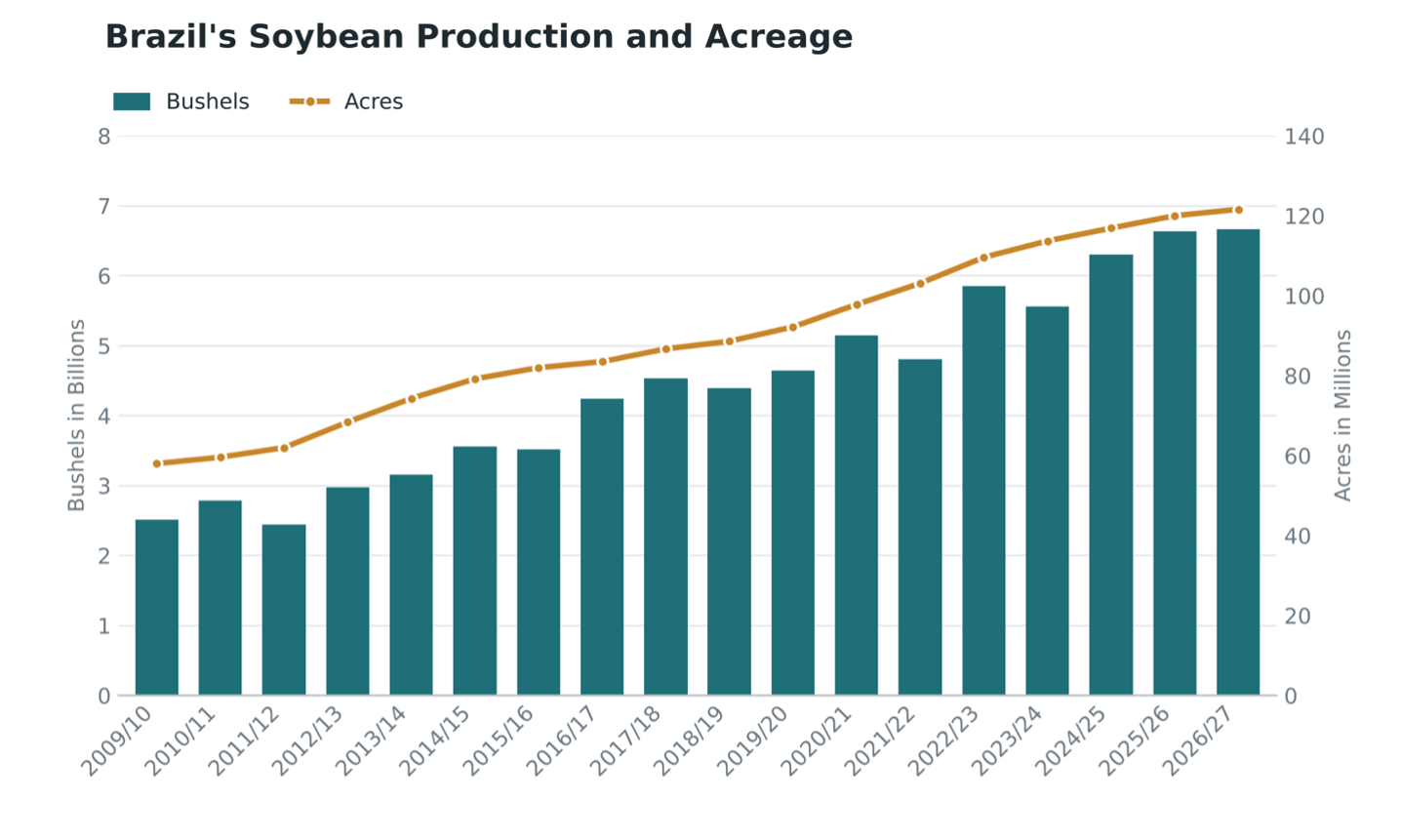
This matters because Brazil’s soybean sector has already expanded dramatically. As Figure 1 shows, both soybean acreage and production have increased substantially during the past decade.
Figure 1. Soybean Acreage and Production in Brazil
Source: Conab, Série Histórica – Soja and Safra 2026/27, 1º Levantamento
Brazil produced a record soybean crop of roughly 6.6 billion bushels during the 2025-26 crop year, and production is expected to reach another record in 2026-27. Current estimates place the 2026-27 crop at approximately 186 million metric tons (6.8 billion bushels), according to USDA.
This growth has not resulted from acreage alone. Brazil has also invested heavily in agricultural technology, transportation, storage, and other infrastructure. Nevertheless, continued increases in planted area have been an important part of Brazil’s rise as an agricultural exporter.
That brings up the second potential effect of Lula’s reelection. Lula has made reducing deforestation a central part of his administration’s environmental policy. When he returned to office in 2023, his government announced a goal of eliminating illegal deforestation in the Amazon by 2030. The government has expanded the use of satellite monitoring, enforcement against illegal logging and land clearing, and financial investigations aimed at identifying economic activity connected to illegal deforestation.
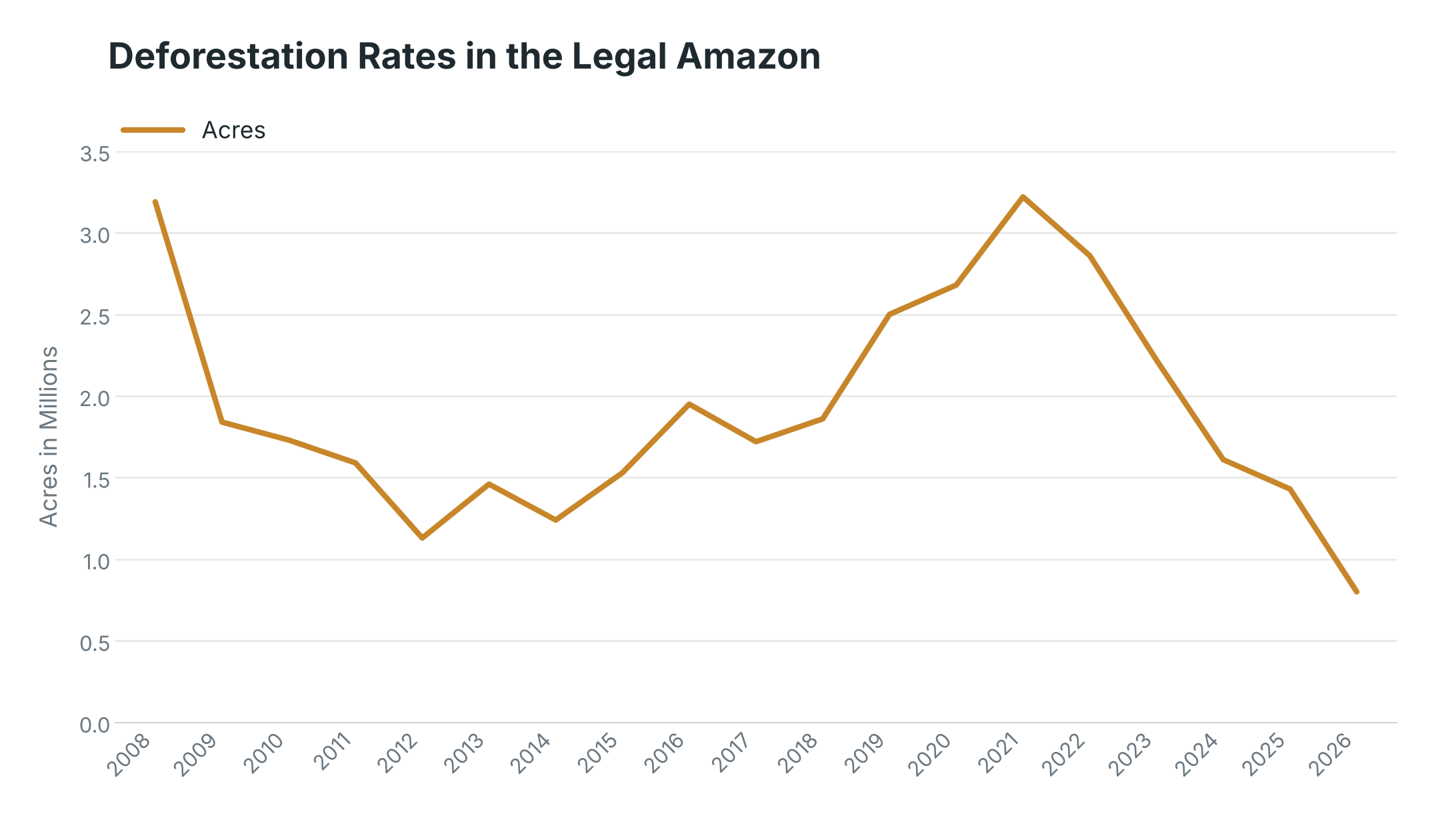
Those efforts appear to be having an effect. Between 2025 and 2026, deforestation in Brazil’s Cerrado fell nearly 24 percent, while Amazon deforestation fell nearly 42 percent. Both reached their lowest levels in their respective monitoring series. Figure 2 shows the longer-term pattern in Brazilian deforestation.
Figure 2. Deforestation in Brazil Over Time
Source: TerraBrasilis Prodes
It would be tempting to conclude that stronger conservation policies will necessarily slow the growth of Brazilian soybean production. The relationship, however, is more complicated.
Brazil has already shown that agricultural production can increase while Amazon deforestation declines. Soybean acreage can expand onto existing pasture or other agricultural land, farmers can increase yields, and production can grow in regions outside the Amazon. As a result, Lula’s environmental policies do not necessarily imply that Brazilian soybean production will stop growing.
Instead, the more important question may be whether Brazil can continue expanding agricultural output at its recent pace without relying on continued conversion of native vegetation.
For U.S. soybean farmers, the near-term implications are clearer than the long-term ones. Brazil is already the United States’ principal competitor in global soybean markets, and a weaker real makes that competition even tougher. Lula’s conservation policies could eventually constrain some forms of agricultural expansion, but they are unlikely to reverse Brazil’s emergence as an agricultural powerhouse.
For now, U.S. soybean producers may therefore feel the effects of Brazil’s election less through Brazilian politics themselves than through something much more familiar: the price of the Brazilian real.
References
Companhia Nacional de Abastecimento (Conab). (2026). Série histórica das safras: Soja [Data set]. Retrieved November 4, 2026, from https://www.gov.br/conab/pt-br/atuacao/informacoes-agropecuarias/safras/series-historicas/graos/soja
Companhia Nacional de Abastecimento (Conab). (2026, October). Acompanhamento da safra brasileira de grãos: Safra 2026/27, 1º levantamento. https://www.gov.br/conab/pt-br/atuacao/informacoes-agropecuarias/safras/safra-de-graos/boletim-da-safra-de-graos
Instituto Nacional de Pesquisas Espaciais (INPE). (2026). TerraBrasilis: PRODES deforestation monitoring [Data set]. Retrieved November 4, 2026, from https://terrabrasilis.dpi.inpe.br/
Keske, J. (2026, October). A weaker real, a stubborn corn market and what U.S. farmers should watch now. Farm Progress. https://www.farmprogress.com/markets-and-quotes/a-weaker-real-a-stubborn-corn-market-and-what-u-s-farmers-should-watch-now
Paraguassu, L., Boadle, A., Porter, M., & Ellis, A. (2023). Brazil’s Lula unveils plan to stop deforestation in Amazon by 2030. Reuters. https://www.reuters.com/world/americas/brazils-lula-launches-plan-stop-deforestation-amazon-by-2030-2023-06-05/
U.S. Department of Agriculture, Foreign Agricultural Service. (2026, October). Oilseeds: World markets and trade. https://apps.fas.usda.gov/psdonline/circulars/oilseeds.pdf