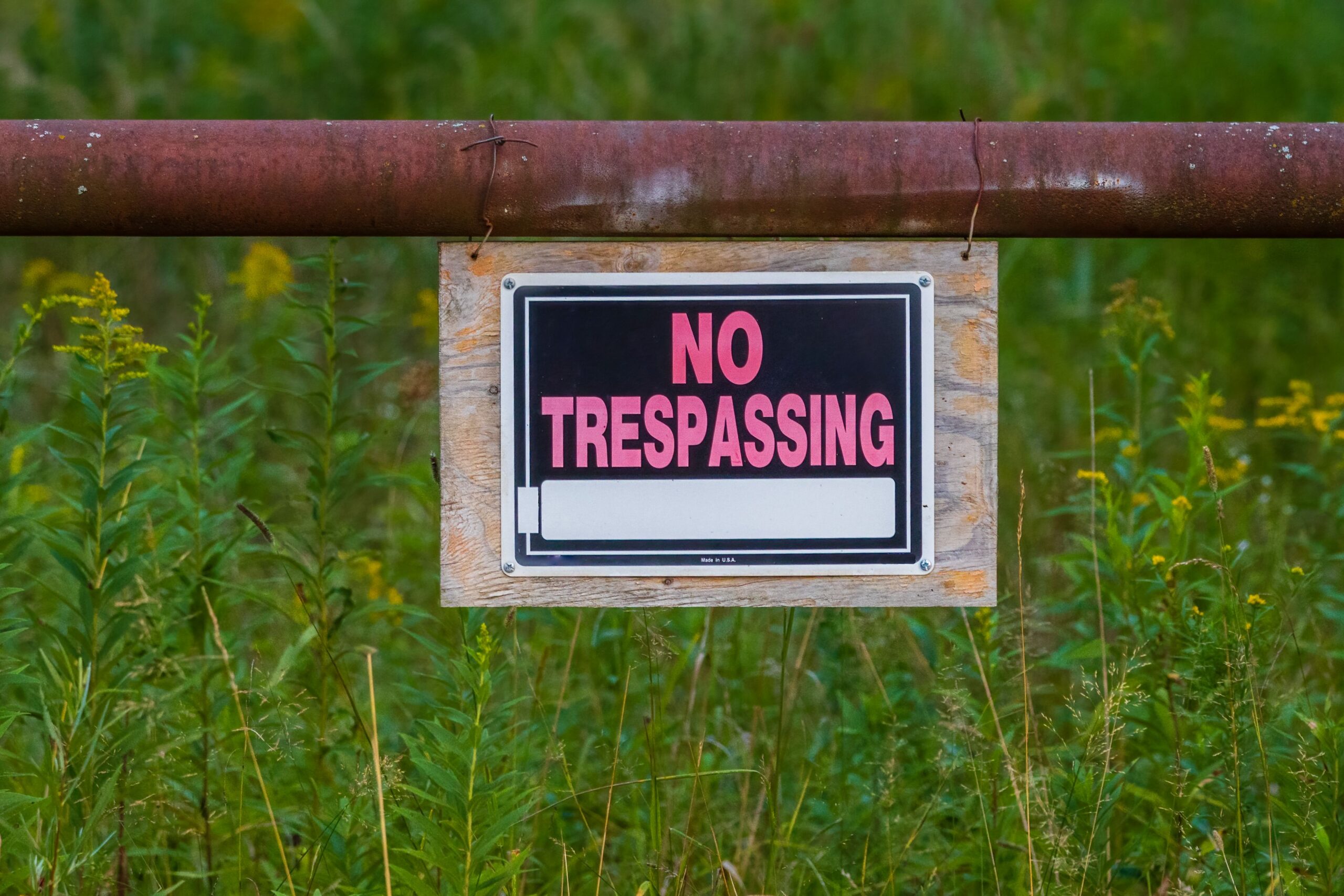
A frequent question that I receive at the National Agricultural Law Center involves trespassers on agricultural property. What steps can, or should, a landowner take to deal with trespassers? The answer, like any good legal answer, always starts with the phrase “it depends.”
First, there is a substantial difference in how the law treats adult trespassers and child trespassers. To learn more about child trespassers, there is a great Southern Ag Today article by Jesse Richardson available here. This article will instead focus on the adult trespassers.
A second issue is whether the person is just a trespasser or whether they are causing an immediate danger to the life of the landowner or other people on the property. We will focus this article solely on the trespassing issue, as there are many other resources on self-defense laws.
Landowners owe trespassers on their property a legal responsibility, called a duty of care. The general duty of care is not to engage in willful or wanton misconduct that injures the trespasser. Basically, this boils down to not shooting them, again, this article assumes that self-defense is not an issue and not setting booby traps.
When presenting on this topic, a suburban or urban crowd asks why people would set up booby traps in the first place, and the rural crowds want to describe the innovative booby traps that they have devised over the years! Police response times tend to be much slower in rural areas because of the vast distances that law enforcement is expected to cover. Rural residents become frustrated after calling law enforcement multiple times about trespassers and law enforcement not having the ability to show up in time to catch the perpetrators. This frustration is often enhanced if the trespasser is poaching or committing theft. This frustration can lead to the landowners resorting to “self-help” which often involves booby traps in some form.
What is a booby trap? This depends on the facts surrounding the incident. Is an electric fence a booby trap? It depends! A hotwire fence to keep cattle in a wheat field is a very common method of fencing and would not be considered a booby trap if it is being deployed as is typical in a given area. A chain-link fence that has 240 volts running through it is a different matter altogether! Both of these are electric fences, but the purpose behind them is what matters.
What about dogs? A Pomeranian lap dog will likely never rise to the level of a booby trap because its sole purpose is to be a pet. An auto parts junkyard where pit bulls are kept, and they are released after closing and then penned back up before the junkyard opens, is different. Those dogs are there to deter or attack people that trespass after hours, so the law will likely treat them much differently than a small Pomeranian dog kept solely as a pet. The facts always matter in these types of cases.
Why does this matter? If a landowner sets up a booby trap, such as a spring gun which is a firearm attached to a tripwire, and that booby trap goes off successfully, then the landowner could potentially be civilly and criminally liable for that action. This means that a landowner could face potential jail time for this action, and the trespasser (or their heirs at law) could, and likely would, sue the landowner for their personal injury damages. Additionally, booby traps are indiscriminate. They will go off whether the trespasser is twenty-eight years of age or eight years of age.
What can a landowner do instead? Technology has provided another option for rural landowners. Landowners can now buy game cameras to set up on their property that will send photos or videos directly to their smartphone when someone crosses over their property line. They can call law enforcement from the comfort of their bed immediately and, because they call them so quickly, the chances of catching the trespasser are higher. Landowners also have evidence that the police can use if the decision is made to bring charges against the trespasser.
Setting booby traps only increases the likelihood that the landowner will be sued or prosecuted themselves. It is frustrating to watch a trespasser come to one’s property repeatedly, but the potential legal exposure of setting booby traps will likely greatly outweigh the value of property that the trespasser could be stealing.
Recommended citation format: Rumley, Rusty. “What can “Legally” be done about trespassers?“ Southern Ag Today 6(45.5). November 6, 2026. Permalink