
Authors: Ruiqing Miao, Professor, Department of Agricultural Economics and Rural Sociology, Auburn University, Bijesh Mishra, Postdoctoral Research Associate, School of Public Policy, Georgia Institute of Technology, Mohit Anand, Professor and Chair, Division of Business and Accounting, Miles College, Madhu Khanna, Distinguished Professor, Institute for Sustainability, Energy and Environment, University of Illinois, Urbana-Champaign, Fahd Majeed, Postdoctoral Research Associate, Institute for Sustainability, Energy and Environment, University of Illinois, Urbana-Champaign
Background
Sustainable aviation fuel (SAF) is a type of aviation fuel that is produced from renewable resources such as animal fats, vegetable oils, grasses, food waste, or agricultural residues. It can be directly used by existing aircraft by blending with conventional jet fuel. SAF has been gaining attention in the United States (U.S.) as European countries and the International Civil Aviation Organization have introduced more stringent environmental regulations. For instance, the European Union (EU)’s ReFuelEU Aviation Regulation requires aviation fuel suppliers at EU airports to supply increasing shares of SAF, from 2% in 2025 to 70% in 2050 (European Commission, n.d.). These regulations also affect U.S. airlines operating international flights from European airports.
To help meet growing international demand for SAF, and to support rural economic development, the U.S. federal government has undertaken various initiatives to encourage domestic SAF production. For instance, the SAF Grand Challenge Roadmap Implementation Framework created by the U.S. Departments of Energy, Transportation, and Agriculture set the goal to produce 3 billion gallons of SAF per year by 2030 and 35 billion gallons per year by 2050 in the United States. Moreover, the One Big Beautiful Bill Act extended the $1/gallon tax credit supporting SAF to December 31, 2029. Currently, the 119th Congress is considering several bills that aim to strengthen support for SAF. As a result, the domestic production of SAF has increased dramatically, from about 5 million gallons in 2021 (USDOE, 2025) to 240 million gallons in 2025 (Bracmort, 2026). With continuing policy support and demand from the aviation industry, the production of SAF in the United States is expected to grow.
An Opportunity for Southern U.S. Farmers
This increasing interest in SAF, both internationally and domestically, presents an opportunity for Southern U.S. farmers as biomass feedstock producers. Although most SAF in the United States is currently produced from used cooking oil, animal fats, or vegetable oils (Commercial Aviation Alternative Fuels Initiative, n.d.), high-yielding perennial grasses, such as miscanthus and switchgrass, are promising sources of biomass feedstock for large scale SAF production (U.S. Department of Energy, 2024). The Southern United States has a comparative advantage in producing these crops due to the relatively high yield potential and low land rent in the region. For instance, the yield of miscanthus and switchgrass in the South can reach about 11 and 6 short tons per acre, respectively—about 10-20% higher than yields in other regions (Miao and Khanna, 2014).
Based on the yield potential of these grasses, row crop yields, and production cost information, a recent study by Miao et al. (2026) estimates that at a biomass price of around $80 per short ton, U.S. farmers, particularly farmers in the South, will find it profitable to supply sufficient feedstock for producing 3 billion gallons of SAF per year, which requires about 65 million tons of biomass annually. The production costs, including establishment costs as well as fixed and variable costs, are around $45 per ton per year. Miao et al. (2026) find that farmers who switch would be better off by up to 7% compared with growing conventional crops.
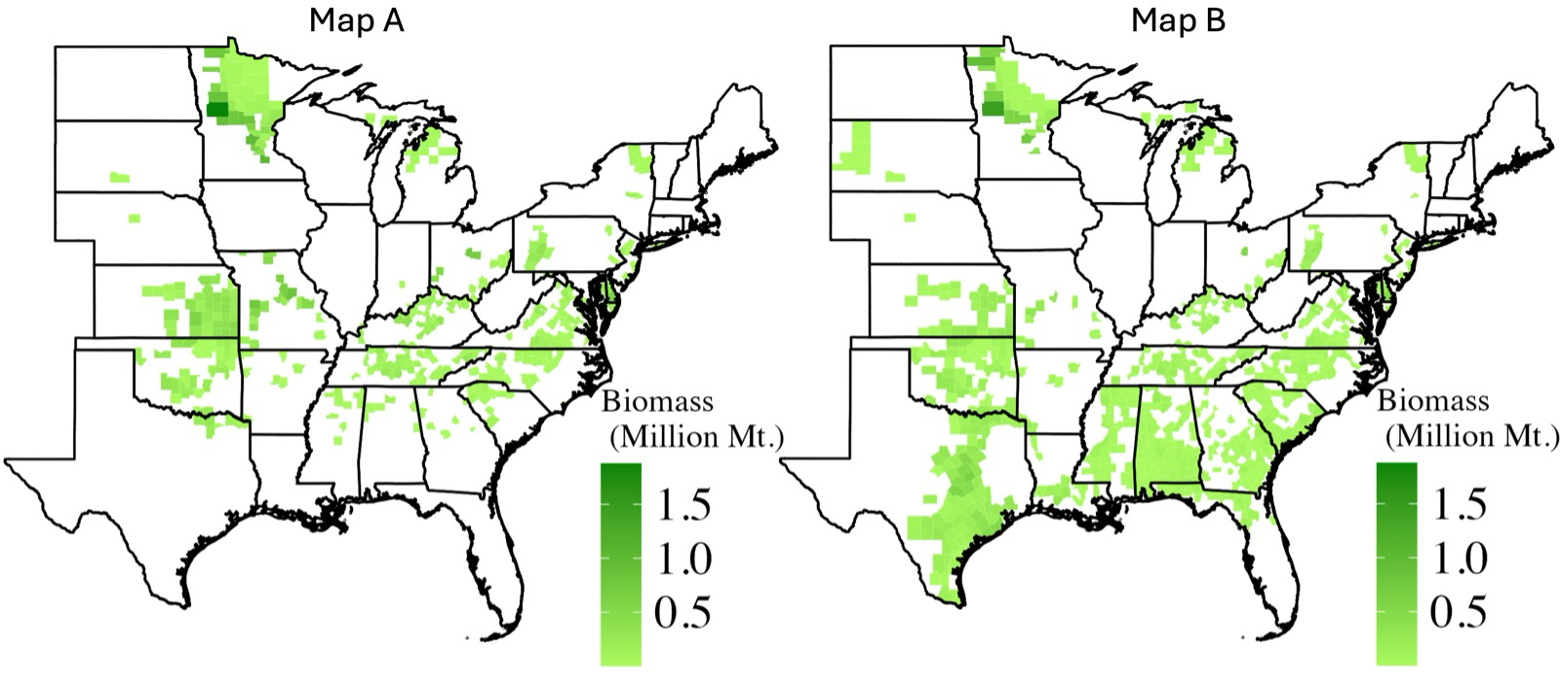
Figure 1 shows that the projected miscanthus (Map A) and switchgrass (Map B) production at this price is located mainly in the South. Due to the high transportation cost of biomass, biorefineries are assumed to locate near the feedstock production area. Little production would be feasible in the Midwest at $80/ton because of the competition from corn and soybeans. Specifically, for miscanthus, the projected production is located mainly in Oklahoma, Kansas, Missouri, Kentucky, Tennessee, North Carolina, and Virginia. For switchgrass, the projected major producing states are the aforementioned states plus Texas, Mississippi, Alabama, Georgia, and South Carolina.
Miao et al. (2026) further show that the projected major producing regions do not vary much with the hypothetical biomass procurement contract types between farmers and biorefineries. Whether it is a fixed-price contract (~$80/ton), a revenue-sharing contract (farmers receive about 35% of revenue from selling SAF), or a land-leasing contract (farmers receive about $180-$190/acre per year of rent from biorefineries), the producing areas are very similar to those shown in Figure 1. Crop insurance for bioenergy crops, if offered by the Risk Management Agency of the U.S. Department of Agriculture, can help farmers manage production risk and facilitate the establishment of the biomass supply chain.
Why Might This Time Be Different?
One may recall that, back in the late 2000s and early 2010s, anticipated cellulosic biofuel development provided potential market opportunities for miscanthus and switchgrass. These opportunities did not materialize due primarily to the high costs of converting cellulosic biomass into fuels. Why might SAF be different this time? One major reason is that, unlike ground transportation, long-distance aviation has very limited alternatives to liquid fuels. For instance, the energy-to-weight ratio of lithium-ion batteries is only about 2% of that of jet fuel (Dalmia et al., 2022), making electric long-distance commercial aviation impractical in the near future.This limitation creates sustained demand for SAF. Moreover, commercial SAF production is already expanding, with the support from the aviation industry’s commitments and U.S. government policy incentives.
However, the present technological reality for powering long-distance commercial aviation and recent SAF development do not naturally guarantee a market for perennial grasses. Currently, SAF production relies primarily on vegetable oils and animal fats, and technologies remain exploratory for the conversion of switchgrass and miscanthus into SAF at a commercial scale. To establish a reliable biomass market from which Southern farmers can benefit, it is essential to have economically viable biorefineries, appropriate procurement contracts, and risk management tools for biomass production. Nevertheless, while the challenges are real, so is the opportunity.
Figure 1. Production distribution of miscanthus (Map A) and switchgrass (Map B) when biomass price is $80/ton (Source: Adapted from Figure 4 in Miao et al., 2026)
References
Bracmort, K. 2026. Sustainable aviation fuel (SAF): An overview of current laws and legislation introduced in the 119th Congress (In Focus No. IF12757). Congressional Research Service. Available at: https://www.everycrsreport.com/reports/IF12757.html(accessed October 24, 2026).
Commercial Aviation Alternative Fuels Initiative. (n.d.). Feedstocks. Available at: https://www.caafi.org/feedstocks (accessed November 2, 2026).
Dalmia, T., Doken, D. N., Kumar, A., Padmanaban, R. M., Sanghi, V., & Shah, H. (2022). Powering the future of electric aviation. Technical Memorandum, National Aeronautics and Space Administration. Available at: https://ntrs.nasa.gov/citations/20220015157(accessed November 2, 2026).
European Commission. (n.d.). ReFuelEU aviation. Available at: https://transport.ec.europa.eu/transport-modes/air/environment/refueleu-aviation_en (accessed October 24, 2026).
Miao, Ruiqing, Bijesh Mishra, Anand, Mohit, Madhu Khanna, and Fahd Majeed. 2026. “Exploring Feedstock Pathways to Three Billion Gallons of Sustainable Aviation Fuel: The Role of Contracts and Bioenergy Crop Insurance.” Applied Economic Perspectives & Policy. doi: https://doi.org/10.1002/aepp.70129
Miao, Ruiqing and Madhu Khanna. 2014. “Are Bioenergy Crops Riskier than Corn? Implications for Biomass Price”. Choices. 29(1). Available at: https://www.choicesmagazine.org/UserFiles/file/cmsarticle_366.pdf (accessed October 25, 2026).
U.S. Department of Energy. (2024). 2023 billion-ton report: An assessment of U.S. renewable carbon resources. Edited by M. H. Langholtz. Oak Ridge National Laboratory. Available at: https://doi.org/10.23720/BT2023/2316165 (accessed November 2, 2026).
U.S. Department of Energy (USDOE). (2025). Federal agencies publish SAF Grand Challenge progress report highlighting historic efforts to grow America’s SAF industry. Available at: https://www.energy.gov/cmei/fuels/articles/federal-agencies-publish-saf-grand-challenge-progress-report-highlighting (accessed October 25, 2026).
Recommended citation format:
Miao, Ruiqing, Bijesh Mishra, Anand, Mohit, Madhu Khanna, and Fahd Majeed. 2026. “Growth of Sustainable Aviation Fuel May Create a Potential Market for Miscanthus and Switchgrass in the Southern U.S.” Southern Ag Today x(y). Date. Permalink