
Brazil’s farmers are under financial strain, yet its soybean crop keeps growing. Here is why, and what it means for U.S. growers.
Brazil is on track for another record soybean crop. Its farmers are also missing loan payments at a record rate. Both facts are true, and the gap between them holds a lesson for U.S. growers.
Start with scale. Brazil’s National Supply Company (Conab) expects 6.7 billion bushels in 2026/27, nearly 50% more than the 4.6 billion bushels USDA expects from U.S. fields this year. Brazilian farmers will plant about 122 million acres of soybeans, up 1.4%. That is the smallest increase in 20 years; since 2007/08, area had grown at least 2% every season. Growth is slowing, not stopping. To see why, go back to the boom years of 2020-2022.
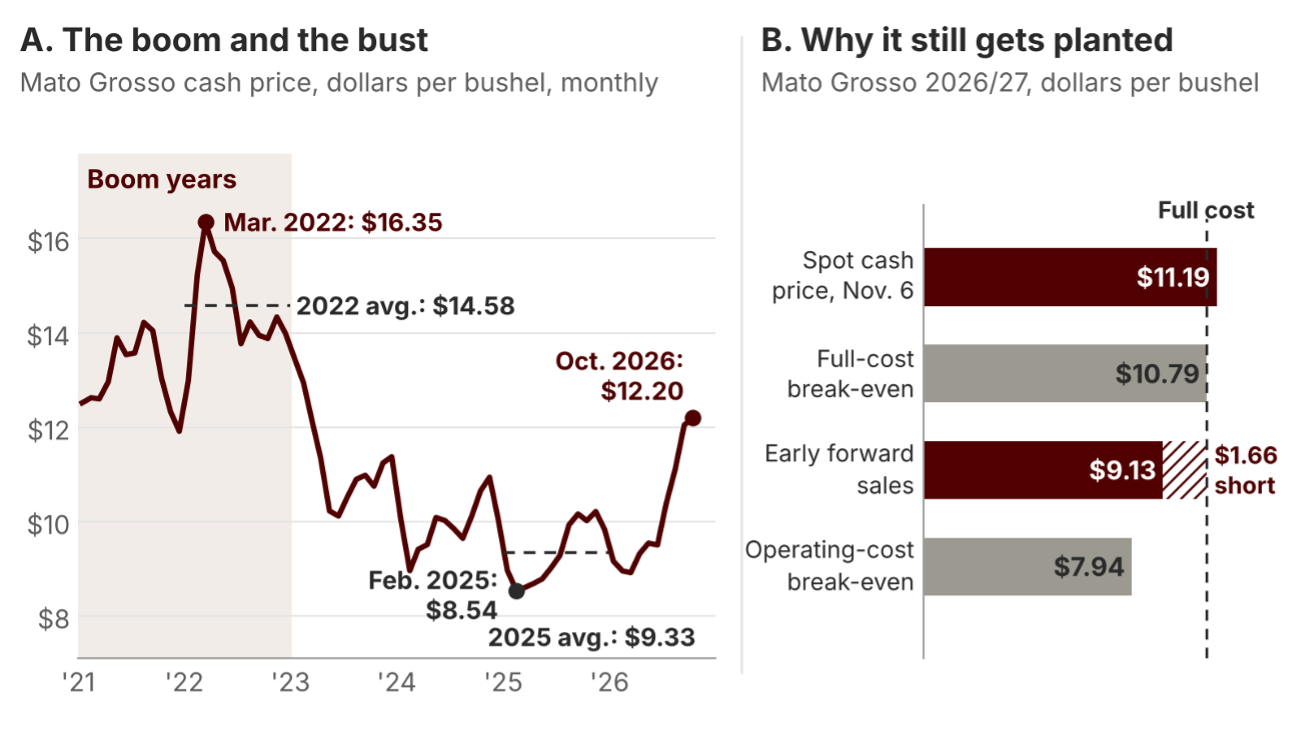
In 2020–2022, Brazilian farmers had the wind at their backs. Brazil’s benchmark interest rate, the Selic, fell to 2%. The U.S.–China trade war steered Chinese buyers toward Brazil. In Mato Grosso, Brazil’s largest soybean state, the cash price averaged about $14.60 per bushel in 2022 and topped $16 that March (Figure 1A). Flush with cash and cheap credit, farmers bought machinery, built storage, and bought or leased more land.
Then the cycle turned. By late 2022, the Selic had climbed to 13.75%. Prices slid for three years. By 2025, the Mato Grosso average was about $9.30 per bushel, 36% below its 2022 level. Payments on boom-era machines did not fall with it, and neither did cash rents, so farmers who leased land at boom rents are among the hardest hit.
Why keep planting? Because cash costs and full costs are different things. The Mato Grosso Institute of Agricultural Economics (IMEA) puts 2026/27 operating costs at about $601 per acre, with an expected 56 bushels per acre. That sets the operating break-even near $7.94 per bushel and the full-cost break-even, which includes land and machinery, near $10.79 (Figure 1B). Early sales near $9.13 fell in between. A farmer may therefore keep planting if the price covers expenses that can still be avoided and financing is available, even if revenue does not cover depreciation and other costs. When a struggling farmer exits, another may take over the acreage. The acres stay; the operator changes.
Figure 1. The price boom did not last
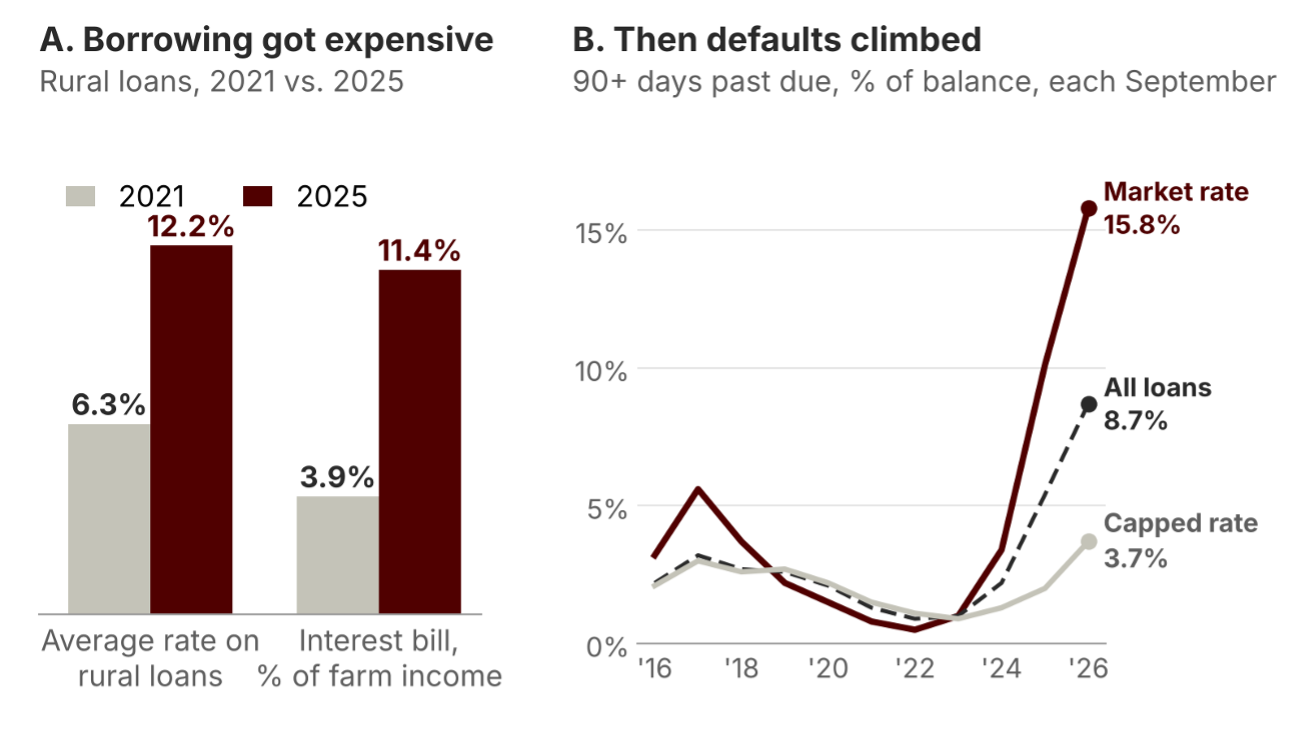
Credit turned the boom into a squeeze (Figure 2). The Center for Advanced Studies on Applied Economics (Cepea) at the University of São Paulo finds that the average rate on rural loans to individuals nearly doubled from 2021 to 2025, to 12.2%, and interest now takes 11.4% of farm income. Defaults followed the squeeze. From 2021 to 2023, only about 1% of rural-loan balances were more than 90 days past due each September. By September 2026, the share was 8.7%, the highest in a decade, and 15.8% on loans at market rates.
Figure 2. Credit got expensive, and defaults followed
These are not habitual bad payers. At Banco do Brasil, the largest farm lender, three of every four delinquent farm borrowers are behind for the first time. Most of the money is owed by large, leveraged producers farming leased land: they held 54% of overdue balances but only 8% of problem contracts (Agroicone, 2026).
Brazil’s safety net is also built differently from ours. It supports farmers mainly through subsidized loans under the Plano Safra, its annual farm-credit program, not through insurance. This year, even that credit is thinning: rural-credit disbursements fell 25.7% from July through October. Subsidized crop insurance covered only about 3% of planted area in 2025, compared with about nine in ten U.S. soybean acres, so an El Niño crop failure would hit farm balance sheets directly.
What does this mean for U.S. growers? First, Brazil’s distress will not shrink its supply. If anything slows its exports, it will be roads, ports and a growing domestic crush, as discussed in an earlier Southern Ag Today article on Brazil’s supply chain (Calil, 2026). Second, a weak real is not an automatic discount: basis, freight and costlier imported inputs absorb part of it. Third, China still decides much of the split in export share. Brazil supplied 74% of China’s soybean imports in 2025, the United States supplied 15%. China’s purchase pledge helps, but it is not a price floor. Fourth, watch fertilizer and machinery. If the cuts last, relief will come through Brazil’s yields, not its acres.
Conversions: Brazilian reais converted at R$5.50 per U.S. dollar (Central Bank of Brazil, November 6, 2026) unless noted; one 60-kilogram bag = 2.2046 bushels; 1 metric ton of soybeans = 36.74 bushels; 1 hectare = 2.471 acres.
References
Agrolink. (2026). Soja em grão, saca de 60 kg, Mato Grosso: Histórico de cotações [Data set]. https://www.agrolink.com.br/cotacoes/historico/mt/soja-em-grao-sc-60kg
Alves, L. R. A., & Barros, G. S. A. de C. (2026). Endividamento rural no Brasil, 2013–2026: Custo, composição e concentração da dívida por trás da inadimplência recorde (Texto Ocasional para Discussão No. 4). Centro de Estudos Avançados em Economia Aplicada (Cepea), Esalq/USP. https://www.cepea.org.br/
Associação Nacional para Difusão de Adubos. (2026). Principais indicadores do setor de fertilizantes [Data set]. ANDA. https://anda.org.br/recursos/
Banco Central do Brasil. (2026). Taxa de câmbio – Livre – Dólar americano (venda) – Média de período – Mensal (SGS Series 3698) [Data set]. https://www3.bcb.gov.br/sgspub/
Calil, Y. (2026, March 25). Brazil’s record soybean crop meets a fragile supply chain. Southern Ag Today, 6(13.3). https://southernagtoday.org/2026/02/05/brazils-record-soybean-crop-meets-a-fragile-supply-chain/
Companhia Nacional de Abastecimento. (2026). Acompanhamento da safra brasileira de grãos: Safra 2026/27, 1º levantamento (Vol. 14, No. 1). Conab. https://www.gov.br/conab/pt-br/atuacao/informacoes-agropecuarias/safras/safra-de-graos/boletim-da-safra-de-graos/1o-levantamento-safra-2026-27/boletim-de-safras-1o-levantamento_2026.pdf
Instituto Mato-grossense de Economia Agropecuária & Serviço Nacional de Aprendizagem Rural de Mato Grosso. (2026). Custo de produção agropecuário de Mato Grosso: Soja, safra 2026/27 [Report]. Imea. https://www.imea.com.br/
Walendorff, R., & Salomão, R. (2026, November 16). Inadimplência avançou com alta dos juros. Valor Econômico, B11.
World Agricultural Outlook Board. (2026). World agricultural supply and demand estimates (WASDE-677). U.S. Department of Agriculture. https://esmis.nal.usda.gov/sites/default/release-files/796142/wasde1126.pdf
Recommended citation format: Calil, Yuri. “Bigger Crop, Thinner Wallets: Brazil’s Soybean Paradox.” Southern Ag Today 6(47.4). November 19, 2026. Permalink