Authors: Charley Martinez, Mason Collins, and Eli Mundy
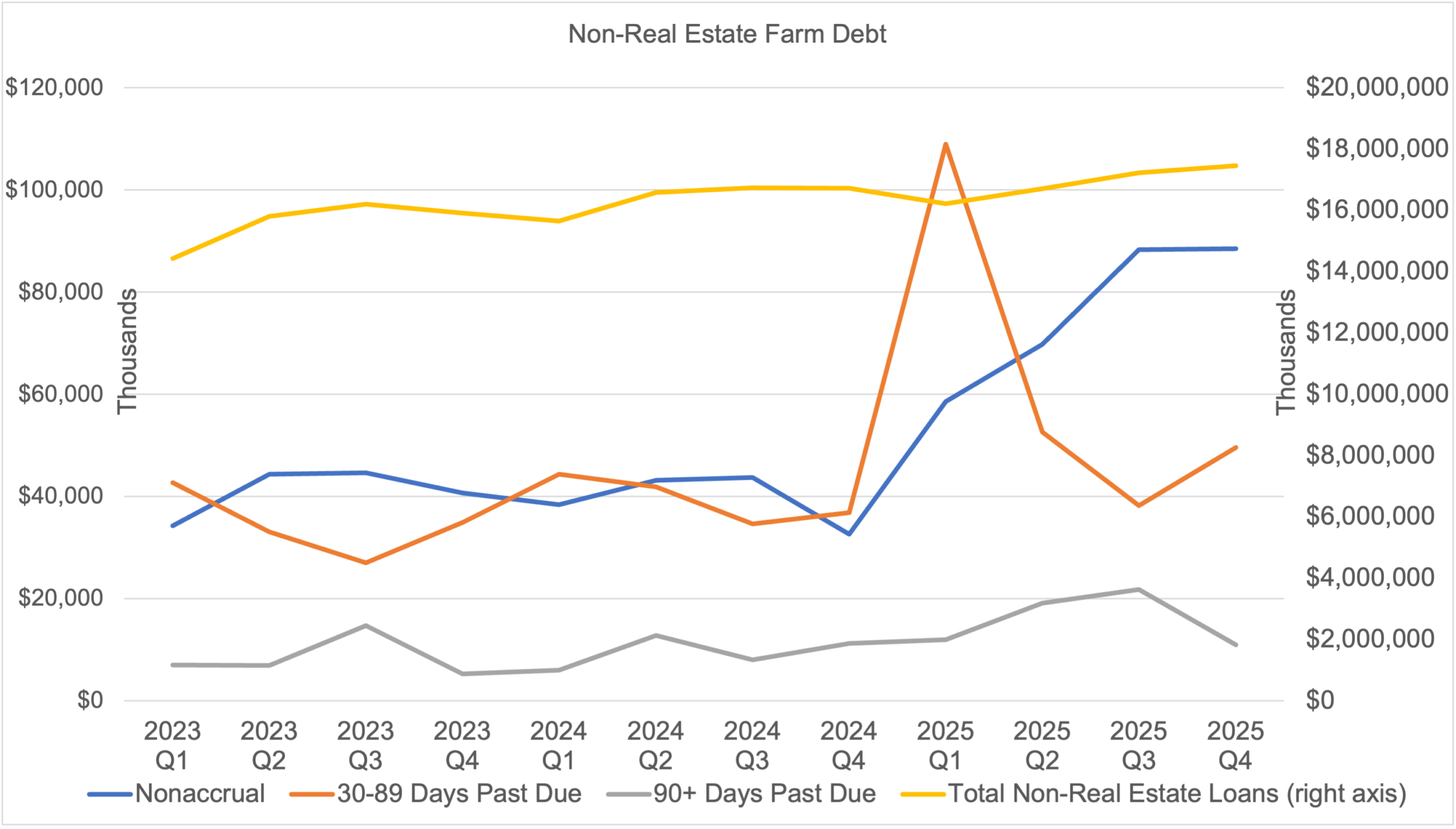
As mentioned in previous Southern Ag Today (SAT) articles (Martinez and Ferguson 2022, Martinez 2023), monitoring Non-Real Estate Farm Debt provides insight into debt health. At the time of this article, planting season has begun or is in full swing for others, input prices have increased over the last few weeks, and livestock prices have remained at high levels. Last month, the Federal Financial Institutions Examination Council released its most recent Call Reports, which provided insights into the final quarter of 2025. As a refresher, every commercial bank in the U.S. submits its quarterly Reports of Condition and Income, which are known as call reports. Within these call reports are totals of agricultural loans and the status (on time or late) of the loans. Figure 1 displays the total loan volume (yellow line) and loan volume for three late categories (30-89 days late, 90+ days late, non-accrual) for the last 12 quarters (3 years). The totals are for all the Southern Ag Today States.
In the fourth quarter of 2025, total non‑real estate loans (yellow line) continued to trend upward overall and was 4% higher compared to 2024 Q4. Non-accrual (blue line) loans remained elevated at the 2025 Q3 levels, and increased 172% from 2024 Q4. Loans that are 90+ days late (grey line) remained about the same as 2024 Q4, and decreased 3%. Last year, the most concerning statistics were the loans that were 30-89 days late (orange line), which increased to $108.9 million in Q1 in the SAT states. By the end of the year, total loan amounts in this category decreased to $49.6 million, but it seems the decline was the result of debt moving to the non-accrual category by Q4 of 2025. While this loan type decreased from Q1, the amount increased by 35% compared to 2024 Q4. Due to the varying size of states, measuring the percentage of 30-89 days late loans compared to total loan volume is a good way to compare the SAT states and the impacts of these bad loan types. In 2025 Q4, the quarterly average of 30-89 days late loans to total loan volume was 0.3% (which is stable), with the highest being Kentucky (0.8%), North Carolina (0.5%), and Louisiana (0.4%). When comparing the percentage of total late debt (non-accrual, 30-89 days late, and 90+ days late) relative to total loan volume, the quarterly average was 0.9%. Alabama (3.1%), Georgia (2.4%), Louisiana (1.8%), Mississippi (1.2%), and Arkansas (1.1%) were the only states above the SAT average. North Carolina and South Carolina were the only two states below 1%.
Taking a broad view, the 2025 fourth‑quarter bank reports give a useful snapshot of farm debt conditions following a difficult profitability year for many row‑crop operations and a strong revenue year for livestock producers across the SAT states. The reports show that financial condition remains stable in several states, but there are also early warning signs in others that warrant close attention. Recent improvements in row‑crop prices offer some potential relief for operating debt in 2026, though margins remain tight. Government payments will also be an important factor this year; ARC and PLC payments are expected again for the current crop year, though they will not be received until October 2026, and should help reduce some problem loan balances. In the meantime, producers should closely monitor working capital, manage short‑term debt carefully, and continue the sound production, marketing, and risk‑management practices they already have in place. Overall, while reliance on non‑real estate credit has increased, rising input costs, higher interest rates, and income variability are placing added pressure on farm finances, making proactive financial management especially important in the months ahead.
Figure 1. Non-Real Estate Farm Debt from 2023 Q1- 2025 Q4
References
Martinez, Charley, and Haylee Ferguson. “Current Non-Real Estate Farm Debt“. Southern Ag Today 2(30.3). July 20, 2022. Permalink
Martinez, Charley, Mason Collins, and Eli Mundy. “Check in on Current Non-Real Estate Farm Debt.” Southern Ag Today 6(21.1). May 18, 2026. Permalink