Authors: Hunter D. Biram, University of Arkansas and Francis Tsiboe, Agricultural Risk and Policy Center at North Dakota State University
Prevented planting insurance, a component of the Federal Crop Insurance Program (FCIP), provides compensation when adverse weather conditions prevent farmers from planting insured crops. This protection is embedded within standard crop insurance policies and is directly linked to the elected coverage level: higher coverage levels mechanically translate into higher prevented planting payments.
Historically, farmers could purchase additional prevented planting protection through a “buy-up” option, which increased prevented planting payments without expanding exposure to other types of losses. This structure allowed early-season planting risk to be managed in a targeted manner while keeping overall FCIP risk largely confined to within-season production losses. That adjustment margin was eliminated by the U.S. Department of Agriculture’s Federal Crop Insurance Corporation (FCIC) through the Expanding Access to Risk Protection (EARP) final rule issued on November 28, 2025. Beginning with the 2027 commodity year, producers can no longer purchase prevented planting buy-up coverage. As a result, farmers seeking to maintain similar levels of prevented planting protection must instead increase their overall insurance coverage. While higher coverage can raise prevented planting payments, it also increases premiums and broadens exposure to non-prevented planting losses, limiting farmers’ ability to target planting risk alone and requiring the FCIP to assume greater risk and higher costs across the entire policy for a given producer.
The earlier removal of the 10 percent prevented planting buy-up option in 2018 provides important context for how producers adjust when targeted prevented planting protection is no longer available. Evidence from recent analyses (Tsiboe, 2026; Biram and Tsiboe, 2026) shows that some farmers responded by gradually increasing their base coverage over time rather than making large or immediate changes, reflecting constraints related to higher premiums, program limits, and farm-specific conditions (Figure 1). When the prevented planting buy-up of 10 percent was removed, insured producers who purchased this coverage shifted out of the 75% coverage level into the 80-85% coverages levels four years after the policy change took effect (Figure 1, top panel). Those producers who had insurance but did not purchase the prevented planting buy-up of 10 percent made essentially no change (Figure 1, bottom panel).
One reason why the switch into higher coverage levels took place is to compensate for a lower prevented planting coverage level. For example, a rice producer faces the base prevented planting coverage level of 55% of liability (i.e., the product of the underlying coverage level and expected revenue). Buying 10% more in prevented planting coverage increases the prevented planting coverage level to 65% of liability. Assuming a rice producer purchases the 75% coverage level on their underlying coverage level, their prevented planting coverage would be 48.75% (i.e., the product of 65% and 75%). A rice producer would need to purchase 88% coverage on their underlying insurance policy to maintain their prevented planting coverage, an option that is above the highest available coverage level of 85%. This highlights the limited flexibility of risk protection for those with relatively high coverage levels on their underlying coverage.
Figure 1: Observed Farm-Level Coverage Adjustment Following the Removal of 10 Percent Prevented Planting Buy-Up in 2018.
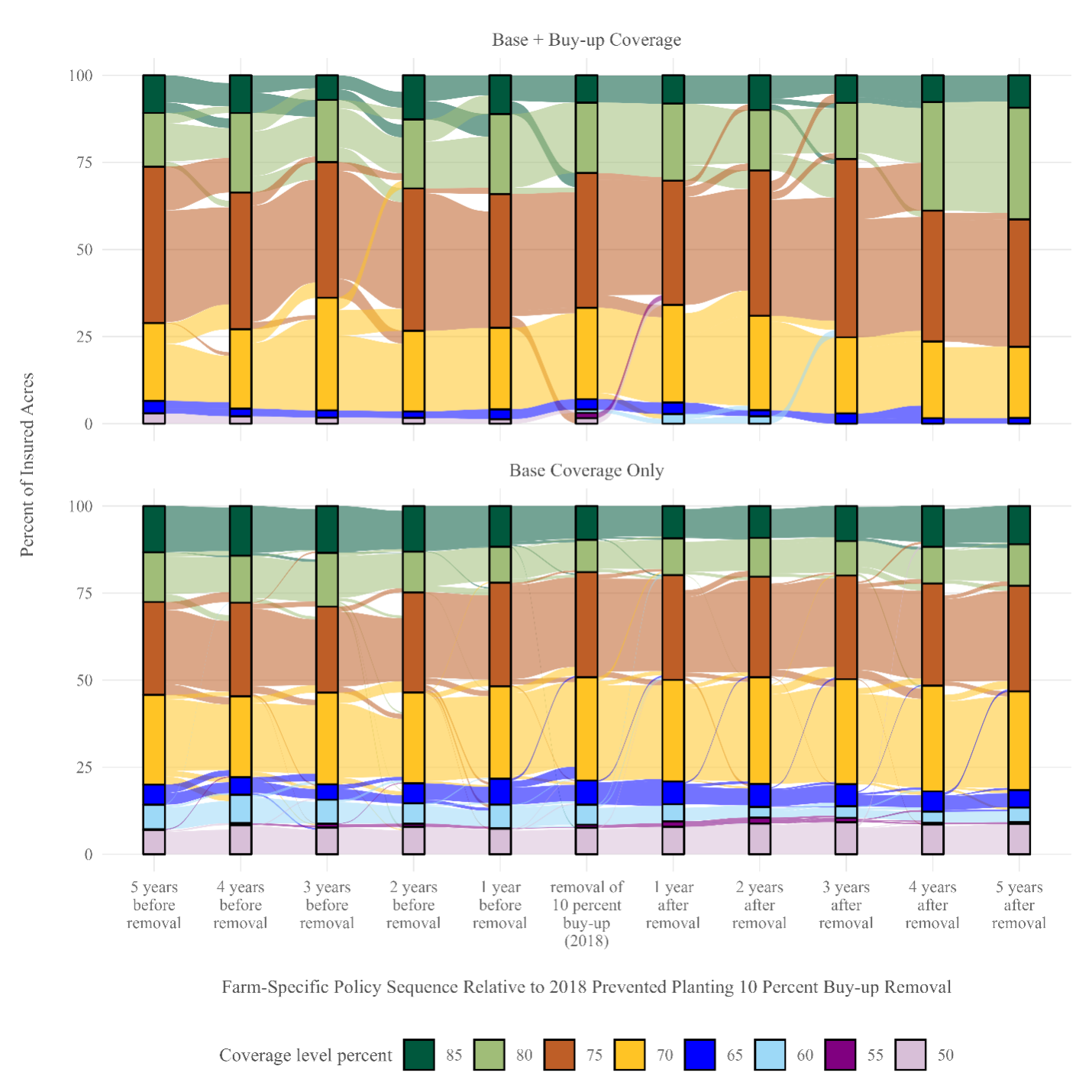
Source: NDSU Agricultural Risk Policy Center (ARPC), using data from USDA, Risk Management Agency Summary of Business as of June 04, 2025.
References
Biram, H.D. and Tsiboe, F., (2026). “Analyzing the Expanding Access to Risk Protection (EARP) USDA Final Rule: Coverage Substitution and Cost Effects of Prevented Planting Buy-Up Elimination in Rice Insurance.” Fryar Price Risk Management Center of Excellence White Paper #FC-2026-002.
Francis Tsiboe (2026). Prevented Planting After Buy-Up Elimination: Coverage Level Substitution, Producer Costs, and the Role of Enhanced Premium Subsidies Under the One Big Beautiful Bill (OBBB). ARPC White Paper 2026–01. Agricultural Risk Policy Center, North Dakota State University.
Recommended citation format: Biram, Hunter, and Francis Tsiboe. “The Expanding Access to Risk Protection (EARP) rule reduces farmer flexibility in production risk management by eliminating prevented planting buy-up coverage.“ Southern Ag Today 6(24.4). June 11, 2026. Permalink
