
Prior to 2019, the United States consistently recorded an agricultural trade surplus, meaning exports exceeded imports in value terms. For example, in fiscal year (FY) 2014, U.S. agricultural exports totaled about $152 billion, while imports were roughly $109 billion, yielding a surplus of $43 billion. This surplus steadily narrowed in subsequent years, falling to less than $5 billion by 2019. Since then, the trend has reversed, with the United States posting agricultural trade deficits over the past three years, culminating in a record deficit of approximately $44 billion in FY 2025, a stark contrast to the surplus observed a decade earlier (USDA-ERS, 2020; 2026).
Given the current White House Administration’s emphasis on bilateral trade imbalances, leadership at the U.S. Department of Agriculture has followed suit, increasingly framing the reduction of the agricultural trade deficit as a key policy objective. However, focusing on the agricultural trade deficit as a target can be misleading, as it obscures the broader economic forces shaping trade flows—a point discussed in previous Southern Ag Today articles. For instance, rising U.S. imports of agricultural goods may reflect not declining competitiveness, but stronger consumer demand for a more diverse set of products, including off-season fruits and vegetables as well as higher-value items such as beer, wine, and spirits. Moreover, a narrow emphasis on the trade deficit ignores the highly integrated nature of modern agricultural supply chains. For instance, the recent import ban on Mexican feeder cattle may contribute to a reduction in the agricultural trade deficit, but it would be difficult to argue that the U.S. beef sector is necessarily better off as a result.
That said, it is still useful to examine the agricultural trade deficit more closely. Recent year-to-date trade data (January–April) suggest a narrowing of the deficit compared to the same period last year. As of April 2026, the agricultural trade deficit stood at $7.5 billion, down 62% from $19.7 billion over the same period in 2025. On the surface, this could be interpreted as evidence of improvement, or even as an indication that current trade policies are working. However, caution is warranted in drawing such conclusions.
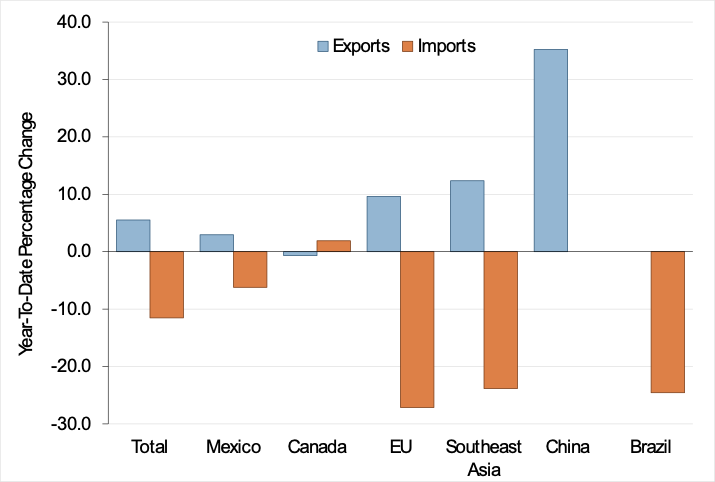
Figure 1 presents year-to-date percentage changes in U.S. agricultural exports and imports, both in aggregate and across major export destinations and import suppliers. The data indicate that the narrowing of the deficit is driven more by declining imports than by strong export growth. Total U.S. exports increased modestly (+5.5%), while imports fell sharply (−11.5%), with particularly large declines in imports from the EU (−27.1%), Brazil (−24.6%), and Southeast Asia (−23.8%). What is driving these changes? The increase in exports is mostly China (+35.2%) due to a strong recovery in soybean and sorghum exports, both of which dropped to negligible levels in 2025. The decline in imports also appears to be concentrated in specific products, including beer, wine, spirits, and essential oils from the EU; coffee and beef fat from Brazil; and beverage sweeteners and cocoa products from Southeast Asia (USDA-FAS, 2026).
This raises an important question: are we truly better off if the narrowing deficit is driven primarily by declining imports rather than broad-based export growth across markets and products?
Figure 1. 2026 Year-To-Date (January–April) Percentage Changes in U.S. Agricultural Exports and Imports, Total and Major Partners
Source: U.S. Department of Agriculture, Foreign Agricultural Service (2026)
For more information:
U.S. Department of Agriculture (USDA-ERS) (2020). Outlook for U.S. Agricultural Trade. Economic Research Service. https://www.ers.usda.gov/media/10231/aes-111.pdf?v=93939
U.S. Department of Agriculture (USDA-ERS) (2026). Outlook for U.S. Agricultural Trade. Economic Research Service. https://www.ers.usda.gov/media/20882/aes-136.pdf?v=85005
U.S. Department of Agriculture (USDA-FAS) (2026). Global Agricultural Trade System. Foreign Agricultural Service. https://apps.fas.usda.gov/gats/default.aspx
Recommended citation format: Muhammad, Andrew. “A Narrowing Agricultural Trade Deficit in 2026 – But Are We Better Off?” Southern Ag Today 6(25.4). June 18, 2026. Permalink