
Authors: Jingyuan Zhang, Sushil Paudyal and Grace Melo
Finding reliable workers has become increasingly difficult for U.S. farmers, especially for physically demanding agricultural jobs (U.S. Department of Agriculture, 2023). The pool of domestic workers willing to take these jobs continues to shrink, even as wages have increased. In response, many farms have turned to the H-2A program.
Between 2015 and 2024, the number of certified H-2A workers more than doubled, reaching 350,000 or more (Figure 1). These workers now represent a significant share of the agricultural labor force and play an important role in supporting food production.
Figure 1. Number of H-2A Workers Certified, 2015–2024
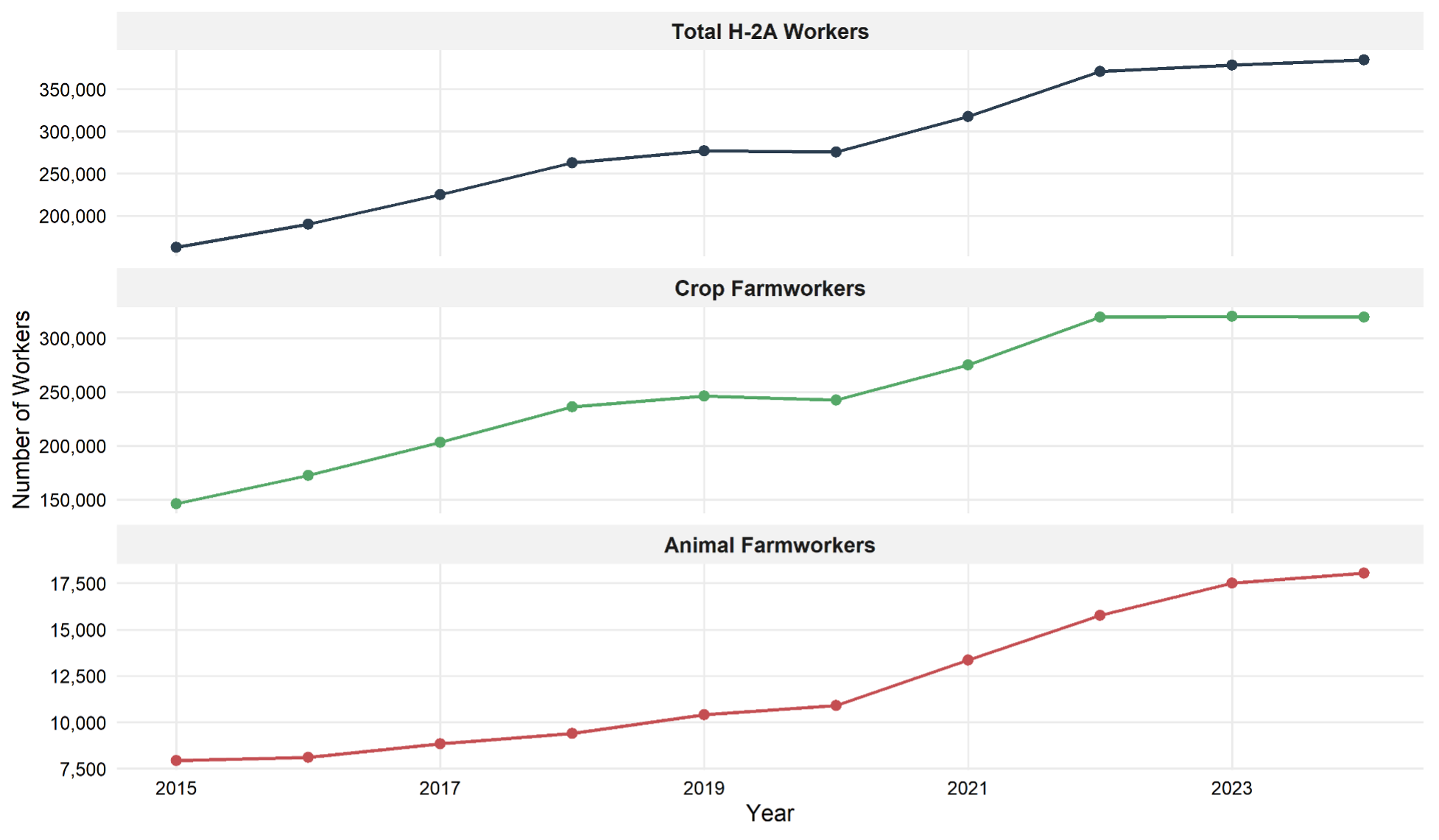
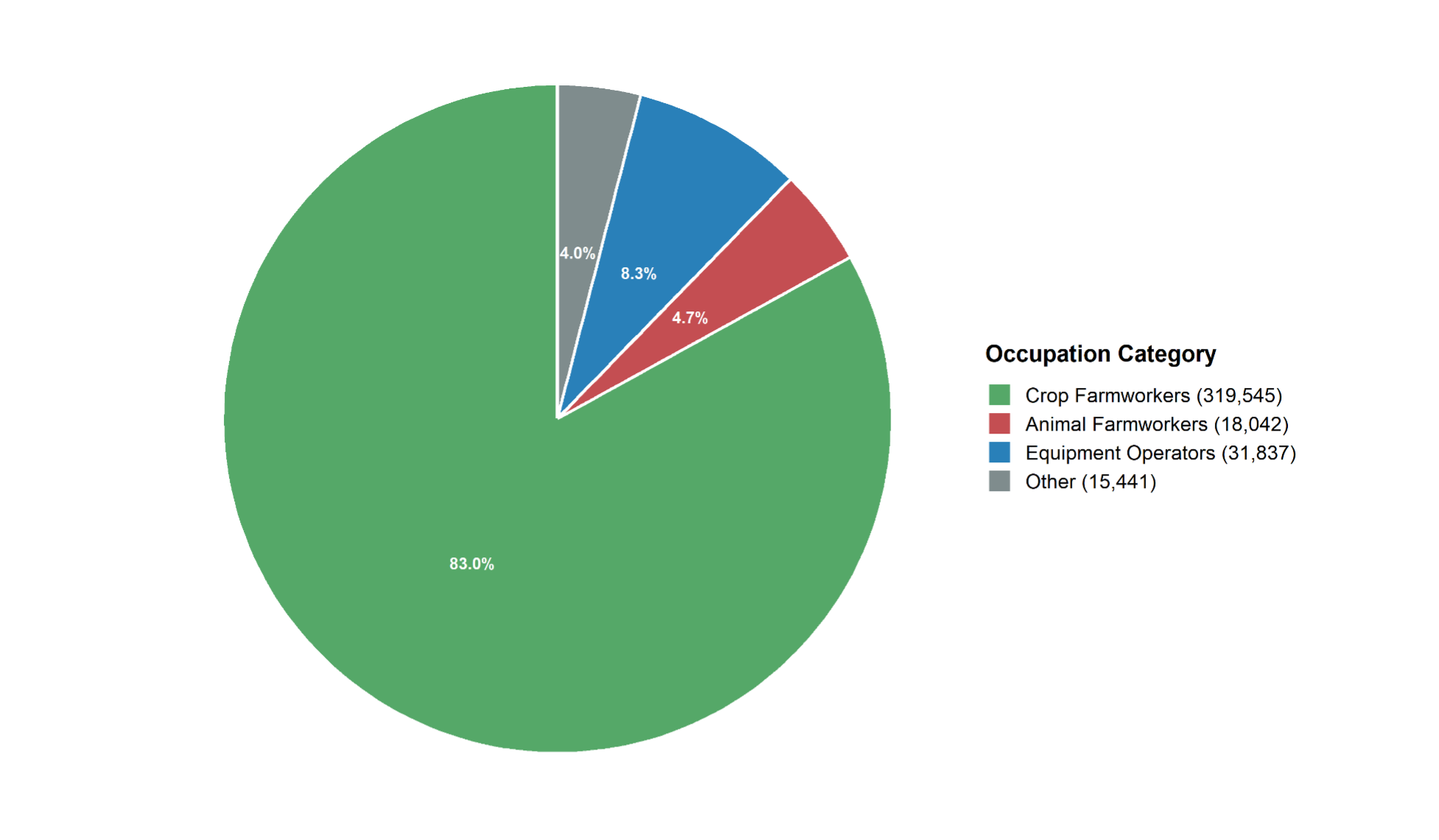
The program has been, and remains, heavily concentrated on crop agriculture (Escalante, 2023). More than 80% of H-2A workers are employed in crop production, while animal farms make limited use of the program (Figure 2). Although the number of H-2A workers in animal agriculture increased from about 7,500 to over 17,500 since 2015 (Figure 1), they accounted for only 4.7% of total H-2A employment in 2024 (Figure 2). This raises an important question: why is adoption so low among livestock farmers, and how could the program better serve their needs?
Figure 2. Number of H-2A Workers Certified by Sector, 2024
A survey conducted with 133 livestock producers in Texas—including 99 beef cattle producers (Zhang and Melo, 2026) and 34 dairy farmers—provides insight into these questions. Farmers in both sectors reported persistent labor challenges, with 81% of beef cattle producers and 71% of dairy producers struggling with labor hiring, turnover, training, and retention. Although both sectors demand substantial labor, beef cattle operations often have more flexible and varied labor needs, while dairy farms tend to focus more on traditional agricultural tasks such as cow care, milking, and farm maintenance. Dairy farms also tend to hire more workers, require more hours per worker, and have a relatively higher share of farms paying higher wages. These trends align with Escalante and Gutierrez-Li (2025). However, producers in both sectors similarly reported four main barriers that limit H-2A use in cattle operations:
- The program is limited to temporary or seasonal work, whereas livestock production typically requires year-round labor, making many operations ineligible. This is particularly true for dairy farms, where milking and animal care are continuous.
- H-2A requires employers to guarantee at least 35 hours of work per week. Livestock labor needs, however, are often variable. For example, beef operations may require fewer hours during some periods and more intensive labor during others, making it difficult for many farms to commit to and reliably meet the required minimum (U.S. Department of Labor, 2023).
- The Adverse Effect Wage Rate (AEWR) is often viewed as too high for livestock farmers. During our survey period in Texas, the AEWR was $15.55 per hour. In contrast, 67% of beef producers and 29% of dairy producers reported paying $13 per hour or less, and only a negligible share paid above $16. While the AEWR is intended to protect domestic workers, the required wage, combined with housing and transportation costs, can be difficult for livestock farms operating on tight margins.
- The program lacks flexibility in job duties. Employers must specify H-2A tasks in advance, and some routine livestock activities, such as hauling cattle or transporting feed and milk, may fall outside the program’s definition of agricultural work (Congressional Research Service, 2021). This creates uncertainty and potential legal risks for producers whose labor needs often shift with weather, emergencies, and animal conditions.
Despite these challenges, interest in the program remains strong. About 85% of dairy farmers and 78% of beef cattle producers in the survey indicated they would benefit from a more flexible H-2A program. Farmers broadly support reforms that would allow year-round employment, introduce more flexible scheduling and job duties, and simplify and speed up the application process. Targeted policy reforms that relax seasonality restrictions, increase flexibility in hours and job duties, and streamline administrative requirements would directly address the binding constraints identified by producers and are likely to facilitate broader adoption of the H-2A program in livestock operations, thereby alleviating persistent labor shortages and supporting the stability of U.S. animal agriculture.
References
Congressional Research Service. (2021). The H-2A temporary agricultural worker program (R44849). https://crsreports.congress.gov/product/pdf/R/R44849
Escalante, Cesar L. “Sectoral and Regional Concentration of H-2A Patronage.” Southern Ag Today 3(42.3). October 18, 2023. https://southernagtoday.org/2023/10/18/sectoral-and-regional-concentration-of-h-2a-patronage/
Escalante, Cesar L., and Alejandro Gutierrez-Li. “Relating Crop and Livestock H-2A Labor Decisions to AEWR and Sectoral Wage Gaps.” Southern Ag Today 5(18.1). April 28, 2025. https://southernagtoday.org/2025/04/28/relating-crop-and-livestock-h-2a-labor-decisions-to-aewr-and-sectoral-wage-gaps/
U.S. Department of Agriculture. (2023). Farm labor report. Economic Research Service. https://www.ers.usda.gov/topics/farm-economy/farm-labor/
U.S. Department of Labor. (2024). Office of Foreign Labor Certification performance data. https://www.dol.gov/agencies/eta/foreign-labor/performance
U.S. Department of Labor. (2023). H-2A temporary agricultural program: Employer requirements. https://www.dol.gov/agencies/whd/agriculture/h2a
Zhang, Jingyuan, and Grace Melo. Does Administration Mode Affect Survey Outcomes Among Hard-to-Reach Populations? An Intercept Survey with Beef Cattle Farmers. Journal of Agricultural and Applied Economics, 2026, 1-20. https://doi.org/10.1017/aae.2026.10040
Recommended citation format: Zhang, Jingyuan. “H-2A Labor: An Opportunity for Beef Cattle and Dairy Farms?” Southern Ag Today 6(26.1). June 22, 2026. Permalink