
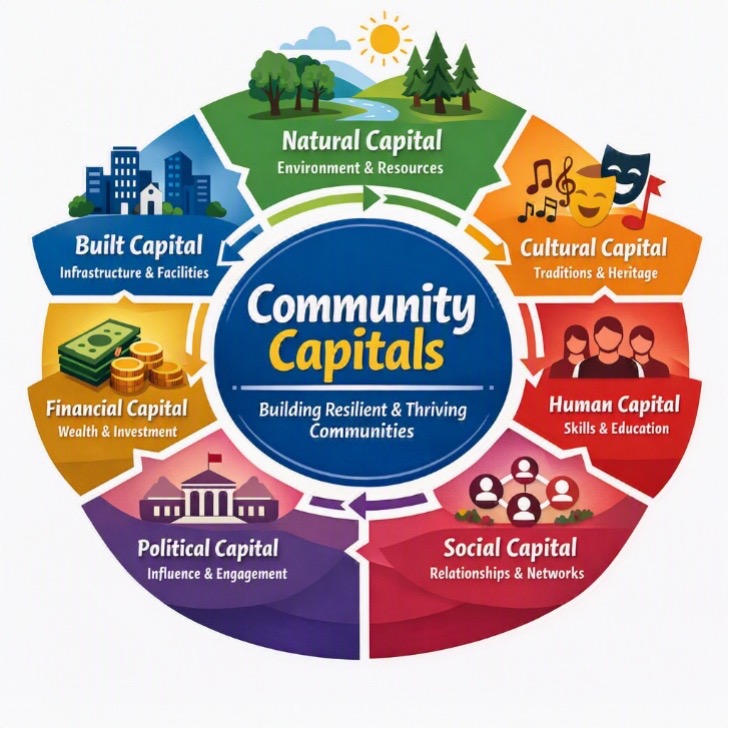
The Community Capitals Framework (CCF), developed by Jan L. Flora and Cornelia B. Flora (2004), provides a framework and tool for understanding community development initiatives through a systems lens. “The CCF offers a way to analyze community and economic development efforts from a systems perspective by identifying the assets in each capital (stock), the types of capital invested (flow), the interaction among the capitals, and the resulting impacts across capitals” (Emery and Flora, 2020). The CCF draws on seven areas of existing stock (assets) in communities: human, social, political, financial, built, natural, and cultural capital (Graphic 1).
Additionally, Asset Based Community Development (ABCD), grounded in the work of Dr. John McMcKnight and Dr. Jody Kretzman as well as global practitioners, sees communities and individuals as having assets and capacities that grow and strengthen their communities. ABCD focuses on what is strong and not what is wrong in the community as a place to foster and build local leadership for positive, collective change. The Asset Based Community Development Instituteutilizes six core assets: individuals and skills, local associations, institutions, economic resources, physical (natural plus built assets), and culture, traditions, and stories.
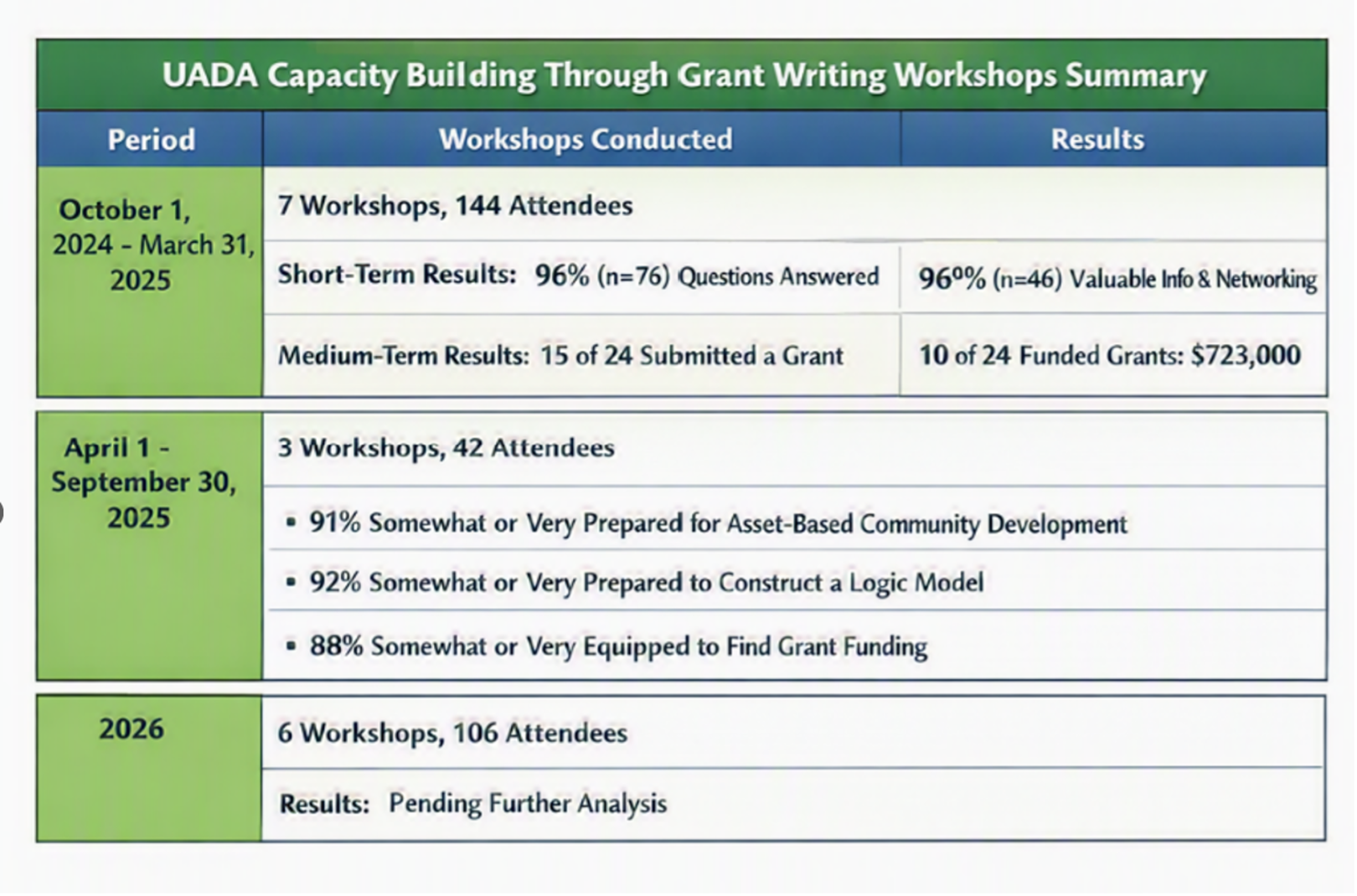
Using the CCF as a framework and tool for measurement and ABCD as an applied tool for community members, the University of Arkansas Division of Agriculture (UADA) teaches a Capacity Building through Grant Writing course for communities, hosted by the county Extension office in partnership with the local Community Foundation as well as the planning and economic development district. Since 2022, 793 workshops have been held in 48 counties throughout Arkansas. The data herein focuses on a specific time period of October 2024-September 2025 (Graphic 2).
The Capacity Building through Grant Writing course delivers content focused on the fundamentals of grant writing practice. However, at the heart of the course is an investment in human and social capital. The course begins with a focus on the individual as the best storyteller for their institution or organization. While grant writing is about successfully receiving funds, it is about effective story telling combined with following all guidelines and priorities for the funder. The curriculum also emphasizes an investment in social capital by exploring, understanding, and defining partnerships that currently exist as well as those that should exist through a win-win approach of both organizations gaining from the project and relationship.
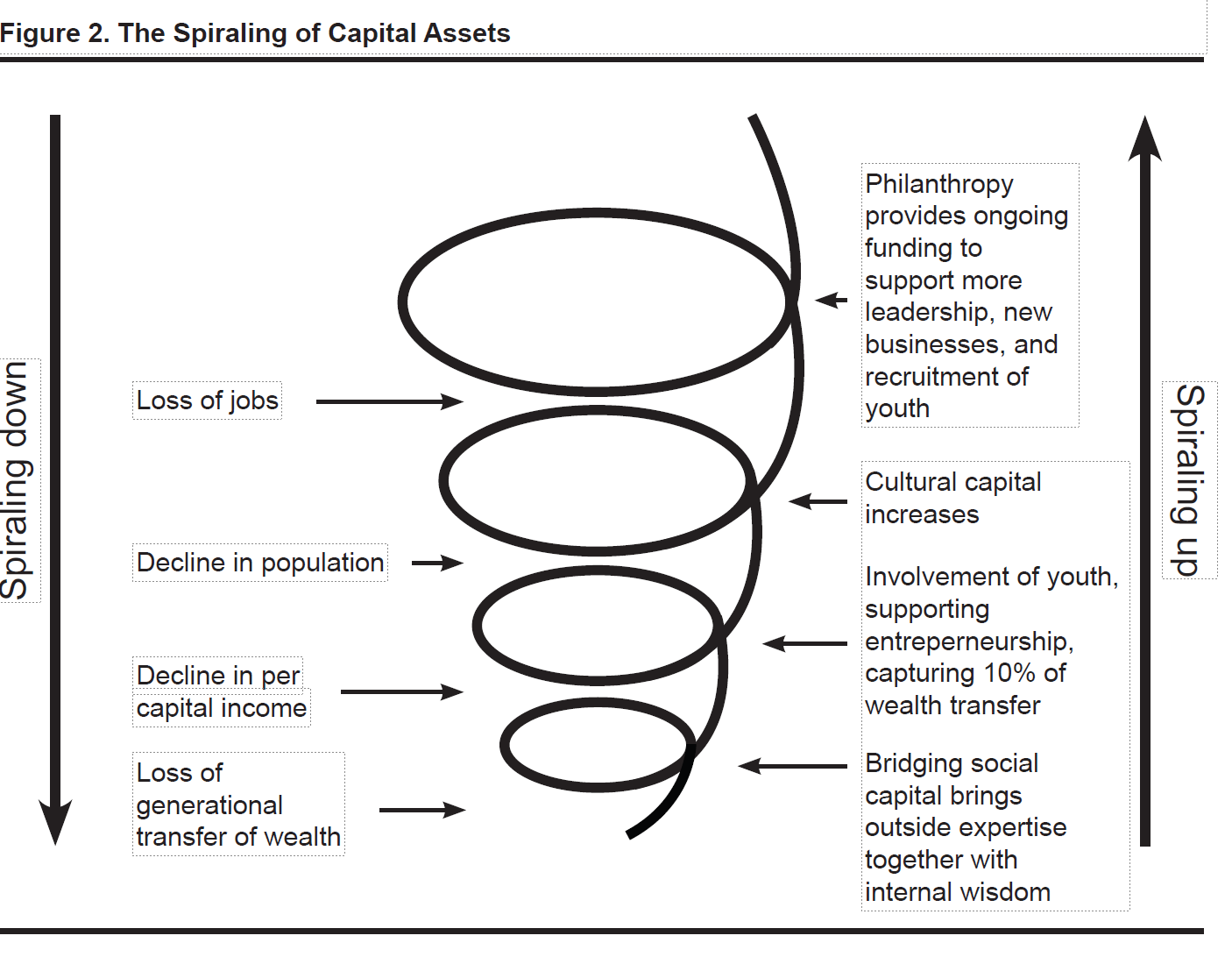
Using the Spiraling of Community Assets model (Emery & Flora, 2020, see Graphic 3), the Capacity Building through Grant Writing course invests in human capital through the training. Short-term and medium-term results show a strong result in knowledge gained by participants. With a focus on partnership cultivation, relationship building, and social capital investment, the course is designed to increase the ability for a county to spiral up its assets for collective investment. Through an applied ABCD lens, participants explore how putting people in the center of local investment and decision making creates a shared plan for action and investment.
As identified in the Spiraling of Community Assets model (Emery & Flora, 2020), the course bridges social capital by connecting outside knowledge of Extension professionals with the internal wisdom of community. The course is open to all members of the community regardless of experience level or community position. Participants range from youth, church leaders, parents, and nonprofit organizations to mayors and county officials, fire departments and local. As Emery and Flora (2020) notes, the building of social capital with the engagement of youth to entrepreneurs leads to greater cultural capital and understanding of how local connections strengthen connected investments across sectors. Participants explore a clearer, more interconnected plan of how their requests for funding are tied to philanthropic and federal investment. The spiraling up model of investment in people and their relationship leads to potential investment rather than disinvestment in the community.
Utilizing a grant writing curriculum developed in partnership with the Southern Rural Development Center (SRDC) and adapted for an Arkansas context, institutions and individuals came together for a six-hour workshop. Participants gain an understanding of mission and focus relative to their funding goals, develop a SMART goal (Heathfield, S.M. (2011) outlining the proposed grant-funded project, define win-win partnerships and relationship development, navigate ways to finding a grant opportunity, explore components of writing the narrative, create a logic model for the proposed project, and understand budget development and financial management. From the beginning of the course, participants outline funding goals that are Specific, Measurable, Attainable, Relevant, and Time-framed (SMART). This outline of setting a clear goal for funding carries through the course to include measurable outcomes using a logic model framework. For new grant writers, it can be tempting to focus on the need for funds first. However, participants need to focus on the purpose of the funding relative to their organization’s mission.
Grant writing is not a solo endeavor. With a clear sense of direction (SMART goal and logic model) and understanding of existing assets, particularly through the lens of human and social capital, participants determine the gap that can be improved through external funding. Using an ABCD lens, the curriculum explores grant writing as building the capacity of human capacity through opportunities and connections that exist amongst all six assets. While grant writing can be seen through a needs-based perspective, looking at the problem to be addressed, the ABCD lens looks at funds, partnerships, and goals as investment in the community.
While the Community Capitals model emphasizes the existing stock in a community that can grow with investments in its assets, the ABCD lens on community development places people at the center through the lens of its community’s strengths. Through connecting the assets and strengths in the community of individuals, associations, institutions, physical assets, marketplace, and culture, stories and traditions, we empower people to create local change. Both the Community Capitals model and ABCD lens allow us to fully understand and explore the impacts of a program invested in the human passion and social, interconnected systems operating locally.
Graphic 1: Community Capitals Framework
Graphic 2: University of Arkansas Division of Agriculture Capacity Building through Grant Writing Workshop Results 2024-2025.
Graphic 3: The Spiraling of Capital Assets.
References
Doran, G. T. (1981). There’s a SMART way to write management’s goals and objectives. Journal of Management Review, 70, 35–36.
Beaulieu, L.J. (2006). Promoting community vitality and sustainability: The community capitals framework. Fact Sheet: Purdue University Extension. https://cdextlibrary.org/wp-content/uploads/resource-media/2020/12/Promoting_Community_VitalitySustainability_ADA2026.pdf
Emery, M., & Flora, C. (2020). Spiraling-up: Mapping community transformation with community capitals framework. In 50 Years of Community Development Vol I (pp. 163-179). Routledge.
Flora, C. B., & Flora, J.L. (2008). A paradigm for community development: The Floras’ community capitals. Department of Agricultural and Applied Economics, University of Wisconsin–Madison.
Flora, C.B. and J.L. Flora. 2013. Rural Communities: Legacy and Change, 4th Edition. Boulder, CO: Westview Press.
Heathfield, S. M. (2011). Beyond smart goals. About.com Human Resources. Retrieved from http://humanresources.about.com/cs/performancemanage/a/goalsetting.htm
Kretzmann, J. P., & McKnight, J. L. (1993). Building communities from the inside out: A path toward finding and mobilizing a community’s assets. Asset-Based Community Development Institute, Institute for Policy Research, Northwestern University.
Microsoft Co-Pilot (2026). A graphic image of University of Arkansas Division of Agriculture Capacity Building through Grant Writing workshop results 2024-2025.
Microsoft Co-Pilot (2026). A graphic image of the Community Capitals Framework.
Recommended citation format: Goodman, Hunter P. “Exploring Human and Social Capital: Capacity Building through Grant Writing“. Southern Ag Today 6(26.5). June 26, 2026. Permalink
