
Authors: Bart L. Fischer and Joe Outlaw
While you will never find us using this platform to attack other regions of the country—as it turns out, we want farmers and ranchers across the entire country to be successful—our colleagues at FarmDoc seemingly never miss a chance to take swipes at Southern agriculture. Typically, their arguments center on some narrow way that federal policy is supposedly disproportionately benefiting producers in the South. We won’t re-plow that ground here, as you can find several other articles where we have taken them to task in response.
But, in one of the latest FarmDoc articles (The Evolving US Southern Crop Problem), they take a new approach. Carl Zulauf from Ohio State University argues that Southern harvested acres are declining…and suggests that is proof that Southern agriculture is actually being harmed by the farm safety net. Before we go any further, we can’t help but offer a quick lesson on spurious correlation—the idea that two variables can move together mathematically but not be causally connected. A quick Google search will yield all manner of outstanding examples.[1] One of our favorites: the popularity of the first name Brooklyn is highly correlated with UFO sightings in Kentucky. Are they correlated? Yes. Are they causally related? Umm….no.
To prove his point, he highlights changing acreage in the South, using cotton, peanuts, and rice as his evidence. Oops…peanut and rice acreage are actually fairly stable (just look at Zulauf’s Figure 2). But, not cotton! He notes that cotton harvested acreage has declined significantly if you look at his random groupings of 1927-1929, 1978-1980, and 2023-2025. Then, if you close your eyes and disengage your brain—and just take at face value his oft-repeated argument that Southern crops have disproportionately benefited from the farm safety net—for him that prompts a “rarely asked question” of whether the support for these crops have hurt Southern crop agriculture in total. We tell our students all the time that there’s no such thing as a dumb question. We may have finally found the exception.
While we could spill gallons of ink addressing this nonsense, we will simply offer three key observations. In the article, he argues that changes in planted acres are the “ultimate” indicator of crop competitiveness…yet he uses harvested acres in his analysis (alongside his arbitrary grouping of years). The problem: he fails to acknowledge significant abandonment in cotton acres (i.e., a large divergence between planted and harvested acres) due to prolonged drought over the last few years in the cotton belt that have nothing to do with competitiveness.
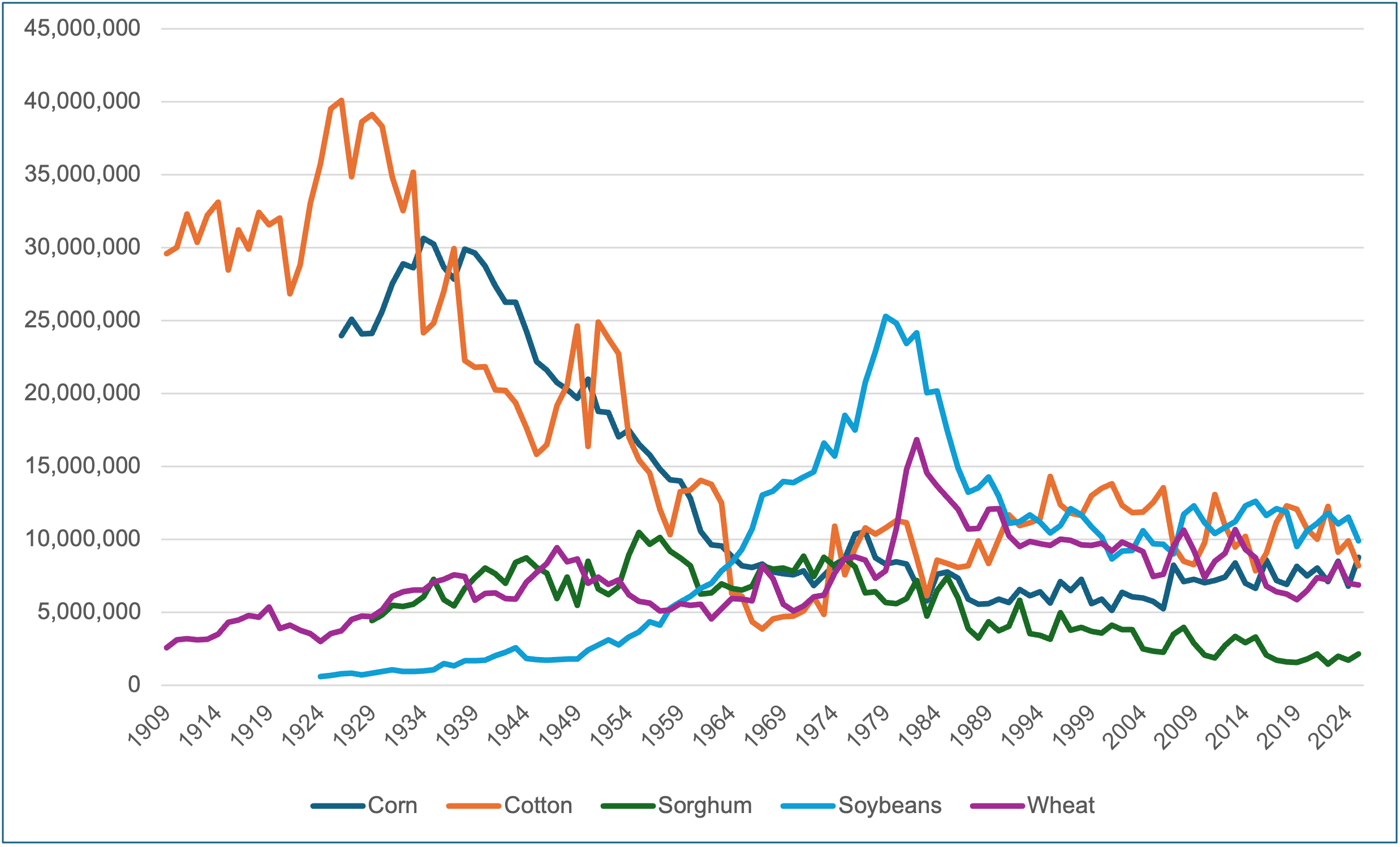
While cotton acres have declined in the group of Southern states used by Zulauf (Alabama, Arkansas, Florida, Georgia, Louisiana, Mississippi, North Carolina, South Carolina, Tennessee, Texas, and Virginia)—with cotton planted acres reaching their low in 1967—they have averaged 9.97 million acres over the 58 years since then (and 10.47 million acres over the last 10 years) as reflected in Figure 1. So, while Zulauf makes considerable noise over the decline in harvested cotton acres since 1927 (and you can find a number of academic articles that describe the reasons behind that decline through 1967 that are beyond the scope of this article), the reality is that cotton planted acres have been relatively stable for the last 60 years.
Figure 1: Planted Acres of Select Crops in the Southern United States, 1909-1925.
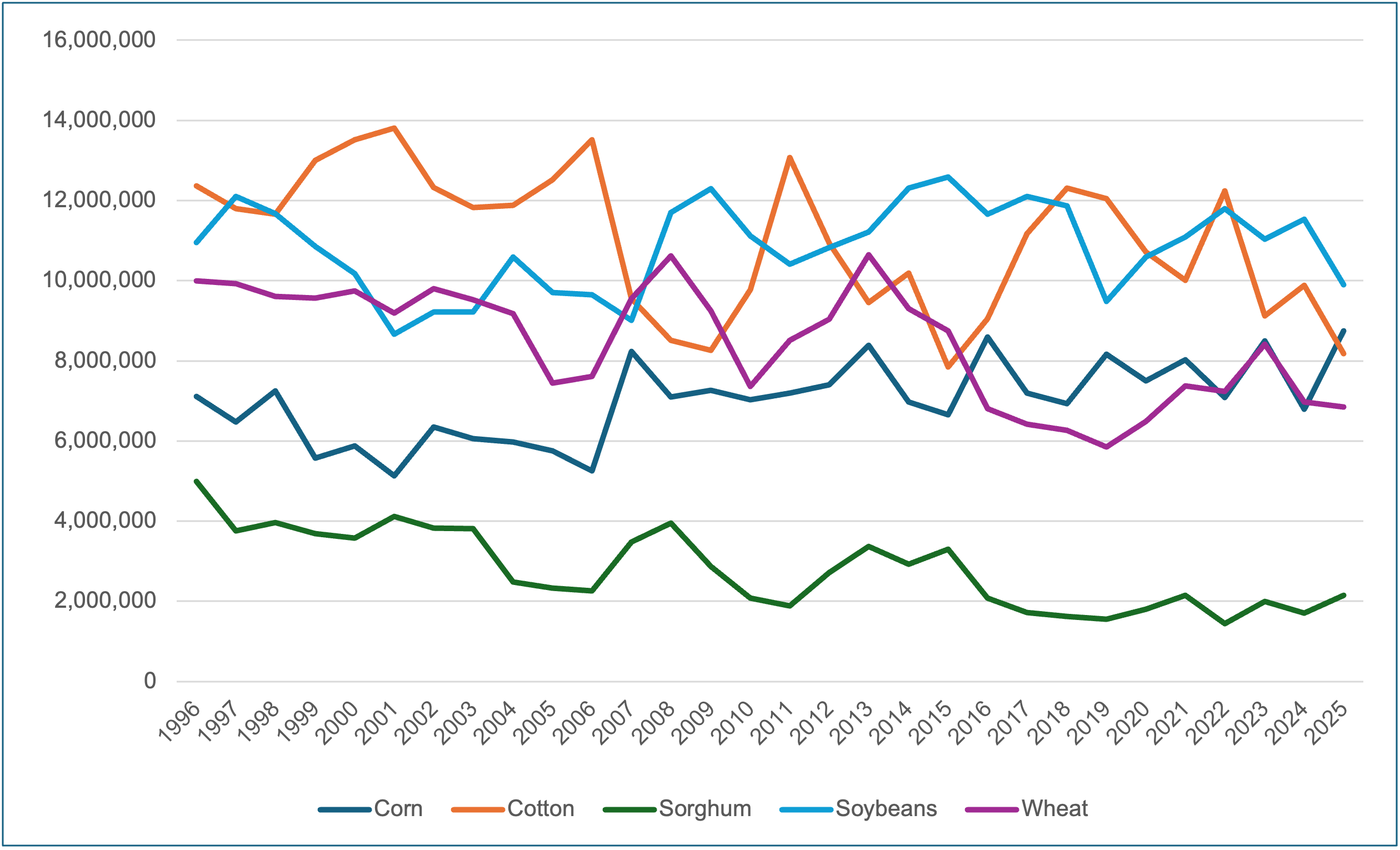
Perhaps more importantly, his article completely ignores the fact that payment acres for Title 1 of the farm safety net have been completely decoupled from production since 1996. While he and some of his colleagues write incessantly about the amount of support for cotton, peanuts, and rice, the reality is that since Freedom to Farm was implemented in 1996, farmers could plant whatever they want (with some restrictions—largely to prevent overplanting of specialty crops) and remain eligible for the farm safety net. You see that dynamic playing out as intended in Figure 2. Over those last 30 years (1996 to 2025), cotton and soybeans have jockeyed for top billing in terms of planted acres in the South. In fact, in 14 of the last 30 years (or 46% of the time), soybean acreage exceeded cotton acreage. While corn and wheat have generally jockeyed for the 3rd and 4th spots, corn overtook cotton in 2025. In other words, farmers have the freedom to plant what commodity markets are indicating will be their most profitable alternative—and the data indicates they do. Profitability is one of many factors that farmers have to consider when making planting decisions, many of which were discussed in a previous article.
Figure 2: Planted Acres of Select Crops in the Southern United States, 1996-1925.
While we agree that overall planted acres have gone down in the South, we would argue that this has had absolutely nothing to do with the decoupled support provided in Title 1 of the farm bill. Since the 1970s, we’ve seen a considerable amount of land go into grasslands for conservation (e.g., Conservation Reserve Program) or in support of the cow-calf sector. We’ve also seen land being used for forestry. The point: landowners have the freedom to decide how they want to use their land, and they have done so accordingly.
We save what is perhaps the most egregious point for last. Zulauf argues that part of the harm being done is that it is “inhibiting diversification.” This seems to be a strange statement from someone who comes from a region that predominantly plants two crops. As noted in Figure 1, at one point in history the South planted 30 million acres of corn. Is that the sort of diversification he’s after…the South should plant more corn? As for other crops that have lost acres, there are a litany of reasons why and none of them have anything to do with ARC and PLC either. As we noted above and as reinforced in Figure 2, Southern growers take a number of factors into consideration when deciding what to plant—none of which are ARC or PLC since they are decoupled from production.
[1] https://www.tylervigen.com/spurious-correlations
Recommended citation format: Fischer, Bart L., and Joe Outlaw. “FarmDoc Continues to Sow Regional Discord.” Southern Ag Today 6(26.4). June 25, 2026. Permalink