Authors: Landyn Young and Luis A. Ribera
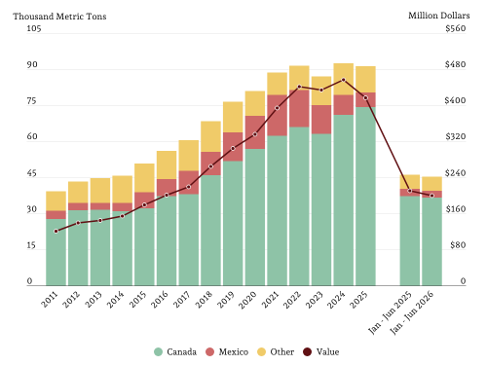
On July 7th, the U.S. International Trade Commission (USITC) chose to leave in place anti-dumping policies for imports of preserved mushrooms from Chile, China, India, and Indonesia (Andberg, 2026). The initial ruling took place in December 1998. Dumping occurs when a producer sells their products at a lower price internationally than they do in their home country or below their production costs. A week after the ruling for preserved mushrooms was continued, on July 14th, it was announced that a preliminary determination had been reached regarding dumping of fresh mushrooms in the U.S. market from Canada (Federal Register, 2026). The USITC implemented an 8.26% preliminary antidumping tariff on most fresh mushrooms from Canada, following a separate 2.84% countervailing duty for alleged unfair subsidies. In 2025, the United States imported 91.2 thousand metric tons (TMT) of mushrooms, valued at $416.9 million. Based on imports from Canada in 2025, it is estimated that 81 percent of fresh mushroom imports could face antidumping tariffs, with Agaricus mushroom imports being 92 percent.
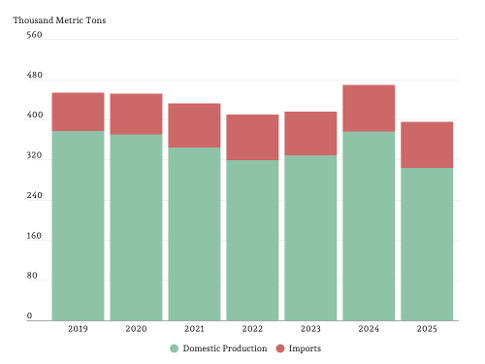
Since 2019, between 96 and 98 percent of U.S. grown mushrooms were the Agaricus variety, which is primarily grown in Pennsylvania and California. Around 69 percent of total production of Agaricus mushrooms occurred in these two states in 2025, or 205 thousand metric tons (TMT) of the 304 TMT grown nationwide. The remaining 31 percent is spread throughout the United States.
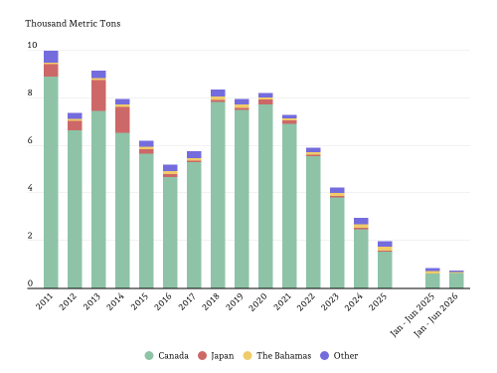
In 2025, 91.2 TMT of mushrooms were imported, with 79.2 TMT being Agaricus; the other 12 TMT were other varieties. By far the largest exporter of fresh mushrooms to the United States was Canada, which sent an estimated 74.2 TMT of mushrooms to the United States worth $345 million. It is estimated that imports accounted for as much as 23 percent of all fresh mushrooms available in the United States in 2025, up from 16.8 percent in 2019. On the other hand, exports have dropped considerably since 2020, while consumption has remained relatively steady. With production on the decline and the reliance on imports rising, this could negatively impact prices for consumers of fresh mushrooms but may also be a windfall for mushroom growers in the United States trying to stay competitive.
Volume of U.S. Mushroom Imports, 2011 – June 2026
Volume of U.S. Mushroom Exports, 2011 – June 2026
Share of U.S. Mushroom Consumption from Imports, 2019 – 2025
Sources:
Andberg, Jennifer. United States International Trade Commission. “USITC Makes Determinations in Five-Year Reviews Concerning Preserved Mushrooms from Chile, China, India, and Indonesia.” Published July 2026.
Federal Register. “Fresh Mushrooms From Canada: Preliminary Affirmative Countervailing Duty Determinations and Alignment of Final Determination With Final Antidumping Duty Determination.” Published July 2026.
Foreign Agricultural Service (FAS). Global Agricultural Trade System (GATS). Online Database. Online public database accessed August 2026.
Recommended citation format: Young, Landyn, and Luis Ribera. “USITC Maintains Anti-Dumping Order on Fresh Mushrooms.” Southern Ag Today 6(33.4). August 13, 2026. Permalink