Authors: Chris Boyer and Aaron Smith – University of Tennessee
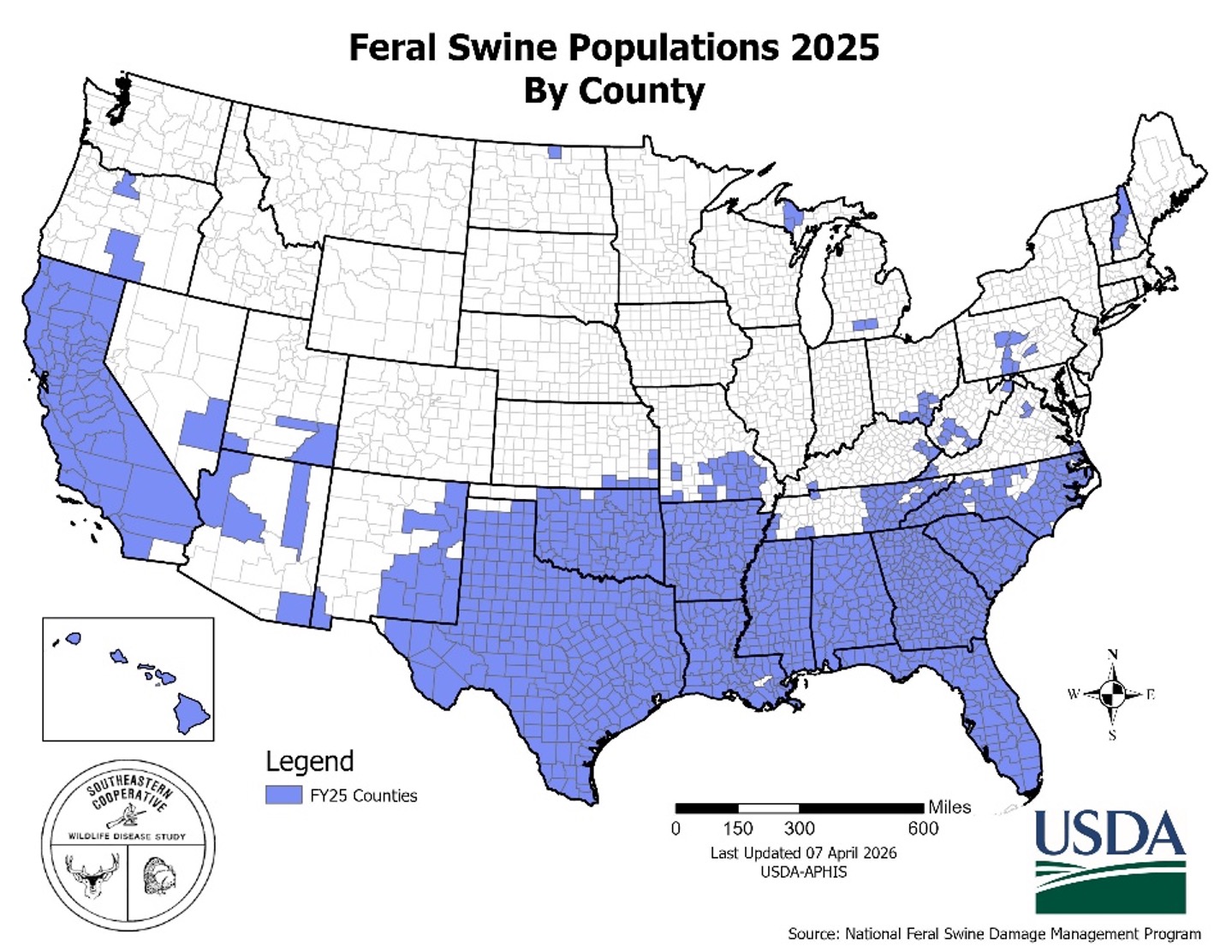
Feral hogs are one of the most destructive and costly wildlife threats facing American agriculture. Across the United States, feral swine populations have exploded from 18 states in 1982 to around 30 states in 2025, with population continuing to rise in many of those locations. The United States Department of Agriculture (USDA) Animal and Plant Health Inspection Service (APHIS) publishes county level population maps from 1982 to 2025 (USDA APHIS 2026). Figure 1 shows the USDA APHIS map for 2025 county level feral swine populations.
Figure 1. USDA APHIS map for county level feral swine populations
The damage they leave behind is staggering. The USDA estimates feral swine cause $2.5 billion in damage each year, but some estimate the annual damages to be nearly $3.4 billion (Link, link). Agriculture, mostly crops, are estimated to account for the $800 million of these damage (Link). Beyond crops, feral hogs spread disease to livestock, damage farm infrastructure like fences and roads needed for agricultural production, destroy recreational parks, and cause extensive environmental damage to wildlife habitats, water quality, and plant ecosystems.
The 2018 Farm Bill established the Feral Swine Eradication and Control Pilot Program (FSCP), a $75 million initiative over a five-year period, to respond to the damage caused by feral swine to agriculture, property, ecosystems, and human and animal health. The program was implemented beginning in 2020 across select counties in ten states (Alabama, Arkansas, Florida, Georgia, Louisiana, Missouri, Mississippi, North Carolina, South Carolina, Oklahoma, and Texas). The program was a partnership between USDA’s Natural Resources Conservation Service, which focused on restoring lands damaged by feral hogs, and USDA’s Animal and Plant Health Inspection Service, which focused on removing feral hogs. Producers and landowners in participating counties were also eligible for grant funding to support hog control efforts. A one-year extension provided additional funding through Fiscal Year 2024. A full report of the projects implemented during this period is found online (Link).
In July 2025, the One Bill Beautiful Bill (link) reinstated the FSCP allocating $105 million through fiscal year 2029. Currently, USDA is accepting applications for grant funding for partners in: Alabama, Arkansas, California, Florida, Georgia, Hawaii, Louisiana, Mississippi, Missouri, North Carolina, Oklahoma, South Carolina, Tennessee, and Texas.USDA have expanded the program from the original 10 states to include California, Hawaii, Missouri, and Tennessee. Partners selected to participate in the FSCP will provide landowner assistance for restoration and on-farm trapping efforts and provide related services, like training. The USDA is currently making available $35 million for grant-funded projects. Applications for these grants are open until 11:59 ET on September 21, 2026. For more information about funding opportunity and to apply, visit the notice of funding on Grants.gov.
Recommended citation format: Boyer, Chris, and Aaron Smith. “Feral Swine Eradication and Control Pilot Program Grant Applications.” Southern Ag Today 6(36.4). September 3, 2026. Permalink