
Authors: Eunchun Park, James L. Mitchell, Xiaoyi Fang, and Lawson Connor[a]
Livestock Risk Protection (LRP) and Chicago Mercantile Exchange (CME) put options both protect cattle producers against lower prices while preserving the opportunity to benefit if prices rise. These risk management tools are not identical, but they function similarly, and their premiums can be compared to assess the cost of establishing a price floor. Understanding how these products compare in terms of cost is especially important in the current market environment, as record-high cattle prices and heightened market volatility have made price protection increasingly expensive. Additionally, USDA’s 2019 and 2020 subsidy expansions substantially changed that comparison.
In a recently published article, Park et al. (2026) compared LRP premiums with similar (matched) CME put premiums before and after the subsidy expansions. The study matched LRP endorsements with CME put options from 2005 through 2024. The main sample included 6,115 fed cattle endorsements and 34,645 feeder cattle endorsements. Each endorsement was paired with a put for the same cattle market and contract month and with a coverage level within one percentage point of the LRP contract.
The comparison uses a “net wedge” equal to the matched CME put premium minus the producer-paid LRP premium minus an assumed $0.20 per cwt implementation cost. A positive wedge means the put premium exceeds the producer-paid LRP premium after the assumed cost; a negative wedge means LRP was relatively more expensive than the put. Before July 2019, average net wedges were -$0.948 per cwt for fed cattle and -$0.604 for feeder cattle. After the tiered subsidy schedule began in July 2020, those averages became $0.105 and $0.119, respectively.
The sign change did not occur because gross LRP premiums fell below option prices. In the post-2020 sample, gross LRP premiums exceeded matched put premiums by $1.880 per cwt for fed cattle and $2.696 for feeder cattle. The statutory subsidy components averaged $2.186 and $3.016 per cwt, more than enough to offset those gross gaps on average.
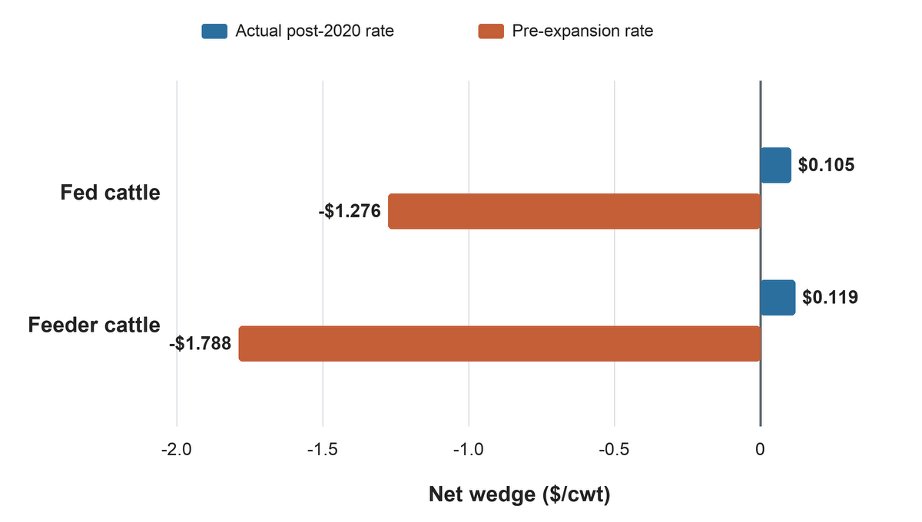
Figure 1 applies the pre-expansion subsidy rate to the post-2020 contracts while holding gross LRP and matched put premiums fixed. The average net wedge changed from $0.105 to -$1.276 per cwt for fed cattle and from $0.119 to -$1.788 for feeder cattle.
These are averages, not guaranteed savings on every endorsement. Even after July 2020, only 49.9 percent of matched fed cattle endorsements and 46.9 percent of matched feeder cattle endorsements had a positive net wedge. LRP and CME puts also differ in contract size, settlement, eligibility, liquidity, brokerage costs, margin requirements, and basis exposure. A positive wedge does not imply risk-free arbitrage, and LRP will not be cheaper for every producer.
This is important for many Southern cattle producers since their sale lots are often smaller than standardized futures contract sizes. LRP can be tailored by head count and target weight, while CME cattle options correspond to standardized 40,000-pound live cattle or 50,000-pound feeder cattle futures contracts (USDA RMA, 2026; CME Group, n.d.). When comparing the two, producers should first match the LRP endorsement end month to the CME contract month and use similar coverage levels. The comparison should then be made on an all-in $/cwt basis, with attention to the expected local cash sale price. After the subsidy expansion, LRP became less expensive than matched CME puts on average, although that was not true for every endorsement.
Figure 1. Post-2020 net wedges under actual and pre-expansion subsidy rates
References
Park, E., X. Fang, L. Connor, and J. L. Mitchell. 2026. “Subsidy Expansions, Pricing Wedges, and Derivative Markets: Evidence from Livestock Risk Protection.” Journal of Risk and Insurance, 1-29. doi:10.1111/jori.70068.
U.S. Department of Agriculture, Risk Management Agency. 2026. Livestock Risk Protection Insurance Standards Handbook (FCIC-20010), 2027 crop year. USDA RMA handbook PDF.
CME Group. n.d. Cattle Futures and Options Fact Card. Accessed August 25, 2026. CME cattle futures and options fact card PDF.
[a] Eunchun Park, Lawson Connor, and James L. Mitchell are assistant professors in the Department of Agricultural Economics and Agribusiness at the University of Arkansas. Xiaoyi Fang is a postdoctoral fellow in the department. Mitchell is also the livestock marketing extension specialist for the University of Arkansas System Division of Agriculture.
Recommended citation format: Park, Eunchun, James L. Mitchell, Xiaoyi Fang, and Lawson Connor. “How Higher LRP Subsidies Changed the Cost Comparison with CME Put Options.” Southern Ag Today 6(39.2). September 22, 2026. Permalink