Authors: Sanchez Philocles, Manuel Garcia, Texas A&M AgriLife Extension Service- Department of Agricultural Economics and Samuel Zapata, Texas A&M University- Department of Agricultural Economics
Certified halal represents a premium-generating attribute in meat production, comparable in commercial terms to organic, grass-fed, antibiotic-free (ABF), or kosher designations (USDA AMS, 2025). Halal certification requires that animals be processed, handled, and stored in accordance with Islamic dietary laws and traditions. This market niche is of particular interest given the significant expansion of halal food markets in the United States (US). To illustrate, Al-Mahmood (2020) showed that the number of halal food markets in the US went from 200 stores in 1998 to 2,100 in 2018, with 85% of those stores selling halal meat. Furthermore, Green and Gammon (2016) have found that halal food is important not only to the US Muslim Population but also to young non-Muslim Americans, many of whom have embraced halal food believing it to be a healthier dietary alternative. This trend creates growth opportunities for livestock operations, slaughter facilities, restaurants, and foodservice providers, in a market expected to reach $20 billion in annual sales (Halawa, 2018).
In this article, we compare retail prices for conventional and halal-certified beef, lamb, goat, and chicken. Data for this analysis comes from the 2025 weekly grocery store feature activity reports published by USDA’s Agricultural Marketing Service (AMS). For example, in 2025, conventional ground beef was sold for an average of $5.65/lb., compared with $8.76/lb. for ABF, $8.19/lb. for USDA organic, $8.08/lb. for grass-fed, and $7.09/lb. for halal (Table 1). Similar price premium patterns were observed across other cuts and meat types.
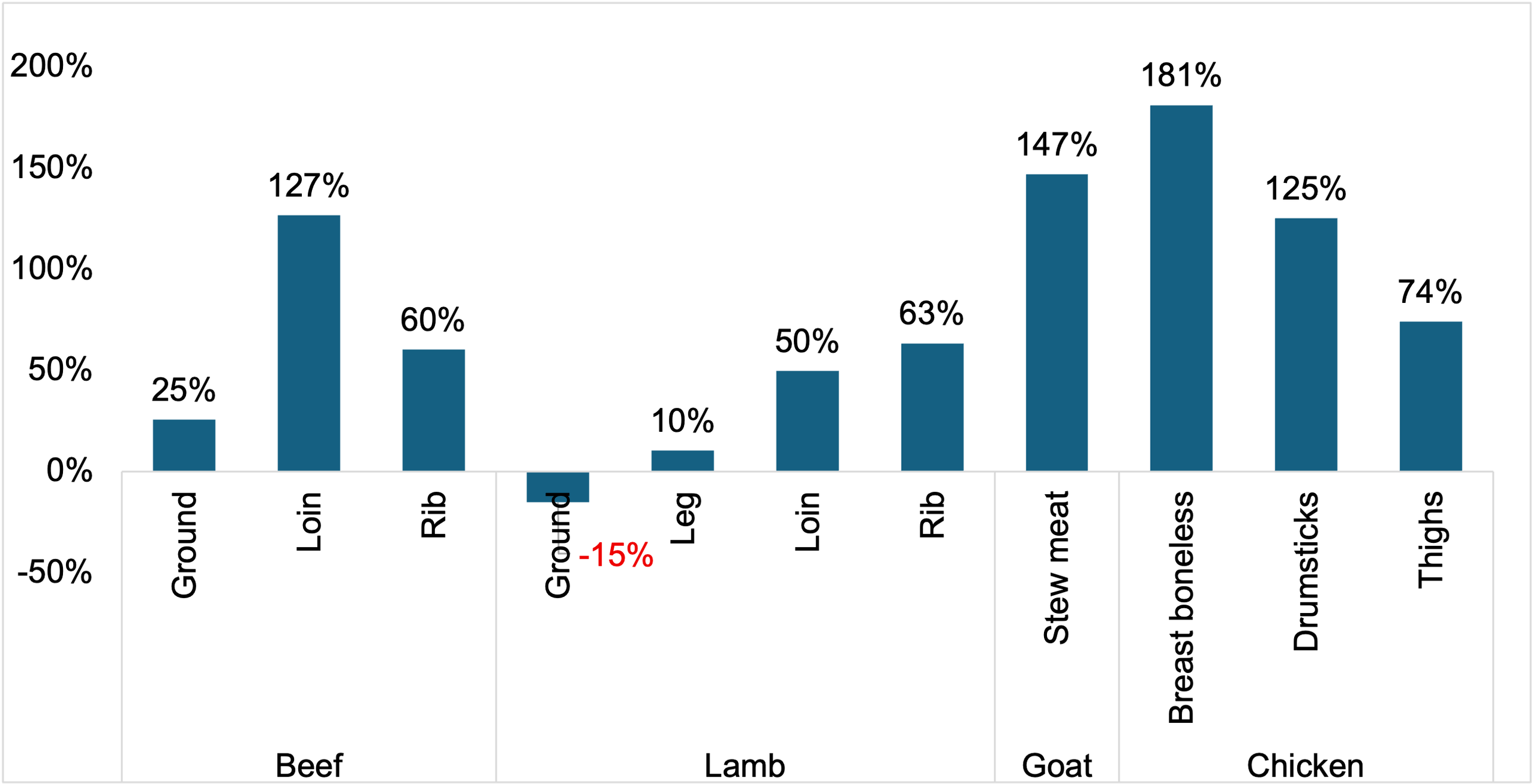
To highlight price differences, Figure 1 presents the percentage premiums across the four main protein categories: beef, lamb, goat, and chicken. Among halal beef products, ribs were sold at a premium of 60% relative to conventional alternatives. Loin cuts commanded the highest premium (127%), while ground beef exhibited the lowest premium (25%). Halal goat products also showed substantial premiums; in particular, goat stew meat was sold at a premium of 147% in 2025. This result has important implications for US goat producers and livestock processors because most of the halal goat consumed in the US is imported from Australia. Therefore, industry stakeholders can develop targeted strategies to capture a market segment with untapped potential.
Halal chicken exhibited the highest average premium across all three cuts included in the analysis. Boneless chicken breasts, drumsticks, and thighs were sold at premiums of 181%, 125%, and 74%, respectively. Despite the high premiums on halal chicken, beef, and goat, higher prices do not automatically translate into higher profits. Premiums should be considered in conjunction with sales volumes, market demand, certification costs, production adjustments, and marketing requirements needed to serve halal consumers.
Finally, halal lamb products showed the smallest and most variable premium levels across four major cuts. Lamb legs were sold at a premium of 10%, while loin and ribs cuts commanded premiums of 50% and 63%, respectively. On the other hand, ground lamb was sold at a discount of 15% compared to conventional.
These findings highlight halal certification as a value-added strategy for US livestock producers and processors, particularly those involved in goat and chicken production, as these categories exhibited some of the highest premiums. However, the potential for higher returns must be weighed against the additional costs and production adjustments required to meet halal certification and market requirements. The premiums reported here should be treated as inputs to that evaluation, rather than a forecast of profitability.
Table 1. Average retail price by product and certification attribute in 2025.
| Commodity | Section/type | Avg. retail price ($/lb.) | ||||||
| Conventional | Grass Fed | Antibiotic Free | Kosher | USDA Organic | Free Range | Halal | ||
| Beef | Ground | 5.65 | 8.08 | 8.76 | 6.24 | 8.19 | 7.09 | |
| Loin | 10.59 | 22.67 | 21.59 | 15.31 | 23.05 | 23.99 | ||
| Rib | 9.76 | 19.92 | 16.40 | 11.49 | 19.45 | 15.64 | ||
| Lamb | Ground | 8.77 | 9.10 | 9.39 | 7.42 | |||
| Leg | 7.74 | 7.86 | 8.24 | 8.52 | ||||
| Loin | 10.39 | 12.03 | 10.21 | 15.56 | ||||
| Rib | 16.06 | 18.08 | 19.51 | 26.21 | ||||
| Goat | Other: Stew meat | 5.06 | 10.99 | 10.99 | 12.49 | |||
| Chicken | Breast, boneless/skinless | 3.03 | 4.63 | 7.98 | 8.02 | 6.39 | 8.51 | |
| Drumsticks | 1.26 | 1.91 | 3.51 | 2.86 | 2.84 | |||
| Thighs | 1.63 | 2.19 | 5.57 | 3.36 | 2.84 | |||
Source: USDA AMS 2025
Figure 1. Retail price premiums (%) for halal meat cuts relative to conventional alternatives in 2025
References:
- Al-Mahmood, O. A., Jiang, X., Bridges, W. C., & Fraser, A. M. (2024). A Longitudinal Study: Microbiological Quality of Raw Beef from Halal and Non-Halal Meat Markets in the United States. Applied Microbiology, 4(3), 1193-1202.
- Green, J., & Gammon, C. (2016). How halal food became a $20 billion hit in America. Bloomberg, available at: www. bloomberg. com/news/articles/2016-09-14/america-loves-muslim-food-so-much-for-a-clash-of-civilizations (accessed 25 October 2016).
- Halawa, A. (2018). Acculturation of Halal Food to the American Food Culture Through Immigration and Globalization: A Literature Review. Journal of Ethnic and Cultural Studies 5(2):53–63. https://doi.org/10.29333/ejecs/89
- U.S. Department of Agriculture, Agriculture Marketing Service (2025). Grocery Store Feature Reports, available at: https://www.ams.usda.gov/market-news/grocerystore
- U.S. Department of Agriculture, Economic Research Service (2025). Food Availability (Per Capita) Data System. https://www.ers.usda.gov/data-products/food-availability-per-capita-data-system
Recommended citation format: Philocles, Sanchez, Manuel Garcia, and Samuel Zapata. “Market Opportunities for Certified Halal Meat in the United States.” Southern Ag Today 6(38.2). September 15, 2026. Permalink