Authors: Authors: Adam N. Rabinowitz, Associate Professor and Extension Economist, Agricultural Economics and Rural Sociology, Auburn University
Sthefani Oliveira, Research Associate, Agricultural Economics and Rural Sociology, Auburn University
When planning for the crop year, farmers create budgets and form expectations of costs that will occur during the growing season. With row crop harvesting in full swing, one critical cost is piling up faster than expected with every pass of the field. Diesel fuel is the most significant consumable input during row crop harvesting. It powers the combine, tractor, cotton picker, and peanut diggers. It is also a critical input to transporting grain to the elevator, cotton to the gin, and peanuts to the buying point. Last year, farmers set budget expectations for this growing season that included fall harvest, but diesel prices across the South have since risen about 75%.
The United States Department of Agriculture Agricultural Marketing Service publishes regular estimates of #2 diesel fuel for farm use in Alabama and Oklahoma. The U.S. Energy Information Administration also publishes estimates of the retail price of #2 diesel fuel at the Gulf Coast. Figure 1 shows the price in Oklahoma at the beginning of September was $4.72 per gallon, while in Alabama it was $4.86 per gallon. Meanwhile, the retail price at the Gulf Coast was $5.75 per gallon. This was up from the average January-February 2026 price of $2.68 per gallon in Oklahoma, $2.73 per gallon in Alabama, and $3.33 per gallon at the Gulf Coast. Those early 2026 prices were the lowest observed prices in several years, concluding a relatively stable period from the fall of 2024 through February 2026. That changed in March because of the conflict with Iran and continued war between Russia and Ukraine. Prices have continued to rise since.
Focusing on the four major row crops grown throughout the South, Table 1 shows the number of acres that are expected to be harvested this fall. Roughly 32 million acres of corn, cotton, peanuts, and soybeans are expected to be harvested across the 13 southern states. We also calculated estimated diesel use during harvest, in gallons per acre, for each of these crops. Not all southern states included in the acreage numbers publish estimates of diesel use for harvest equipment. To account for this, along with variations in machinery efficiency and farms within a state, we compute an Olympic average of the diesel use from the available estimates to apply across the South.
The estimated diesel price increased by approximately $2.20 per gallon, based on the average of the Alabama, Oklahoma, and Gulf Coast prices and the change from January/February ($2.91/gal) to September ($5.11/gal). This represents roughly a 75% increase relative to the diesel prices producers observed during the budgeting period. As shown in the last two columns of Table 1, the harvest cost increase from the rise in diesel prices is estimated at $214 million for the four row crops discussed. This is a harvest-acreage-weighted average increase of $6.67 per acre across the South, ranging from $5.56 per acre for corn to $18.83 per acre for peanuts. The main reason peanut diesel use and cost per acre are much higher than for other crops is that peanuts require two passes for harvest. The first pass is for digging and inverting the peanuts so they may dry, while the second pass is for picking.
The estimates presented here should be viewed as conservative because they exclude diesel used for transporting harvested commodities, which depends upon the distance to the delivery point. Several states (Alabama, Arkansas, Georgia, Louisiana, North Carolina, Oklahoma, Kentucky, and Texas) have issued directives to temporarily halt enforcement of penalties for using tax-exempt off-road diesel on public roads. This can reduce the price for transporting commodities by the amount of the federal and state taxes. Meanwhile, Georgia has also suspended the state excise tax on regular gasoline and on-road diesel. At the federal level, President Trump issued an executive order on October 5 that temporarily allows the use of off-road diesel on U.S. highways in addition to deferring the federal excise tax of 24.4 cents a gallon. There is still further federal action necessary to provide forgiveness of deferred taxes.
Some might counter that the price for these crops has also increased since planting expectations were formed. While this is true, the reality is that the increase was from an extremely low price point that for many was already below cost of production. Thus, one should not see market price increases as an offset to unexpectedly high diesel prices, but instead as continued pressure on already tight margins. Margins that get squeezed even more when one considers the increases in diesel costs for post-harvest transportation necessary for marketing. For more insight on marketing of row crops, check out the Wednesday Southern Ag Today articles.
Figure 1. Number 2 Diesel Prices: Alabama, Oklahoma, and Gulf Coast: February 2022-September 2026
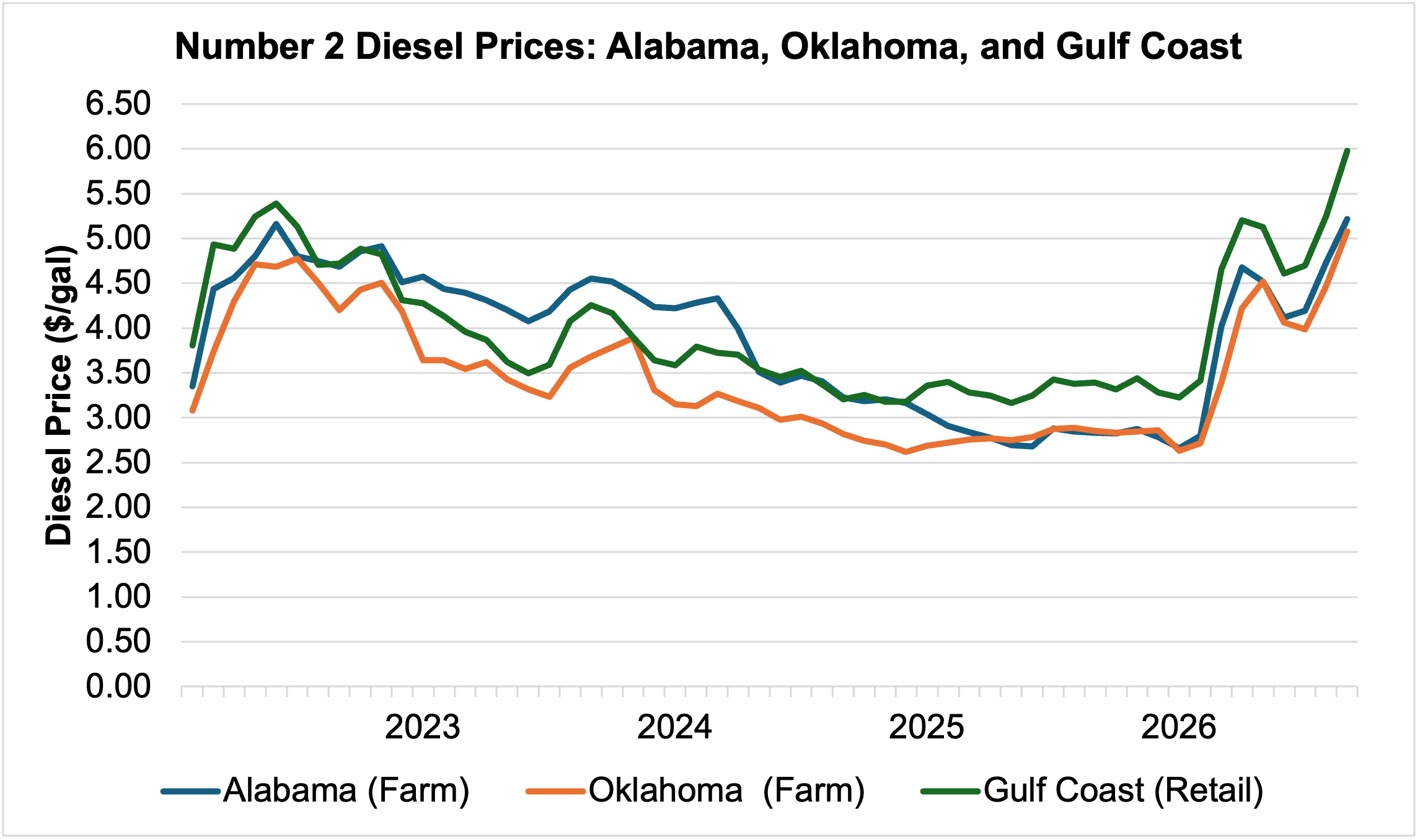
Table 1. Estimated Increase in Cost of Diesel for Harvesting Southern Row Crops
| Crop | Expected Harvest (1,000 acres) | Estimated Diesel Use for Harvest (gal/acre) | Harvest Cost Increase from Diesel | Cost Increase Per Acre |
| Corn (grain) | 9,424 | 2.53 | $52,438,089 | $5.56 |
| Cotton | 7,540 | 4.38 | $72,550,508 | $9.62 |
| Peanuts | 1,334 | 8.56 | $25,124,055 | $18.83 |
| Soybeans | 13,785 | 2.11 | $63,818,990 | $4.63 |
| Unexpected Harvest Cost Increase | $213,931,642 | $6.67 | ||
References:
U.S. Department of Agriculture, Agricultural Marketing Service. Alabama Production Cost Report (Weekly). Available at: https://mymarketnews.ams.usda.gov/viewReport/3051
U.S. Department of Agriculture, Agricultural Marketing Service. Oklahoma Production Cost Report (Bi-Weekly). Available at: https://mymarketnews.ams.usda.gov/viewReport/3621
U.S. Energy Information Administration, Weekly Gulf Coast No 2 Diesel Retail Prices. Available at:
https://www.eia.gov/dnav/pet/hist/LeafHandler.ashx?n=PET&s=EMD_EPD2D_PTE_R30_DPG&f=W
U.S. Department of Agriculture, Crop Production, Available at:
https://esmis.nal.usda.gov/publication/crop-production
Rabinowitz, Adam, and Sthefani Oliveira. “Harvest Cost Increases Tightening Margins for Southern Row Crop Farmers.” Southern Ag Today 6(42.1). October 12, 2026. Permalink