Authors: Bart Fischer and Joe Outlaw
We all know that production agriculture is notoriously risky, with crop insurance having become the cornerstone of the farm safety net. While crop insurance will pay an indemnity once the actual yield or revenue on a farm falls below the guarantee, indemnities reach their maximum in cases when the crop is so poor that it’s not worth harvesting—a situation known as abandonment.
While abandonment is a problem for all crops and all regions, it is particularly acute for cotton producers. Compounding the problem, if a cotton crop isn’t worth harvesting, there are virtually no other options for extracting value from the crop. You can chop a poor corn crop for silage, or you can bale hailed out wheat for hay. None of these are viable options for cotton (and while some have tried grazing and baling, they are of limited value). Most failed cotton ends up simply being destroyed. And, while abandonment is a challenge for producers, it has huge implications for downstream industry as well, from harvest aid manufacturers to chemical applicators to custom harvesters to cotton gins, warehousers, and merchants.
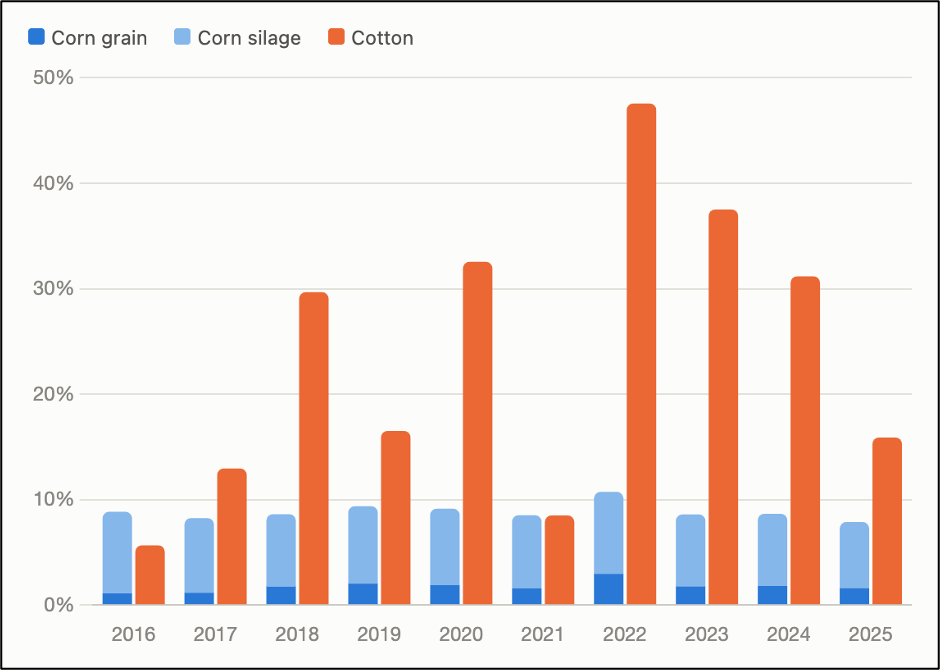
As noted in Figure 1, from 2016 to 2025, an annual average of 2.8 million unharvested acres of cotton accounted for 24% of planted acres. By contrast, for corn, approximately 8 million unharvested acres (i.e., not harvested for grain) accounted for 9% of planted acres. However, an annual average of 6.4 million acres of silage closed 80% of that gap. In other words, after accounting for silage, the net abandonment averaged just 1.8%.
Figure 1. Unharvested Share of Planted Acres for Corn and Cotton
Source: NASS QuickStats
Historically, most of the concerns with abandonment have come at harvest. Crop insurance becomes a factor because a farmer will naturally compare the value of the crop against the cost of harvesting, and a sufficiently low crop insurance appraisal will tip the scales toward abandonment. Again, as noted above, there is no other alternative for salvaging value with cotton. In response, in the mid-1990s, USDA’s Risk Management Agency (RMA) established the Cotton Harvest Incentive (CHI) pilot program for the 1995 and 1996 crop years in select counties in Texas. In general, the pilot allowed producers to exclude the crop they harvest from the production to count for purposes of calculating crop insurance indemnities.[1] RMA revised and extended the pilot program for the 1997, 1998, and 1999 crop years in the same counties. In our view, the approach to addressing late-season abandonment was sound, but the mechanics of the pilot were unnecessarily complicated and overly restrictive, completely undermining the incentive the pilot attempted to provide. Rather than trying to improve the pilot, RMA simply abandoned it starting with the 2000 crop year.
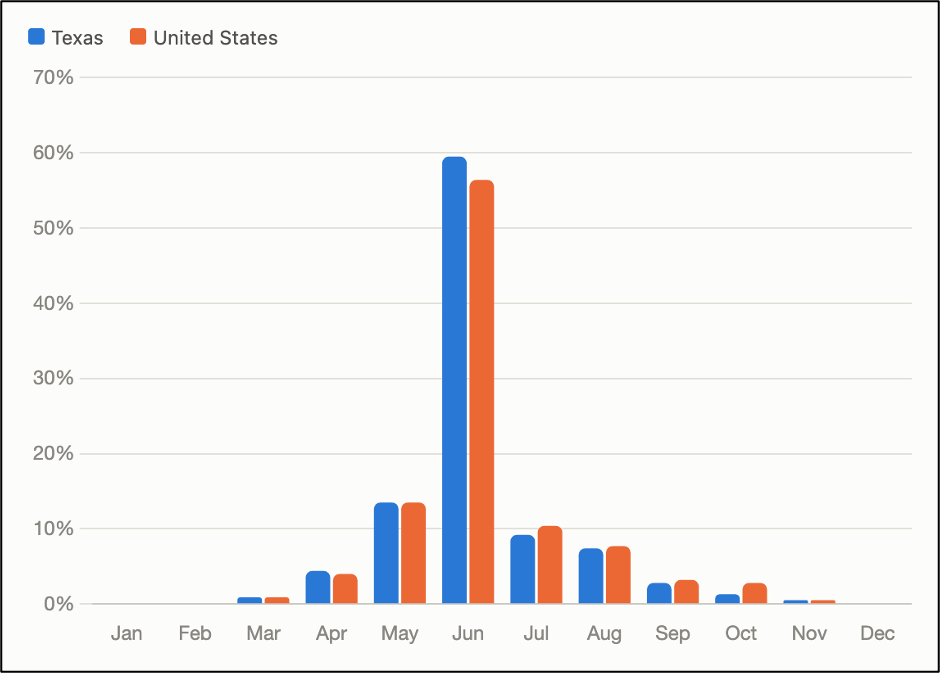
While abandonment at harvest has continued to be a problem over the last 26 years since the pilot was terminated, early-season abandonment has also become a major issue. When we first started working on this issue back in 2024, we discovered that, on average across the United States from 2014 to 2023, 72% of the indemnities paid on Revenue Protection policies for cotton were for unharvested acres. As noted in Figure 2, a significant share of the indemnities were coming from loss situations that were at least materializing very early in the growing season (while acknowledging that this data related to the timing of the cause of loss and not necessarily the timing of indemnities). Regardless, it demonstrates the early-season pressure facing producers, in many cases due to lack of rainfall at/near planting.
Figure 2. Revenue Protection Indemnities for Unharvested Cotton by Cause-of-Loss Month, 2014-2023
While crop insurance is tailor made for situations where a producer does their absolute best to raise a crop and it simply never emerges from the ground, not all situations are that clear cut. For example, if a producer is facing the prospect of raising a crop in a tough production environment, they necessarily are also facing the prospect of having to harvest a mediocre crop (at best) that may barely cover the cost of harvest. Facing that prospect, if given a sufficiently low appraisal, they may choose to walk away from the crop at (or near) planting. Further, if a grower is in a failing Enterprise Unit that has one or two farms that might make it to harvest, they may still choose to take an early appraisal and abandon the crop on those farms rather than trying to take those farms to harvest and also having to wait until the end of the growing season to receive an indemnity.
We’ve spent the last three years analyzing if a harvest incentive could help tip the scales toward maintaining a crop and taking it to harvest. In response, the National Cotton Council worked with USDA’s Risk Management Agency (RMA) to develop a new Harvest Cost Endorsement (HCE) that would supplement a producer’s underlying crop insurance policy. While we will save the mechanics for another day, the bottom line is this: a grower that adds the HCE endorsement could go into the planting season knowing that if they end up with a disappointing crop that triggers a crop insurance indemnity, it would also begin triggering a supplemental indemnity to help offset the cost of harvest. Naturally, if there is no cotton to harvest at all, the incentive would phase completely out (after all, we don’t want to incentivize producers taking harvest equipment through the field just for the sake of collecting an indemnity).
While some may argue this isn’t a crop insurance issue, we would strongly disagree. In fact, we can easily envision a scenario where the HCE could end up saving taxpayers a considerable amount of money. The premise is this: if cotton that is being abandoned is instead taken to harvest, would that sufficiently lower the indemnities being paid to offset (or more than offset) the cost of the incentive? While no one can truly know which way the scales will tip (because none of us know whether cotton that had been abandoned would have ended up making a crop), we suspect that the introduction of an incentive could significantly reduce the amount of crop insurance indemnities being paid for cotton (with the incentive instead encouraging producers to take the crop to harvest and sell it into the market).
Where do we go from here? Both the cotton industry and the U.S. Department of Agriculture have worked in good faith over the last two years to develop an HCE product that could be approved by the Federal Crop Insurance Corporation (FCIC) as soon as next week. In our view, this issue has been begging for a solution for far too long. We would be remiss if we didn’t note that the current proposal is being offered as a pilot. By definition, a pilot is intended to be a vehicle for testing new concepts before committing to widespread adoption. While some might be tempted to simply resurrect the old CHI pilot, it would not meet the added challenge of addressing early-season abandonment. Further, while the temptation also exists to keep studying and tweaking, there is no substitute for the real-life laboratory of introducing a pilot and observing how it functions in the real world. Again, that is the entire point of a pilot. One thing we already know with certainty: if action is not taken soon, producers will be left waiting until 2028 at the earliest to pilot a new endorsement, and in the meantime we will keep paying crop insurance indemnities that we suspect could be avoided.
[1] For more information, see: https://www.rma.usda.gov/-/media/RMA/Publications/Specialty-Crops/specialty-crop-report-1999.ashx?la=en and https://www.rma.usda.gov/-/media/RMA/Publications/Specialty-Crops/specialty-crop-report-2004.ashx?la=en.
Recommended citation format: Fischer, Bart L. and Joe Outlaw. “Closing the Gap on Cotton Abandonment: The Case for a Harvest Incentive.” Southern Ag Today 6(46.4). November 12, 2026. Permalink